
Tag: CNBC

  • The “Mainstream Moment”: Prediction Markets Evolve Into Wall Street’s New Favorite Asset Class

    The “Mainstream Moment”: Prediction Markets Evolve Into Wall Street’s New Favorite Asset Class

    As of early February 2026, the financial world has officially crossed the Rubicon. Prediction markets, once relegated to the fringes of internet forums and academic theory, have fully integrated into the DNA of the global financial system. The tipping point arrived not with a single event, but through a series of massive institutional migrations that have turned "Event Contracts" into a standard fixture on the screens of retail investors and professional traders alike.

    Currently, the market for Federal Reserve policy shifts serves as the most potent example of this transformation. On Kalshi, the probability of a 25-basis-point rate cut at the March 2026 meeting is currently trading at 64%, with over $450 million in open interest across the curve. This isn't just a niche bet anymore; it is the "real-time truth engine" being cited by major networks and used by hedge funds to hedge macro risk. The surge in interest is driven by a unprecedented level of accessibility, with prediction market data now flowing through the same pipelines as the S&P 500.

    The Market: What's Being Predicted

    While the 2024 election was the catalyst, the "Market" in early 2026 is no longer just about politics. The focus has shifted toward high-frequency economic indicators and corporate events. On Kalshi, the "Fed Funds Rate" contracts remain the liquidity kings, but new categories are exploding. Traders are now actively betting on quarterly earnings beats for companies like Apple Inc. (NASDAQ:AAPL) and NVIDIA Corporation (NASDAQ:NVDA), as well as the monthly Consumer Price Index (CPI) prints.

    These markets are primarily trading on two dominant domestic platforms: Kalshi and the recently expanded event contract suite from Robinhood Markets, Inc. (NASDAQ:HOOD). Since Robinhood’s January 2026 launch of "Custom Combos," liquidity has reached record highs. Trading volume across the industry topped an estimated $45 billion in 2025, and February 2026 is already on track to break monthly records. The resolution criteria for these contracts are now strictly standardized, typically relying on official government data or audited corporate filings, providing a level of "settlement certainty" that was missing in the early days of the industry.

    Why Traders Are Betting

    The migration of traders into prediction markets is being fueled by three major technological and strategic shifts. First is the integration of Coinbase Global, Inc. (NASDAQ:COIN) into the Kalshi ecosystem. By leveraging Coinbase Custody and USDC for settlement, institutional players can now move millions of dollars into event contracts with the same speed and security they expect from the crypto or equity markets. This has eliminated the "on-ramp friction" that previously kept large capital on the sidelines.

    Second, the introduction of Robinhood's "Custom Combos" has revolutionized how retail speculators interact with the news. Similar to a parlay in sports betting but structured as a CFTC-regulated financial instrument, Custom Combos allow users to bundle up to 10 different outcomes—such as a Fed rate cut, a specific CPI print, and a tech earnings beat—into a single high-payout contract. This "gamification of macroeconomics" has brought a younger, more aggressive demographic of traders into the space.

    Finally, the narrative has shifted because the data has become unavoidable. When CNBC (subsidiary of Comcast Corporation (NASDAQ:CMCSA)) and CNN (subsidiary of Warner Bros. Discovery, Inc. (NASDAQ:WBD)) began featuring live Kalshi tickers on-air in late 2025, it created a feedback loop. Traders are betting because they see the "market odds" mentioned in every major news cycle, treating the probability percentages as more reliable than traditional expert punditry or lagging opinion polls.

    Broader Context and Implications

    The mainstreaming of these platforms represents the birth of what Ethereum founder Vitalik Buterin famously termed "Information Finance" (InfoFi). By 2026, prediction markets are no longer just places to gamble; they are seen as the most accurate sensors of public and private information available. The Intercontinental Exchange, Inc. (NYSE:ICE), the parent company of the New York Stock Exchange, essentially validated this in late 2025 by investing $2 billion in the space and integrating prediction data into its professional terminals (ICE Connect).

    This integration has profound implications for public sentiment. Unlike polls, which can be influenced by social desirability bias, prediction markets require "skin in the game." The resulting data is cleaner, faster, and less partisan. This has forced regulatory bodies, particularly the CFTC, to move from a posture of skepticism to one of structured oversight. The 2026 landscape is defined by a rigorous regulatory framework that treats event contracts as a legitimate asset class, alongside futures and options.

    What to Watch Next

    As we move toward the middle of 2026, the next major milestone is the full vertical integration of these platforms. Robinhood’s acquisition of a 90% stake in MIAXdx in January 2026 suggests that the firm will soon launch its own dedicated clearinghouse for event contracts, potentially cutting out middlemen and lowering fees even further. This could trigger a "fee war" that benefits retail traders.

    The upcoming 2026 Midterm Elections will be the next "Stress Test" for these integrated systems. We should expect to see the first multi-platform "Election Night" where CNN and CNBC use real-time market data to call states or predict shifts in Congressional control before traditional models have enough data to do so. Watch for the emergence of "Cross-Platform Arbitrage," where traders exploit price differences between the crypto-native Polymarket and the regulated domestic exchanges like Kalshi.

    Bottom Line

    The mainstreaming of prediction markets via major financial platform integrations is the definitive financial story of 2026. By embedding event contracts into the tools that 100 million Americans already use—like Robinhood and Coinbase—the industry has moved past the "early adopter" phase. These markets are now a vital piece of the global information infrastructure, providing a hedge against uncertainty in an increasingly volatile world.

    Ultimately, the rise of prediction markets tells us that in the digital age, market-based consensus is more valuable than ever. Whether you are a retail trader using Robinhood to bet on a "Custom Combo" of tech news or an institutional investor using Kalshi to hedge interest rate risk on a CNBC-branded dashboard, the message is clear: the future is not just something we wait for—it is something we price.


    This article is for informational purposes only and does not constitute financial or betting advice. Prediction market participation may be subject to legal restrictions in your jurisdiction.

    PredictStreet focuses on covering the latest developments in prediction markets.
    Visit the PredictStreet website at https://www.predictstreet.ai/.

  • The Decacorn Ascendant: Kalshi Hits $11B Valuation as Prediction Markets Go Prime Time

    The Decacorn Ascendant: Kalshi Hits $11B Valuation as Prediction Markets Go Prime Time

    The landscape of American finance and media underwent a seismic shift this week as Kalshi, the first regulated event contract exchange in the U.S., officially reached "Decacorn" status with a staggering $11 billion valuation. The milestone follows a massive $1.1 billion Series E funding round, signaling that what was once a niche corner of the derivatives market has now become a pillar of the mainstream economy.

    As of January 17, 2026, the enthusiasm surrounding Kalshi isn't just coming from Silicon Valley venture capitalists. Market participants are pouring record liquidity into the platform, with daily trading volumes recently peaking at an all-time high of $466 million. This surge is fueled by the brand-new, multi-year media partnerships with CNN, owned by Warner Bros. Discovery, Inc. (NASDAQ:WBD), and CNBC, owned by Comcast Corporation (NASDAQ:CMCSA), which have begun broadcasting Kalshi’s real-time prediction data to millions of viewers worldwide.

    The Market: What's Being Predicted

    While Kalshi is an exchange rather than a single market, the "market" for the company’s own success has been one of the most watched narratives in the fintech sector. Throughout 2025, traders on social forecasting platforms like Manifold Markets correctly anticipated Kalshi’s ascent, with odds of the company surpassing a $10 billion valuation by 2026 climbing steadily from 30% in early 2025 to over 85% by the time the Series E closed in December.

    Currently, the primary activity on the Kalshi platform itself has shifted toward "The Market of Everything." Since its landmark 2024 legal victory against the CFTC, which cleared the way for political event contracts, Kalshi has seen its volume explode. The platform now captures approximately 66.4% of the global prediction market share, recently overtaking its primary rival, Polymarket. Much of this liquidity is concentrated in the upcoming 2026 U.S. Midterm Election markets, where over $8 billion in open interest has already accumulated—a level of engagement typically reserved for major commodity or equity indexes.

    Why Traders Are Betting

    The primary driver behind Kalshi’s $11 billion valuation is the successful "financialization of information." Unlike traditional sportsbooks or speculative crypto platforms, Kalshi has built a regulated "moat" that allows institutional investors to hedge against real-world outcomes. A critical catalyst for this growth was the 2025 integration with Robinhood Markets, Inc. (NASDAQ:HOOD), which brought Kalshi’s event contracts to the fingertips of millions of retail investors who already trade stocks and options.

    The new partnerships with CNN and CNBC have added a layer of "social proof" and utility that traditional polling simply cannot match. On CNBC’s Squawk Box, a dedicated Kalshi ticker now runs alongside the S&P 500 and the 10-year Treasury yield, providing a real-time "probability of recession" or "likelihood of a Fed rate cut." Traders are betting that this mainstream integration will create a feedback loop: as more people see the data on TV, more participants join the markets, leading to deeper liquidity and even more accurate forecasts.

    Furthermore, Kalshi’s strategic pivot into sports—offering peer-to-peer "Combos" that act as a regulated alternative to parlays—has accounted for nearly 90% of the platform's volume growth in the last quarter. This has attracted a different class of trader, moving the platform beyond political junkies and into the broader gaming and hedging audience.

    Broader Context and Implications

    The rise of the "Decacorn" prediction market signifies the end of the "Opinion Era" in broadcast journalism. For decades, news networks relied on pundits and traditional polling, which often lagged behind reality. By partnering with Kalshi, CNN is leaning into the expertise of its Chief Data Analyst, Harry Enten, who now uses live market probabilities to supplement—and often challenge—traditional polling data.

    This shift has profound regulatory implications. Kalshi’s success has validated the "regulated-first" approach, proving that working within the U.S. framework provides a level of stability that offshore, decentralized platforms struggle to maintain. This has not gone unnoticed by big tech; Alphabet Inc. (NASDAQ:GOOGL), through its growth fund CapitalG, was a major participant in the recent funding round, signaling that the giants of the "Attention Economy" view prediction markets as the next evolution of search and discovery.

    Historically, prediction markets have often been more accurate than experts or polls, particularly in high-stakes elections and economic pivots. As we move further into 2026, the "Kalshi Probability" is becoming the gold standard for truth in an era of fragmented information.

    What to Watch Next

    The immediate focus for Kalshi and its media partners will be the 2026 Midterm Elections. As campaigns gear up, the volatility in the "Control of the House" and "Control of the Senate" markets will be a nightly feature on CNN. Investors should watch for whether these markets can maintain their predictive accuracy as volume scales into the tens of billions.

    Another key milestone to monitor is a potential Kalshi IPO. While the company is currently flush with cash from its Series E, the $11 billion valuation puts it in the prime window for a public debut. On the Kalshi platform itself, markets are already trading on the IPO dates of other fintech giants like Kraken and Databricks, and many expect a "Kalshi IPO" market to appear on secondary platforms by the end of the year.

    Finally, keep an eye on the technical depth of the CNBC "Prediction Hub." If the integration proves successful in driving viewership and user engagement, it is likely that other major news conglomerates, such as News Corp or Disney, will seek their own prediction market partners to keep pace.

    Bottom Line

    Kalshi reaching an $11 billion valuation is more than just a win for its founders and investors; it is a coming-of-age moment for the entire prediction market industry. By embedding itself into the fabric of mainstream news through CNN and CNBC, Kalshi has transformed from a trading platform into a primary source of truth for the digital age.

    The move from "what people say" (polls) to "what people do with their money" (markets) is a fundamental shift in how society processes information. As we head deeper into 2026, the question is no longer whether prediction markets are a viable tool, but rather how we ever managed to navigate the world without them. For now, the "Kalshi Ticker" is the new pulse of the global economy.


    This article is for informational purposes only and does not constitute financial or betting advice. Prediction market participation may be subject to legal restrictions in your jurisdiction.

    PredictStreet focuses on covering the latest developments in prediction markets.
    Visit the PredictStreet website at https://www.predictstreet.ai/.
  • The Death of the Pundit: Kalshi’s Media Deals Turn Prediction Markets into Newsroom ‘Truth Engines’

    The Death of the Pundit: Kalshi’s Media Deals Turn Prediction Markets into Newsroom ‘Truth Engines’

    As of mid-January 2026, the landscape of broadcast journalism has fundamentally shifted. For decades, viewers tuned into news networks for opinions, expert "hot takes," and statistical polling that often lagged behind reality. That era ended this month. With the full-scale launch of landmark media partnerships between the regulated exchange Kalshi and news giants CNN (NASDAQ: WBD) and CNBC (NASDAQ: CMCSA), prediction market data has moved from the financial fringe to the center of the television screen.

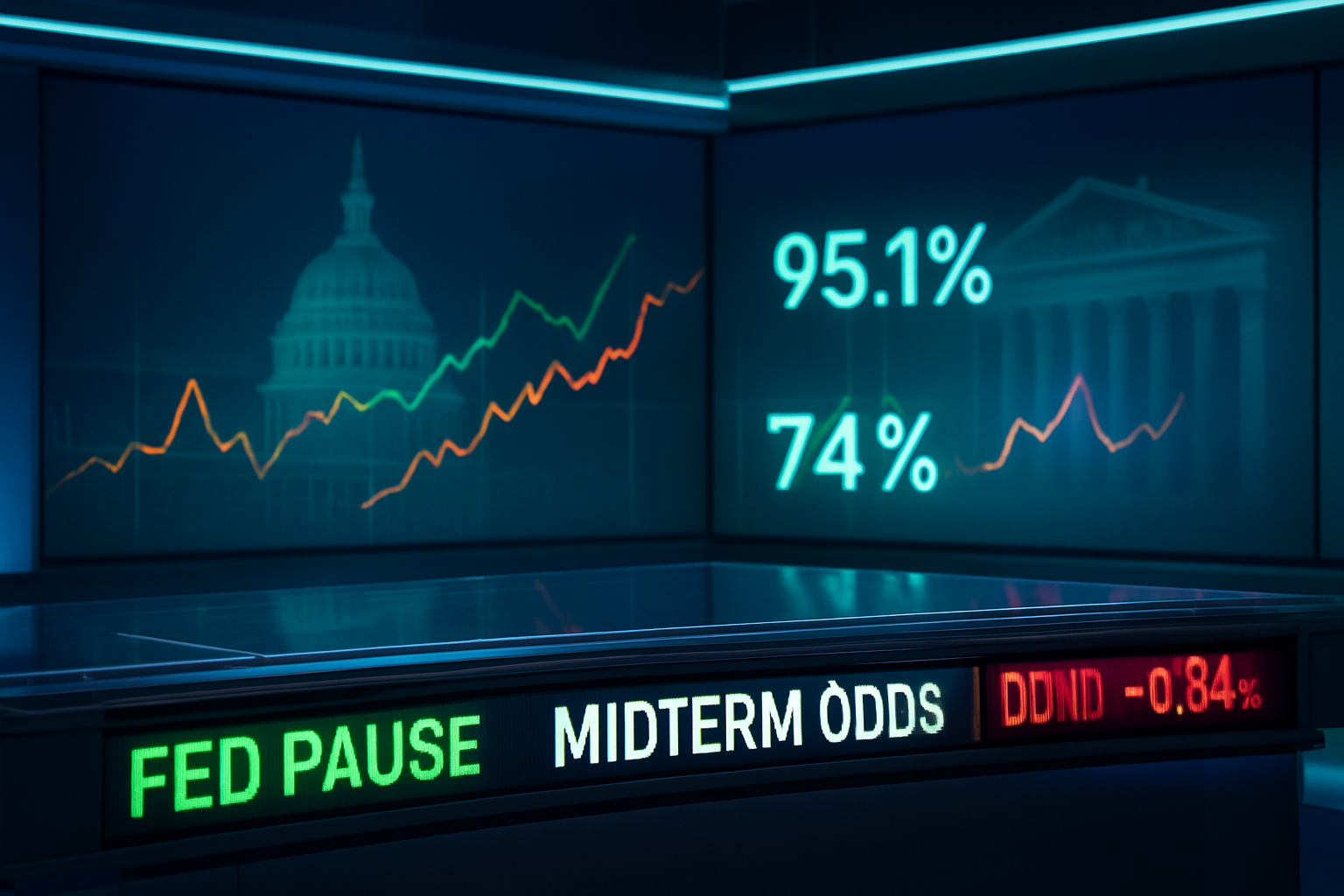
    Today, if you tune into "Squawk Box" or "The Lead," you won't just hear a pundit's guess on the next Federal Reserve move or a legislative vote. Instead, you'll see a live, ticker-tape stream of real-money probabilities. As of January 16, 2026, these markets show a staggering 95.1% probability that the Fed will pause interest rate hikes at its upcoming meeting on January 28. This isn't just a survey; it’s the collective "hive mind" of thousands of traders who have hundreds of millions of dollars on the line.

    The Market: What’s Being Predicted

    The integration of Kalshi data into mainstream media is powered by an explosion in trading volume. In the first full week of January 2026, Kalshi recorded over $2 billion in weekly notional volume, capturing approximately 66% of the U.S. regulated event-trading market. While Polymarket—recently bolstered by a $2 billion investment from the Intercontinental Exchange (NYSE: ICE)—continues to lead in global decentralized markets, Kalshi has become the "official scoreboard" for American domestic affairs.

    The specific "Information Finance" contracts being broadcast to millions of households cover a vast array of topics:

    • Monetary Policy: Real-time odds on Fed rate cuts, inflation benchmarks, and employment numbers.
    • Political Shifts: Probability of the Democrats reclaiming the House (currently 74%) vs. Republicans retaining the Senate (66%) in the 2026 Midterm elections.
    • Corporate Events: Likelihood of specific mergers passing regulatory hurdles and CEO transitions.
    • Cultural Milestones: From the winner of Super Bowl LX (the Los Angeles Rams currently lead at 14%) to the probability of 2026 becoming the hottest year on record (38%).

    These contracts are settled based on verifiable real-world outcomes, and their prices, ranging from $0.01 to $0.99, serve as a direct proxy for the percentage chance of an event occurring.

    Why Traders Are Betting

    The surge in market participation is driven by a radical "skin in the game" philosophy. Unlike traditional pollsters, who face little consequence for being wrong, prediction market participants are financially incentivized to be right. This has attracted a new class of "truth-seekers," including high-frequency trading (HFT) firms like Jane Street and Susquehanna (SIG), which now act as designated market makers, providing deep liquidity and razor-thin spreads.

    Traders are increasingly moving away from traditional forecasting methods. The 2024 and 2025 election cycles proved that polling often fails to capture "shy" voters or rapid sentiment shifts. In contrast, prediction markets reacted in real-time to breaking news, such as the 2025 court rulings that legalized election betting in the U.S. This legal clarity, following Kalshi’s victory over the CFTC, has allowed retail platforms like Robinhood (NASDAQ: HOOD) and Interactive Brokers (NASDAQ: IBKR) to offer event contracts to their millions of users, further deepening the pool of intelligence.

    Broader Context and Implications

    The deals with CNN and CNBC signal the birth of a new era: the "Information Finance" age. CNN’s Chief Data Analyst, Harry Enten, has largely replaced his traditional "Poll of Polls" segments with "Market-Driven Signals," arguing that a market of incentivized traders is a more reliable filter for truth than a panel of consultants. CNBC has even launched a "Prediction Hub," allowing viewers to see live probabilities directly on the CNBC Pro app.

    This shift has profound implications for public discourse. By providing a cold, hard number for the probability of an event, prediction markets help to de-polarize news. It is difficult to argue with a market where people are betting their own money against your bias. Historically, these markets have proven more accurate than experts in predicting everything from Supreme Court decisions to the timing of recessionary dips.

    However, the rapid growth has not been without controversy. Legislative battles are currently raging in states like New York, where the "ORACLE Act" (Assembly Bill A9251) seeks to limit political event contracts. Kalshi’s market currently prices the probability of that ban passing at a modest 22%, suggesting that the "truth engine" believes it will ultimately prevail in the courts.

    What to Watch Next

    As we move deeper into 2026, several key milestones will test the robustness of this new media-market alliance:

    1. The FOMC Meeting (Jan 27–28): This will be the first major test of the CNBC-Kalshi ticker during a period of high economic volatility.
    2. The 2026 Primary Season: Watch for how CNN utilizes Kalshi data to forecast primary upsets, potentially influencing donor behavior and campaign strategies in real-time.
    3. The "Super Bowl Signal": On February 8, the massive liquidity flowing into Super Bowl LX contracts will demonstrate Kalshi's ability to handle high-frequency, mass-market sports data alongside its "serious" economic contracts.

    Bottom Line

    The 2026 media deals between Kalshi, CNN, and CNBC mark the moment prediction markets ceased being a "sideshow" and became the "truth engine" for the public. By moving probability data from the trading floor to the living room, these platforms are providing a more objective, faster, and more accurate way for the world to understand the future.

    In an age of deepfakes and extreme partisanship, "Information Finance" offers a rare commodity: a scoreboard for reality. Whether the event is a rate hike or a presidential primary, the question is no longer "What do the experts think?" but rather "What does the market say?"


    This article is for informational purposes only and does not constitute financial or betting advice. Prediction market participation may be subject to legal restrictions in your jurisdiction.

    PredictStreet focuses on covering the latest developments in prediction markets.
    Visit the PredictStreet website at https://www.predictstreet.ai/.
  • The New Newsroom: Why Real-Time Prediction Odds Are Replacing Traditional Punditry

    The New Newsroom: Why Real-Time Prediction Odds Are Replacing Traditional Punditry

    The landscape of American news has undergone a radical transformation over the past twelve months. As of January 15, 2026, the once-sharp divide between financial speculation and civic journalism has effectively collapsed. Today, when viewers tune into major news networks, they are no longer just seeing poll results or expert opinions; they are seeing live, fluctuating probabilities powered by real-money prediction markets.

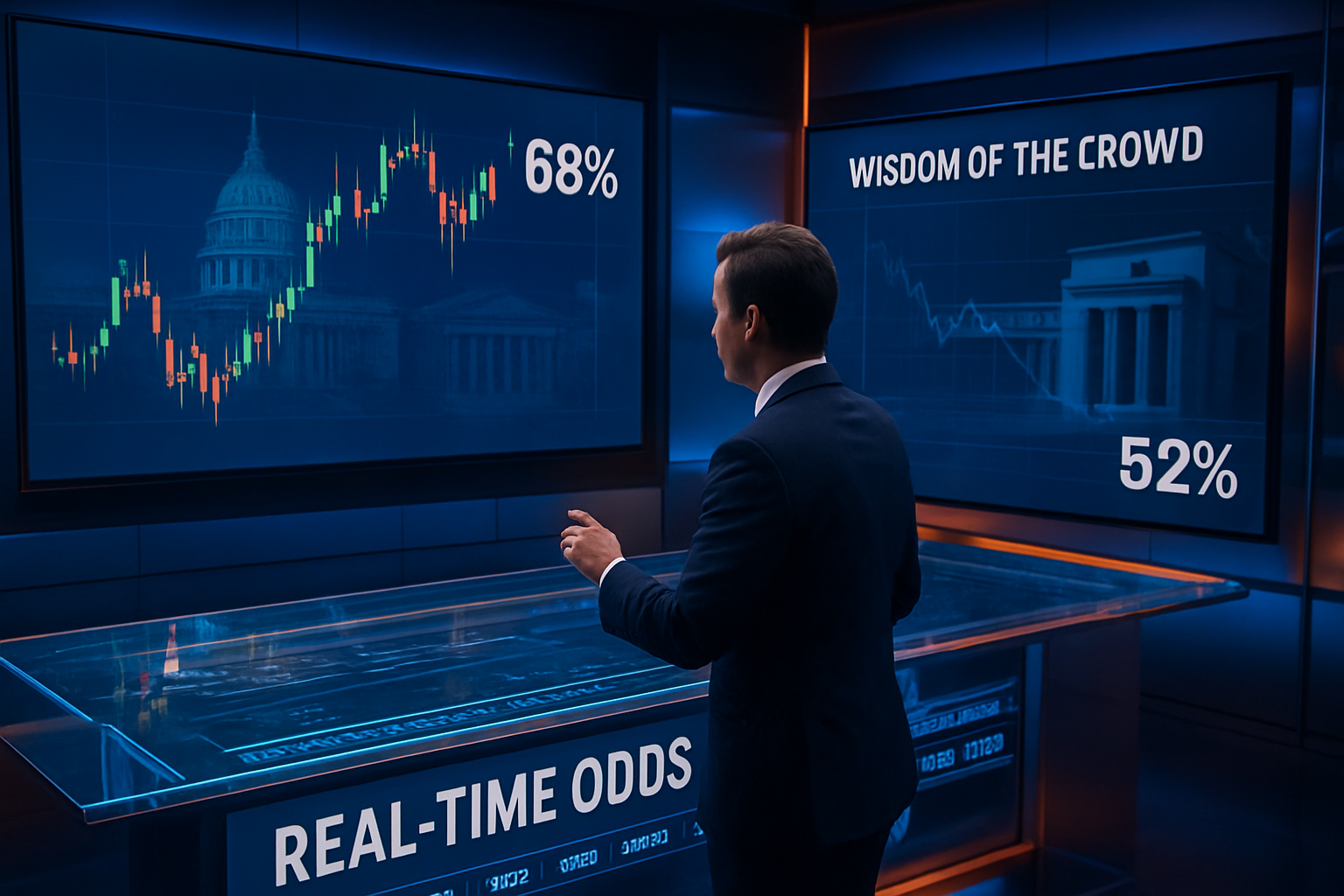
    At the center of this shift is the "Information Finance" revolution. Currently, major market-implied probabilities—such as the 68% chance of a federal interest rate cut in March or the 52% probability of a specific legislative package passing the Senate—are being treated with more gravity than traditional surveys. This shift is driven by the massive success of prediction markets during the 2024 election cycle and a series of landmark regulatory victories that have rebranded "gambling" as "the ultimate data-driven insight."

    The Market: What's Being Predicted

    The primary vehicle for this integration has been Kalshi, the first federally regulated prediction market in the U.S. Throughout 2025, Kalshi moved aggressively to colonize the mainstream media landscape. In December 2025, Kalshi announced a historic partnership with CNN, owned by Warner Bros. Discovery (NASDAQ: WBD), establishing the exchange as the network's "Official Prediction Market Partner." This deal introduced a live on-screen ticker during prime-time broadcasts, providing viewers with "market-driven signals" on everything from geopolitical conflicts to domestic policy shifts.

    Simultaneously, CNBC, a subsidiary of Comcast Corporation (NASDAQ: CMCSA), fully integrated Kalshi’s data API into its financial news suite. This wasn't merely a citation of odds; it was a structural integration. CNBC launched a dedicated "Prediction Hub" where viewers could watch a segment on Squawk Box and immediately click through to trade on the outcome being discussed. By the end of 2025, Kalshi reported that its weekly trading volume had eclipsed $1 billion, fueled largely by these mainstream media funnels and the high liquidity of its event contracts.

    The resolution criteria for these markets are strictly defined by verifiable real-world outcomes. Whether it is a Bureau of Labor Statistics report or a confirmed vote in the House of Representatives, the binary nature of these contracts—paying out $1 if the event occurs and $0 if it does not—creates a transparent probability that is updated in micro-seconds as new information hits the wire.

    Why Traders Are Betting

    The migration of traders to these platforms is fueled by a growing distrust in traditional forecasting methods. The 2024 U.S. Presidential Election served as a watershed moment; while many traditional polls suggested a "dead heat" until the final days, prediction markets on Kalshi and other platforms like Polymarket consistently maintained a 55% to 60% probability for the eventual winner weeks in advance.

    Traders are not just "betting"; they are participating in a decentralized intelligence gathering process. The core philosophy driving this activity is the "Incentive to be Right." Unlike a political pundit who faces little personal cost for a wrong prediction, a trader on Kalshi loses capital. This financial accountability creates a more rigorous filter for information.

    Recent activity in January 2026 shows a heavy concentration of volume in "Policy Pivot" markets. As the new administration settles in, traders are aggressively positioning themselves in contracts related to trade tariffs and regulatory rollbacks. The sheer volume of these trades provides a "wisdom of the crowd" effect that news networks are now leveraging to provide context that traditional reporting often misses.

    Broader Context and Implications

    The transition of prediction markets from the fringes of the internet to the center of CNN’s "Election Center" is the result of a hard-fought legal battle. In late 2024, a federal court ruling by Judge Jia Cobb stripped away the Commodity Futures Trading Commission's (CFTC) ability to block election markets, a decision the agency officially stopped appealing in May 2025. This legal clarity opened the floodgates for institutional participation.

    This shift reveals a significant change in public sentiment. The term "gambling" is rapidly being replaced in the public lexicon by "Information Finance." This terminology highlights the belief that prediction markets are a way of pricing the future, much like the stock market prices the value of a company.

    Historically, prediction markets have proven more accurate than experts in various fields, from Oscar winners to scientific breakthroughs. By 2026, this historical accuracy has finally been institutionalized. The implications are profound: when the "market" says an event has a 90% chance of happening, it changes how corporations plan their budgets, how politicians frame their speeches, and how the public perceives the inevitability of change.

    What to Watch Next

    The coming weeks represent another potential leap forward for the industry. Rumors are circulating that Alphabet Inc. (NASDAQ: GOOGL) is prepared to update its global advertising policies as early as next week, potentially allowing federally regulated prediction markets to advertise across its entire network. Such a move would allow Kalshi and its peers to reach billions of users directly, further democratizing access to event trading.

    Key dates to monitor include the upcoming Federal Reserve meeting in late January and the rollout of several high-stakes "Supreme Court Ruling" contracts on Kalshi. These markets are expected to see record liquidity as the CNN and CNBC integrations continue to mature, bringing in a new wave of retail participants who see these markets as a more reliable news source than the articles they are reading.

    The industry is also bracing for potential new legislation. With the 2024 "proof of concept" complete, some lawmakers are calling for a formal "Prediction Market Act" to provide a permanent regulatory framework, ensuring that these markets remain transparent and free from manipulation as they become a core part of the American information diet.

    Bottom Line

    The integration of prediction market data into mainstream news marks the end of the era of the "opinion-based" news cycle. By 2026, the data has won. The partnerships between Kalshi, CNN, and CNBC have validated a new form of journalism—one that prioritizes skin-in-the-game probabilities over speculative punditry.

    Prediction markets are no longer viewed as a "side show" for enthusiasts; they are the scoreboard for reality. As the $1 billion weekly volume suggests, the public is increasingly willing to vote with their wallets on what they believe the future holds. While risks regarding market manipulation and volatility remain, the sheer transparency of a price-discovery mechanism for truth is a tool that the 2026 newsroom simply cannot live without.


    This article is for informational purposes only and does not constitute financial or betting advice. Prediction market participation may be subject to legal restrictions in your jurisdiction.

    PredictStreet focuses on covering the latest developments in prediction markets.
    Visit the PredictStreet website at https://www.predictstreet.ai/.
  • Decacorn Status: Kalshi’s $11 Billion Valuation and Media Deals Usher in the ‘Prediction Media’ Era

    Decacorn Status: Kalshi’s $11 Billion Valuation and Media Deals Usher in the ‘Prediction Media’ Era

    The landscape of information and finance reached a historic turning point this week as Kalshi, the leading U.S. regulated prediction market, announced a staggering $1 billion Series E funding round, valuing the company at $11 billion. This "decacorn" milestone, finalized in late December 2025, signals a paradigm shift in how global markets and the general public consume information, transitioning from static polls to dynamic, real-time probability markets.

    The funding news coincides with a massive media blitz. Starting in January 2026, Kalshi has officially launched exclusive partnerships with CNN, owned by Warner Bros. Discovery (NASDAQ: WBD), and CNBC, a subsidiary of Comcast (NASDAQ: CMCSA). These deals integrate Kalshi’s live prediction data directly into televised broadcasts and digital platforms, effectively making market-based odds a central pillar of news reporting alongside traditional journalism and financial data.

    The Market: What's Being Predicted

    The scale of the prediction market ecosystem has exploded over the last 12 months. On January 12, 2026, daily trading volume across the industry hit a record-breaking $701.7 million, with Kalshi accounting for nearly two-thirds of that activity. While politics dominated 2024, the "Market of Everything" has now matured. Traders are currently heavily positioned in contracts ranging from the 2026 Midterm Election control to corporate merger outcomes, such as the rumored acquisition of Warner Bros. Discovery by Netflix, Inc. (NASDAQ: NFLX).

    Kalshi’s growth is anchored by its status as a CFTC-regulated exchange, which allows for high-liquidity contracts that were previously unavailable to the American retail public. Currently, the "Who Will Control the House in 2027?" market is one of the most active, with over $150 million in open interest. The odds have seen significant volatility this week following the funding announcement, as institutional "whales" increasingly use these markets to hedge against political and regulatory risks.

    Why Traders Are Betting

    The surge in valuation and volume is driven by a unique convergence of institutional adoption and retail enthusiasm. Following the CFTC’s decision to withdraw its legal appeals against Kalshi in May 2025, major brokerages including Robinhood Markets, Inc. (NASDAQ: HOOD) and Interactive Brokers Group, Inc. (NASDAQ: IBKR) integrated Kalshi’s event contracts into their platforms. This has democratized access to event-based hedging for millions of individual investors.

    Traders are moving away from traditional polling, which many see as lagging and prone to bias. "The market doesn't have an opinion; it has a price," noted one prominent institutional trader. The $1 billion funding round, led by Paradigm with participation from Alphabet Inc. (NASDAQ: GOOGL) via its growth fund CapitalG, provides Kalshi with the war chest needed to maintain deep liquidity. This liquidity attracts "smart money" that views prediction markets as the most accurate "truth machine" for forecasting binary events, from Fed rate hikes to the success of summer blockbusters.

    Broader Context and Implications

    The partnerships with CNN and CNBC represent a fundamental shift in the media landscape. For the first time, prediction market tickers are appearing on flagship shows like CNBC’s Squawk Box and CNN’s political coverage featuring Harry Enten. By presenting "market-implied odds" as a primary metric, these networks are validating the idea that skin-in-the-game data is more reliable than expert punditry.

    This integration serves a dual purpose: it provides a more engaging, data-driven viewer experience while simultaneously driving new users to the prediction platforms. However, the rapid ascent of these markets has not been without friction. While Kalshi won its federal battle with the CFTC, it is now navigating a patchwork of state-level challenges. Regulators in Tennessee and Nevada have recently raised questions about whether sports-related prediction contracts constitute "illegal gambling," leading to a flurry of legal filings as 2026 begins.

    What to Watch Next

    The coming months will be a crucial "stress test" for the newly minted decacorn. All eyes are on the 2026 Midterm Election markets, which are expected to dwarf the volume of the 2024 cycle. The infusion of $1 billion in capital will allow Kalshi to expand its infrastructure to handle the anticipated multi-billion dollar monthly volumes.

    Furthermore, investors are watching for the resolution of the "Third Circuit" case in New Jersey, where a group of state attorneys general is challenging the federal preemption of state gambling laws. A victory for Kalshi here would likely clear the final legal hurdles for a national rollout of its sports and event-based contracts. Additionally, keep an eye on Alphabet Inc. (NASDAQ: GOOGL) and Yahoo Finance, which are rumored to be deepening their own data integrations with Kalshi by mid-2026.

    Bottom Line

    Kalshi’s $11 billion valuation is more than just a corporate milestone; it is a signal that prediction markets have officially entered the mainstream of American finance and culture. By partnering with the biggest names in news, Kalshi is positioning itself as the infrastructure layer for the "Information Economy," where every headline has a price and every forecast can be traded.

    As we move further into 2026, the distinction between a "trader" and a "news consumer" will continue to blur. Whether this leads to a more informed public or a more volatile society remains to be seen, but one thing is clear: the era of the prediction market decacorn is here, and it is reshaping the way we understand the future.


    This article is for informational purposes only and does not constitute financial or betting advice. Prediction market participation may be subject to legal restrictions in your jurisdiction.

    PredictStreet focuses on covering the latest developments in prediction markets.
    Visit the PredictStreet website at https://www.predictstreet.ai/.