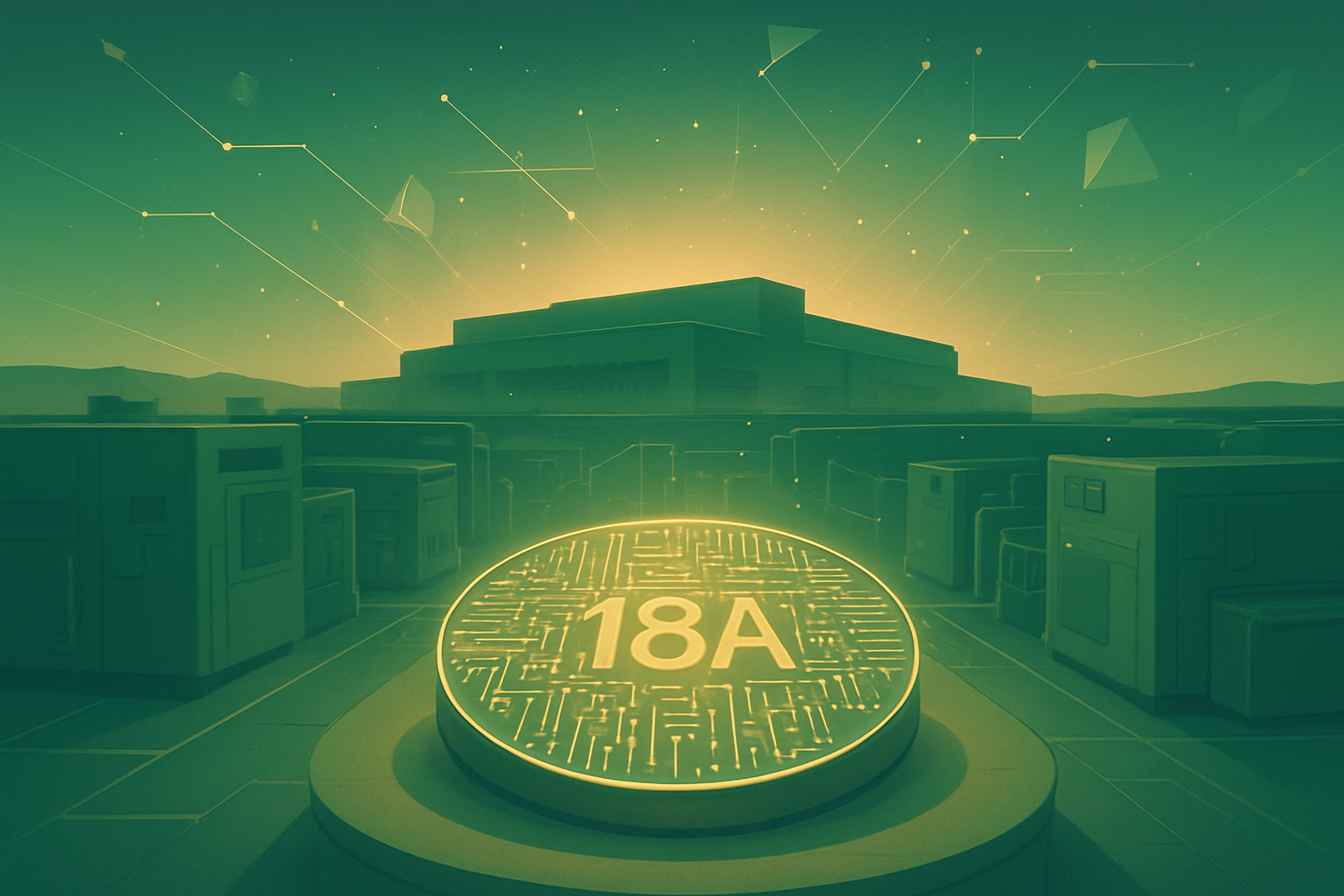
As of January 13, 2026, Intel Corporation (Nasdaq: INTC) stands at the most critical juncture in its 58-year history. After decades of undisputed dominance followed by a humbling period of market share loss and manufacturing delays, the company is mid-way through a "Silicon Renaissance." Today, Intel is no longer just a chip designer; it has effectively become a "National Champion" for the United States, a designation solidified by massive government backing and the successful high-volume launch of its 18A process node.
The "Intel of 2026" is a bifurcated entity: a leaner, more efficient product group focused on the burgeoning AI PC market, and a rapidly scaling foundry business that aims to challenge TSMC for global leadership. With a new leadership team at the helm and a stock price that has recovered significantly from its 2024 nadir, Intel has transitioned from a story of survival to one of strategic execution.
Historical Background
Founded in 1968 by Robert Noyce and Gordon Moore, Intel was the pioneer of the microprocessor, the "brain" of the modern computer. Through the 1980s and 90s, the "Intel Inside" campaign and the partnership with Microsoft (Nasdaq: MSFT)—the "Wintel" era—created a global monopoly in personal computing.
However, the 2010s were marked by complacency. Intel missed the mobile revolution, lost its manufacturing edge to Taiwan Semiconductor Manufacturing Co. (NYSE: TSM), and saw Advanced Micro Devices (Nasdaq: AMD) reclaim territory in the data center. The tenure of former CEO Pat Gelsinger (2021–2024) was defined by the "IDM 2.0" strategy—a multi-billion-dollar gamble to return to process leadership through "five nodes in four years." While Gelsinger retired in late 2024, his technical roadmap laid the foundation for the company’s current status. The appointment of Lip-Bu Tan as CEO in March 2025 marked the beginning of Intel’s "Foundry First" era, focusing on financial discipline and external customer acquisition.
Business Model
Intel’s business model has undergone a radical transformation into two primary reporting segments:
- Intel Products: This includes the Client Computing Group (CCG), which dominates the laptop and desktop markets, and the Data Center and AI (DCAI) group. The focus here has shifted toward "AI PCs" and specialized accelerators like the Gaudi series.
- Intel Foundry (IFS): Operating as an independent commercial foundry, this segment builds chips for both Intel and external customers. By 2026, this has become the engine of Intel’s valuation, leveraging the 18A node to attract world-class fabless companies.
Intel also maintains specialized units like Network and Edge (NEX) and its majority stake in Mobileye (Nasdaq: MBLY), though the latter has seen increased autonomy to focus on autonomous driving software.
Stock Performance Overview
The last decade has been a rollercoaster for Intel shareholders.
- 1-Year Performance: Intel has been one of the top performers in the semiconductor sector over the last 12 months, with the stock rising nearly 60% as the 18A node reached high-volume manufacturing (HVM).
- 5-Year Performance: The five-year chart reflects the "U-shaped" recovery. After plummeting from highs in 2021 to a decade-low of roughly $19 in 2024, the stock has rallied to its current range of $44–$45.
- 10-Year Performance: Long-term holders have seen a CAGR that trails the broader S&P 500 and the SOX (PHLX Semiconductor Index), largely due to the lost years between 2018 and 2023. However, the 2025–2026 rebound has finally brought the stock back toward its 2020 peaks.
Financial Performance
Fiscal Year 2025 was the "Year of Stability." After a loss-making 2024 characterized by massive restructuring costs, Intel’s financials for the year ending December 2025 showed:
- Revenue: Stabilized at approximately $54.5 billion, a modest but healthy 3% year-over-year increase.
- Margins: Gross margins, which dipped into the low 30s during the height of the 18A development cycle, recovered to 41% by Q4 2025 as fab utilization improved.
- Cash Flow: Intel turned cash-flow positive in the second half of 2025, supported by $7.86 billion in CHIPS Act grants and massive Investment Tax Credits (ITCs).
- Valuation: Trading at a forward P/E of approximately 22x 2026 earnings, Intel is no longer priced as a "distressed asset" but as a growth-oriented foundry play.
Leadership and Management
The transition from Pat Gelsinger to Lip-Bu Tan in early 2025 was a watershed moment. While Gelsinger was the technical visionary who saved Intel’s R&D, Tan—a legendary figure in the EDA (Electronic Design Automation) industry and former Cadence CEO—brought the operational rigor needed to run a foundry.
Tan’s strategy has been "Foundry First," meaning the manufacturing side of the house is no longer subservient to the internal product teams. The board, chaired by Frank Yeary, has also been refreshed with more manufacturing and logistics expertise, reflecting Intel's role as a global infrastructure provider rather than just a software/chip designer.
Products, Services, and Innovations
Intel's 2026 product portfolio is the strongest in a generation:
- Intel 18A (1.8nm): The crown jewel. It is the first process node to successfully implement PowerVia (backside power delivery) and RibbonFET (gate-all-around) at scale, giving Intel a temporary power-efficiency lead over TSMC’s N3 and N2 nodes.
- Panther Lake (Client): Launched at CES 2026, this is the first consumer CPU built entirely on the 18A process. It targets the "Premium AI PC" segment with an integrated NPU (Neural Processing Unit) capable of 180 TOPS.
- Clearwater Forest (Server): A high-density E-core Xeon processor designed for hyperscalers like Amazon (Nasdaq: AMZN) and Google (Nasdaq: GOOGL), aiming to stall the migration to ARM-based custom silicon.
- Gaudi 3 & Falcon Shores: Intel’s AI accelerators have found a niche in "sovereign AI" clouds and mid-tier enterprise deployments, providing a cost-effective alternative to Nvidia’s (Nasdaq: NVDA) Blackwell architecture.
Competitive Landscape
Intel faces a "three-front war":
- The Foundry Front (TSMC): TSMC remains the volume leader, but Intel has successfully positioned itself as the "Western Alternative." In late 2025, Nvidia made a historic $5 billion investment to secure Intel packaging capacity, a major signal that the industry no longer views TSMC as the only option.
- The CPU Front (AMD): AMD continues to be a formidable rival in the data center, but Intel’s Clearwater Forest has begun to reclaim market share in the power-sensitive hyperscale segment.
- The AI Front (Nvidia): Nvidia remains the undisputed king of AI training. Intel's strategy is not to beat Nvidia in training, but to dominate "AI at the Edge" via the AI PC.
Industry and Market Trends
The semiconductor industry in 2026 is defined by "Geographic Resiliency." Global supply chains have shifted from a "just-in-time" model to a "just-in-case" model, with the U.S. and EU aggressively subsidizing local production.
Furthermore, the "AI PC" has become the primary driver of the consumer refresh cycle. Every laptop sold in 2026 is expected to have an integrated AI processor, a trend that plays directly into Intel’s historical strength in the OEM (Original Equipment Manufacturer) channel with partners like Dell and HP.
Risks and Challenges
Despite the "Renaissance," Intel is not without significant risk:
- Execution Risk: The 18A ramp must maintain high yields. Any "stumble at the finish line" would destroy the fragile trust Intel has rebuilt with external foundry customers.
- Capital Intensity: Intel is spending $20B-$25B annually on CapEx. If a global recession hits in late 2026, the company’s balance sheet could come under renewed pressure.
- Legacy Debt: The cost of the 2021–2024 turnaround was high, leaving Intel with a debt load that requires disciplined servicing.
Opportunities and Catalysts
- External Foundry Wins: Rumors of a major "Top 3" mobile SoC customer (potentially Apple or Qualcomm) signing on for 18A-P (the 2027 optimized node) could be a massive catalyst for the stock.
- Windows 12/AI Refresh: A major Windows update centered on AI features could spark the largest PC upgrade cycle since the early 2000s.
- Spin-off Potential: Analysts continue to speculate that Intel may eventually spin off the Foundry business entirely, which could unlock significant shareholder value.
Investor Sentiment and Analyst Coverage
Sentiment has shifted from "Deep Value/Contrarian" to "Cautious Optimism."
- Wall Street: The consensus rating has moved from "Hold" to "Overweight" as of January 2026. Price targets range from $48 to $55.
- Institutional Moves: Major funds like Vanguard and BlackRock increased their positions in Q3 2025, cited by many as the "inflection point" for the foundry business.
- Retail Sentiment: Intel remains a favorite among "patriotic" retail investors who view the company as a vital piece of American national security.
Regulatory, Policy, and Geopolitical Factors
The most significant development in Intel’s regulatory environment occurred in late 2025, when the U.S. Department of Commerce converted a portion of Intel's CHIPS Act grants into a 9.9% direct equity stake. This "National Champion" status effectively guarantees that the U.S. government will not allow Intel to fail, given its role as the only U.S.-based company capable of leading-edge logic manufacturing. However, this also brings increased scrutiny regarding executive compensation and stock buybacks.
Conclusion
Intel’s journey from the brink of irrelevance in 2024 to its current status as a "National Champion" in 2026 is one of the most remarkable turnarounds in corporate history. By successfully delivering the 18A node and securing the backing of the U.S. government, Intel has de-risked its manufacturing future.
For investors, Intel is no longer a "dividend play" or a "legacy tech" stock; it is a high-stakes bet on the re-shaping of the global semiconductor supply chain. While TSMC and Nvidia still hold the leads in volume and AI training respectively, Intel has carved out a vital, subsidized, and technologically advanced niche that makes it a cornerstone of the 2026 technology landscape. Investors should watch 18A yield reports and external foundry announcements as the primary indicators of the stock's next leg up.
This content is intended for informational purposes only and is not financial advice.