Tag: CFTC

  • The Preemption Power Play: Why Prediction Markets Are Betting 81% on a Federal Victory

    The Preemption Power Play: Why Prediction Markets Are Betting 81% on a Federal Victory

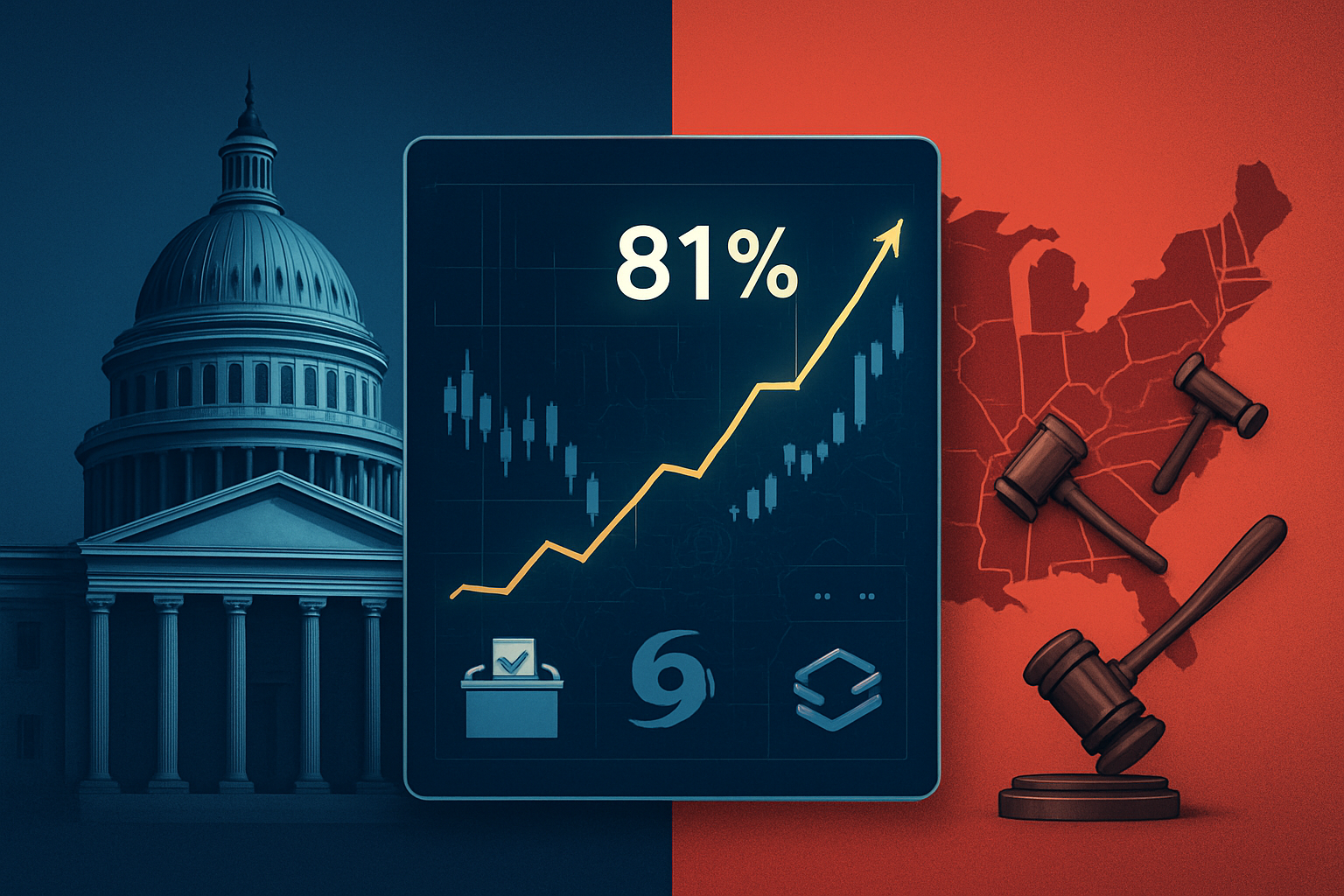
    The battle for the soul of the prediction market industry has reached a fever pitch as 2026 begins, with traders increasingly convinced that federal authority will ultimately crush state-level attempts to ban event contracts. On Manifold Markets, a leading sentiment-based forecasting platform, the probability that federal preemption will protect regulated exchanges from state-level bans currently sits at a dominant 81%. This high-conviction forecast reflects a growing belief among legal experts and high-stakes traders that the "Wild West" era of state-by-state regulation is nearing its end, potentially being replaced by a unified federal framework under the Commodity Exchange Act (CEA).

    This surge in confidence follows a chaotic 2025 that saw a direct collision between the U.S. Commodity Futures Trading Commission (CFTC) and aggressive state regulators in New York and Maryland. As several states attempt to enforce "gaming" bans on markets involving elections and catastrophic events, the 81% odds suggest the market believes the federal government’s exclusive jurisdiction over derivatives will serve as an impenetrable shield for companies like Kalshi and Interactive Brokers Group, Inc. (NASDAQ: IBKR).

    The Market: What's Being Predicted

    The specific market fueling this discussion is a high-volume "legal futurism" contract on Manifold Markets titled "Will Federal Preemption Protect DCMs from State Bans by End of 2026?" This market tracks whether a federal court or acts of Congress will explicitly prevent state gaming commissions from shutting down exchanges that hold Designated Contract Market (DCM) status. While Manifold operates on a play-money and sweepstakes model, it has become the primary hub for real-time legal analysis, with the 81% probability serving as a benchmark for institutional confidence.

    The odds have seen a dramatic climb since early 2025. Following a mixed ruling in Maryland that initially cast doubt on federal supremacy, the probability dipped to 55%. However, it rebounded sharply in late 2025 after a Manhattan federal judge issued a "litigation stay" against New York’s newly proposed ORACLE Act, allowing exchanges to continue operating while the constitutionality of the state's ban is litigated. The resolution criteria for this market require either a definitive U.S. Supreme Court ruling or a federal law that codifies the CFTC’s exclusive jurisdiction over event contracts as "financial derivatives."

    Liquidity in this niche legal market has been surprisingly deep, with over 1.2 million "mana" (Manifold’s currency) traded. Observers note that the market has become a "shadow docket" for the actual litigation occurring in the Second and Fourth Circuits. The timeline is tight; if no clear federal protection is established by December 31, 2026, the market will resolve to "No," creating a sense of urgency among the "bullish" legal theorists who currently hold the majority of positions.

    Why Traders Are Betting

    The core of the 81% bull case rests on the "Field Preemption" theory derived from the Commodity Exchange Act. Proponents argue that when Congress passed the CEA, it intended to "occupy the field" of derivatives trading. Traders point to the landmark 2024 victory by Kalshi against the CFTC as the foundational precedent. That ruling established that the CFTC could not block election contracts simply by labeling them "gaming." By extension, traders believe that if a contract is a federal financial instrument, it cannot simultaneously be a state-level gambling crime.

    "The logic is simple: you can't have a national exchange if 50 states have 50 different definitions of what constitutes a hedge versus a bet," says one high-volume Manifold trader known as LegalEagle. Traders are also heartened by the introduction of the Financial Prediction Markets Public Integrity Act of 2026 by U.S. Rep. Ritchie Torres. While the bill seeks to limit insider trading by government officials, its very existence is viewed by markets as a de facto federal recognition of prediction markets as a legitimate asset class. This legislative "nod" has contributed significantly to the recent 10-point jump in the preemption odds.

    Furthermore, "whale" activity suggests that institutional players are betting on the "too big to fail" nature of the current market. With daily global volumes for event contracts now exceeding $700 million, the fragmentation of these markets through state bans would cause massive financial disruption. Traders are betting that federal courts will prefer a uniform standard to avoid a "checkerboard" of legality that would render national hedging strategies impossible for corporations and retail investors alike.

    Broader Context and Implications

    The tension between federal and state authority is not a new phenomenon in the U.S. financial system, but its application to prediction markets is revolutionary. This conflict mirrors the early days of the internet and interstate commerce, where the Supreme Court eventually ruled that states could not burden the "national marketplace." If the 81% probability holds true, it would transform prediction markets from a legal gray area into a regulated pillar of the American financial system, akin to the Chicago Mercantile Exchange (CME Group Inc. (NASDAQ: CME)).

    In states like New York, the stakes are particularly high. The reintroduction of the ORACLE Act (Assembly Bill A09251) in January 2026 represents the "Last Stand" of state gaming commissions. The bill specifically targets "death markets" and "political wagering," categories that Kalshi and others argue are essential for hedging economic risk. A federal victory would effectively nullify the ORACLE Act, stripping state regulators of their power to define what constitutes a "productive" financial trade.

    Moreover, this market reveals a profound shift in public sentiment. By pricing the probability of federal preemption at 81%, the crowd is signaling that the era of viewing prediction markets as mere "gambling" is over. Instead, they are being priced as essential information-aggregation tools that require federal protection to function effectively. The historical accuracy of these markets—which correctly predicted the 2024 Kalshi court victory and the subsequent explosion in election trading volume—gives this 81% figure significant weight among policymakers.

    What to Watch Next

    The most immediate catalyst for market movement will be the resolution of the "litigation stay" in Manhattan. If the stay is lifted and New York begins active enforcement against DCMs, the 81% probability will likely plummet toward the 40-50% range as the "State Rights" argument gains momentum. Conversely, if the Manhattan court grants a permanent injunction against the ORACLE Act, the market could move toward a near-certainty of 95%.

    Another key milestone is the potential for a "Circuit Split." With the Maryland court (Fourth Circuit) currently favoring state rights and the D.C. and potentially New York (Second Circuit) favoring federal preemption, a collision at the Supreme Court is almost inevitable by late 2026. Legal observers are closely watching the "certiorari" filings—if the Supreme Court agrees to hear a preemption case, the Manifold market will likely see massive volatility as traders react to the conservative or liberal leanings of the justices regarding the "Administrative State" and the "Major Questions Doctrine."

    Finally, keep an eye on the CFTC’s own internal rulemaking. If the Commission, under new leadership in 2026, chooses to officially codify "Event Contracts" as "Swaps," it would provide the "Field Preemption" argument the definitive legal footing it currently lacks. Such a move would effectively end the state-level resistance and resolve the Manifold market at 100%.

    Bottom Line

    The 81% probability on Manifold Markets is a powerful testament to the perceived inevitability of federal dominance in the prediction market space. Traders have weighed the risks of aggressive state-level bans and found them lacking against the combined weight of the Commodity Exchange Act and recent pro-market court precedents. The market is increasingly viewing event contracts not as a subset of gambling, but as a primary financial tool that requires a single, federal regulator.

    This high conviction suggests that prediction markets have successfully navigated their most dangerous legal phase. While the "ORACLE Acts" of the world present a temporary hurdle, the prevailing sentiment is that the federal government—driven by the need for market stability and the push for financial innovation—will eventually act as the industry's ultimate protector.

    As we move further into 2026, the Manifold odds serve as a vital signal for both regulators and participants. The message is clear: the market expects federal law to prevail, and it is betting heavily that the "state ban" era is a closing chapter in the history of American forecasting.


    This article is for informational purposes only and does not constitute financial or betting advice. Prediction market participation may be subject to legal restrictions in your jurisdiction.

    PredictStreet focuses on covering the latest developments in prediction markets.
    Visit the PredictStreet website at https://www.predictstreet.ai/.
  • The $11 Billion Prediction: How Kalshi’s Meteoric Rise Defined the 2025 Financial Landscape

    The $11 Billion Prediction: How Kalshi’s Meteoric Rise Defined the 2025 Financial Landscape

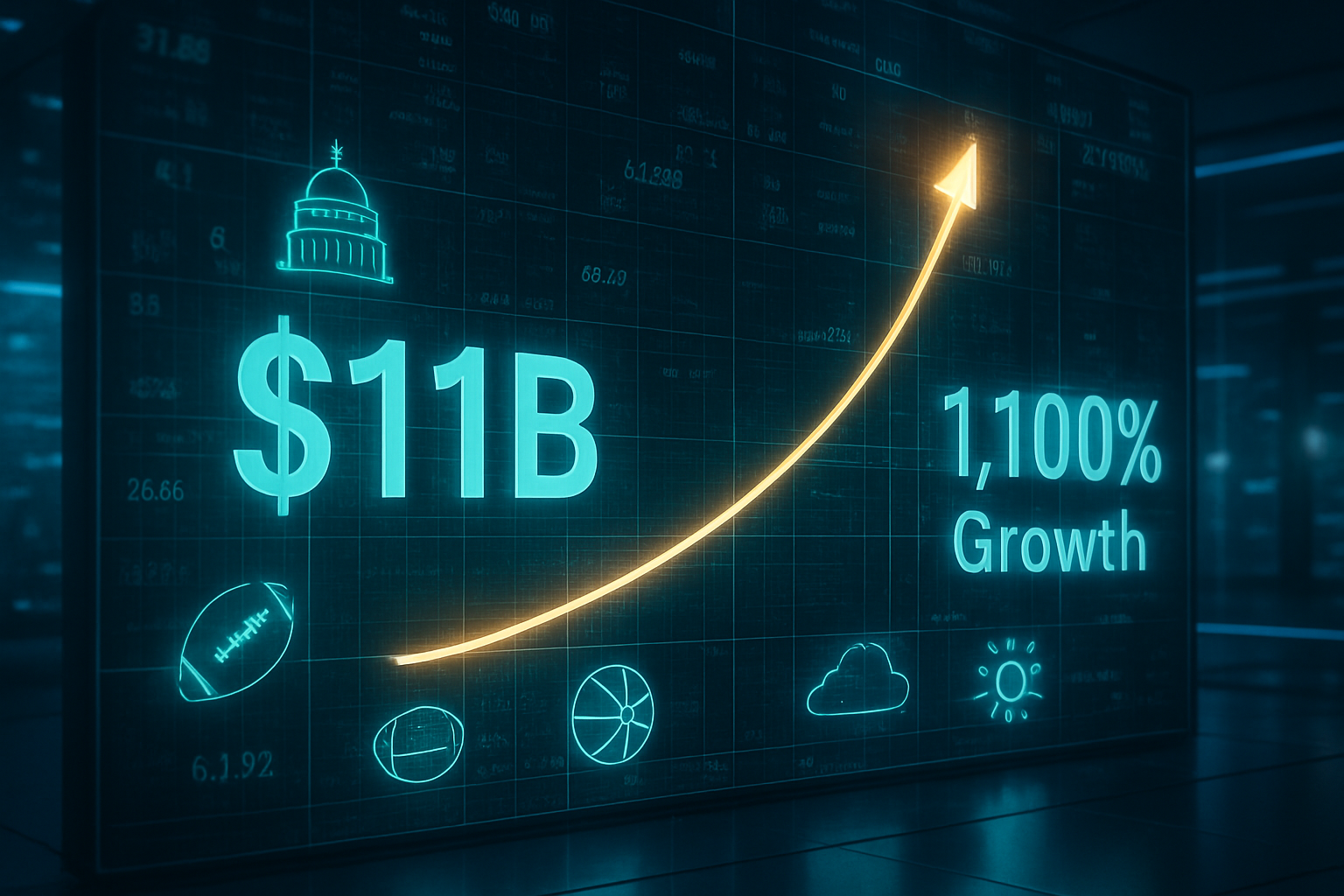
    The prediction market landscape has officially transitioned from a niche interest for statisticians into a cornerstone of the global financial system. As of January 15, 2026, Kalshi has cemented its status as the "CME of event contracts," reaching a staggering $11 billion valuation following a record-breaking $1 billion Series E funding round. This valuation marks a historic milestone for the platform, which only a year ago was battling for its legal life in federal court.

    The surge in valuation is underpinned by a year of unprecedented growth. In 2025, Kalshi’s total notional trading volume skyrocketed by 1,100%, hitting a massive $23.8 billion. Traders are no longer just betting on political outcomes; they are hedging against inflation, wagering on Federal Reserve pivots, and increasingly using the platform for sports and entertainment outcomes with the same precision once reserved for commodities and equities.

    The Market: From Election Volatility to Everyday Utility

    The primary driver of Kalshi’s dominance has been its transition from a specialized election-betting site to a high-volume exchange for nearly every conceivable event. While the 2024 U.S. presidential election served as the "killer app" that brought millions of users to the platform, the 2025 volume was sustained by a diversification into sports and economic indicators. By late 2025, the platform was regularly clearing over $1 billion in weekly volume, with NFL and NBA event contracts accounting for nearly 75% of the activity in the fourth quarter.

    Unlike its offshore, crypto-native competitor Polymarket, Kalshi has leaned heavily into its status as a federally regulated exchange. This positioning allowed it to integrate directly with mainstream financial platforms. A pivotal partnership with Robinhood Markets (NASDAQ: HOOD) in early 2025 allowed millions of retail investors to trade event contracts alongside their stock portfolios, drastically increasing liquidity. This integration turned "event trading" into a standard feature of the modern brokerage experience, moving the needle on liquidity and narrowing bid-ask spreads to levels comparable to major options exchanges.

    Why Traders Are Betting: Regulatory Clarity and Institutional Might

    The catalyst for this growth was the resolution of a long-standing legal battle with the Commodity Futures Trading Commission (CFTC). After a series of court victories in late 2024, the CFTC officially dropped its appeal in May 2025, effectively providing a green light for regulated political and event derivatives in the United States. This regulatory "seal of approval" triggered an immediate influx of institutional capital.

    Venture capital heavyweights Sequoia Capital and Andreessen Horowitz (a16z) led the charge, viewing Kalshi not just as a betting platform but as a vital piece of market infrastructure. Alphabet Inc. (NASDAQ: GOOGL), through its independent growth fund CapitalG, also participated in the $1 billion Series E round, signaling that Big Tech sees the inherent value in the data generated by these markets.

    "Kalshi has created the first true 'truth machine' for the financial world," noted one lead investor during the funding announcement. Institutional traders are now using Kalshi’s data to inform their strategies in traditional markets, recognizing that the "wisdom of the crowd" on a regulated exchange often moves faster than traditional polling or economic forecasting models.

    Broader Context and Implications

    The rise of Kalshi signifies a fundamental shift in how the public consumes and acts on information. During the 2024 election cycle, prediction markets famously outpaced traditional pollsters in accuracy, correctly pricing the outcome long before the major networks. This success fostered a "credibility revolution" that has forced traditional media outlets like CNN, owned by Warner Bros. Discovery (NASDAQ: WBD), and CNBC, owned by Comcast (NASDAQ: CMCSA), to feature Kalshi’s real-time odds as a primary data source for their coverage.

    Furthermore, the $11 billion valuation places Kalshi in the same conversation as established exchange operators like the Intercontinental Exchange (NYSE: ICE) and CME Group (NASDAQ: CME). It suggests that the market for "risk on outcomes" is potentially as large as the market for "risk on assets." By allowing individuals to hedge against specific real-world events—such as a government shutdown or a specific interest rate hike—Kalshi has democratized sophisticated hedging tools that were previously the exclusive domain of hedge funds and institutional desks.

    What to Watch Next

    As we move further into 2026, the focus for Kalshi shifts toward international expansion and the potential for an Initial Public Offering (IPO). Rumors are already circulating that the company has begun preliminary talks with investment banks for a late-2026 listing. If successful, it would be the first dedicated prediction market exchange to go public on a major U.S. exchange.

    Investors should also keep an eye on the platform’s "Day 1" contracts for the 2026 midterm elections and its expanding suite of weather-related derivatives. As climate volatility increases, Kalshi’s weather markets are becoming a vital tool for the insurance and agriculture industries. The ability for a local farmer to hedge against a specific temperature drop on Kalshi could be the next major growth frontier for the platform.

    Bottom Line

    Kalshi’s journey from a regulatory underdog to an $11 billion financial powerhouse is a testament to the power of prediction markets. The 1,100% volume increase in 2025 proves that there is an insatiable appetite for transparent, regulated, and liquid markets where participants can put their money where their mouth is.

    The involvement of blue-chip institutional backers and the clearing of regulatory hurdles have removed the "fringe" label from prediction markets. As we look ahead, the question is no longer whether prediction markets are a viable financial tool, but how deeply they will integrate into every aspect of our economic and political lives. For Kalshi, $11 billion may just be the beginning.


    This article is for informational purposes only and does not constitute financial or betting advice. Prediction market participation may be subject to legal restrictions in your jurisdiction.

    PredictStreet focuses on covering the latest developments in prediction markets.
    Visit the PredictStreet website at https://www.predictstreet.ai/.
  • Federal Judge Blocks Tennessee’s Crackdown on Kalshi in Landmark Preemption Battle

    Federal Judge Blocks Tennessee’s Crackdown on Kalshi in Landmark Preemption Battle

    In a significant blow to state-level gambling regulators, a federal judge in Tennessee has temporarily halted the state’s attempt to shut down Kalshi’s sports prediction markets. On Monday, January 12, 2026, Judge Aleta Trauger of the U.S. District Court for the Middle District of Tennessee issued a temporary restraining order (TRO), preventing Tennessee officials from enforcing a cease-and-desist order that would have effectively banned the platform’s operations within the state.

    The ruling comes as prediction markets face an existential tug-of-war between federal regulators, who view them as financial exchanges, and state authorities, who see them as unlicensed sportsbooks. For Kalshi, the TRO is more than just a procedural victory; it represents a critical foothold in the company’s mission to establish its "event contracts" as federally protected financial instruments. Traders and legal experts alike are now focused on January 26, 2026, when the court will hold a hearing for a preliminary injunction that could set a long-term precedent for how these markets operate nationwide.

    The Market: What's Being Predicted

    At the heart of the legal dispute are Kalshi's "sports event contracts," which allow users to buy and sell positions on the outcomes of professional and collegiate sporting events. Unlike traditional sportsbooks, Kalshi operates as a Designated Contract Market (DCM), a status granted by the Commodity Futures Trading Commission (CFTC). This allows the platform to list binary options—contracts that pay out $1 if an event occurs and $0 if it does not—on a wide range of outcomes.

    The markets in question include high-volume contracts on the NFL and NBA, as well as controversial proposals regarding college sports, such as the NCAA transfer portal. Since the TRO was granted, volume on Kalshi’s sports-related contracts has seen a sharp uptick as Tennessee-based traders, who were facing a January 31 deadline to liquidate their positions, were given a reprieve. Currently, the odds for major sporting events on Kalshi remain highly liquid, often moving in lockstep with traditional betting lines but reflecting the unique risk-management strategies of financial traders rather than recreational bettors.

    Why Traders Are Betting

    The surge in interest surrounding this legal battle isn't just about sports; it's about the regulatory future of the entire prediction market industry. Traders are closely monitoring the court’s leanings because a victory for Kalshi would solidify the argument that federal law—specifically the Commodity Exchange Act—preempts state gambling regulations.

    Factors driving current market sentiment include:

    • Legal Precedent: Judge Trauger’s notation that Kalshi is "likely to succeed on the merits" of its claims has boosted confidence that federal DCM status acts as a legal shield.
    • State Overreach: Many traders view the Tennessee Sports Wagering Council’s (SWC) cease-and-desist as an aggressive move to protect state tax revenue from traditional licensed operators like Flutter Entertainment plc (NYSE: FLUT), the parent company of FanDuel, and DraftKings Inc. (NASDAQ: DKNG).
    • Whale Activity: Data suggests that large-scale institutional traders are increasingly using Kalshi’s sports contracts as a "proxy" for broader economic sentiment, particularly as these markets correlate with consumer spending and media rights valuations.

    The conflict intensified last Friday when Tennessee regulators threatened Kalshi and its competitors with civil penalties of up to $25,000 per violation and potential criminal charges for "aggravated gambling promotion." The judge’s intervention has, for now, neutralized those threats, allowing the market to function without the immediate shadow of a state-mandated shutdown.

    Broader Context and Implications

    This case is a microcosm of a much larger national debate. For years, prediction markets have lived in a grey area, but Kalshi’s recent legal successes—including its high-profile win against the CFTC over election markets—have emboldened the platform to take on state regulators. The core of Kalshi's argument is that its markets provide valuable economic data and hedging opportunities that traditional sports betting does not.

    From a regulatory perspective, the outcome in Tennessee will have ripples across the United States. If the court ultimately rules that federal CFTC regulation overrides state gambling laws, it could open the floodgates for prediction markets to operate in states where sports betting is currently restricted or heavily taxed. Conversely, a win for Tennessee would embolden other states to issue similar cease-and-desist orders, creating a fragmented "patchwork" of legality that could stifle the growth of centralized exchanges.

    Historically, prediction markets have proven to be remarkably accurate, often outperforming traditional polling and expert analysis. By treating sports as "events" rather than "games of chance," Kalshi is attempting to shift the public sentiment away from the stigma of gambling and toward the utility of information markets.

    What to Watch Next

    The most immediate milestone is the January 26, 2026, preliminary injunction hearing. This will be a more exhaustive examination of the legal arguments than the TRO phase. Legal analysts will be watching to see if the state of Tennessee can provide a compelling reason why federal preemption should not apply to sports contracts.

    Between now and the hearing, traders should watch for:

    1. Amicus Briefs: Potential filings from the NCAA or other major sports leagues that have expressed concern over "event contracts" involving collegiate athletes.
    2. Competitor Movement: Whether other platforms like Polymarket or Crypto.com seek similar injunctions based on the Tennessee ruling.
    3. Federal Response: Any clarifying statements from the CFTC regarding the extent of their "exclusive jurisdiction" over DCMs.

    If the preliminary injunction is granted, Kalshi will likely continue its Tennessee operations for the duration of the lawsuit, which could take months or years to reach a final verdict. If it is denied, the January 31 deadline for refunds and account closures will likely be reinstated, causing a massive liquidation event for Tennessee-based users.

    Bottom Line

    The legal skirmish in Tennessee is a defining moment for the intersection of finance and sports. By securing a TRO, Kalshi has successfully asserted that its federal credentials are not easily dismissed by state-level enforcement. For prediction markets, this is a test of the "DCM shield"—the idea that being a federally regulated exchange provides a level of legitimacy and protection that traditional gambling platforms lack.

    While the odds currently favor Kalshi in the courtroom of Judge Trauger, the broader war for the soul of prediction markets is far from over. As January 26 approaches, the industry stands at a crossroads: one path leads to a unified federal framework for all event-based trading, while the other leads to a contentious, state-by-state battle for survival. For now, the "vols" are high, and the legal stakes are even higher.


    This article is for informational purposes only and does not constitute financial or betting advice. Prediction market participation may be subject to legal restrictions in your jurisdiction.

    PredictStreet focuses on covering the latest developments in prediction markets.
    Visit the PredictStreet website at https://www.predictstreet.ai/.