Tag: CFTC

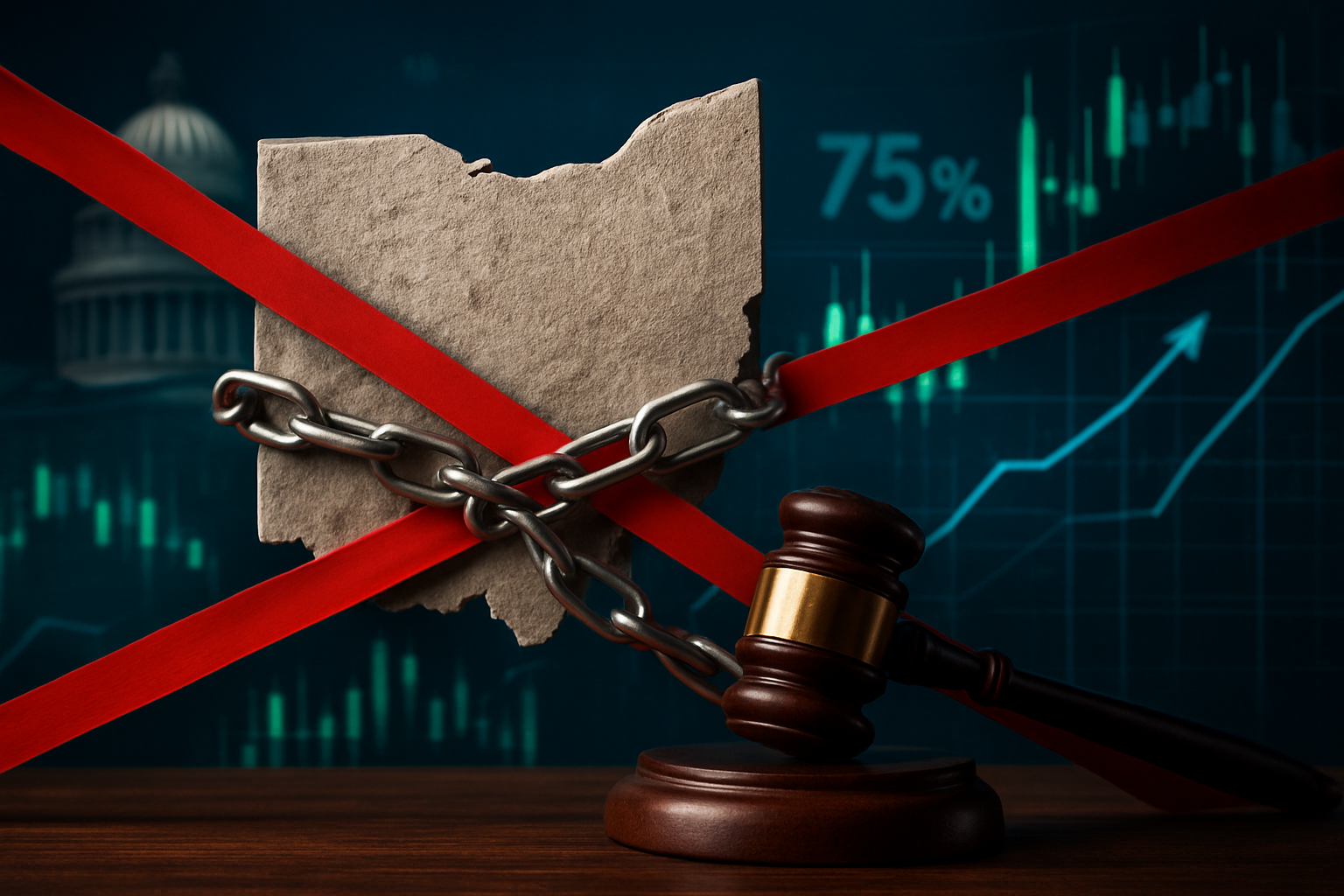
  • The Buckeye Blockade: Ohio Intensifies War on Federally Licensed Prediction Markets

    The Buckeye Blockade: Ohio Intensifies War on Federally Licensed Prediction Markets

    In a legal maneuver that has sent ripples through the prediction market community, the state of Ohio has formally doubled down on its efforts to block federally regulated exchanges from operating within its borders. On January 23, 2026, the Ohio Casino Control Commission (OCCC) filed a notice of supplemental authority in federal court, signaling a significant escalation in the battle between state gambling regulators and the Commodity Futures Trading Commission (CFTC). The move is aimed directly at KalshiEx LLC, the pioneer of regulated event contracts in the U.S., which is currently suing Ohio to protect its right to offer markets to the state’s residents.

    Traders and legal analysts are watching this development with intense scrutiny. At the heart of the conflict is a fundamental question: does a federal license from the CFTC provide a "nationwide permission slip," or can individual states use their historic "police powers" to classify prediction markets as illegal gambling? With Ohio now leveraging a fresh legal victory from Massachusetts to bolster its case, the probability of a fragmented, state-by-state regulatory landscape for prediction markets has never been higher.

    The Market: What's Being Predicted

    While prediction markets are typically used to forecast elections or economic data, the "market" currently under the most intense observation is the legal survival of the industry itself. In the U.S. District Court for the Southern District of Ohio, the case KalshiEx LLC v. Ohio Casino Control Commission et al. has become the primary theater for this conflict. Kalshi seeks to prevent Ohio’s Attorney General, Dave Yost, and the OCCC from enforcing state gaming laws against its CFTC-regulated platform.

    The tension has escalated since April 2025, when the OCCC issued cease-and-desist orders not only to Kalshi but also to major fintech players like Robinhood Markets, Inc. (NASDAQ: HOOD) and Crypto.com, alleging they were facilitating unlicensed sports gaming. Trading volume on these platforms in Ohio has effectively frozen as geofencing measures were tightened in response to the state’s aggressive posture. Investors are now pricing in a significant risk that other states will follow Ohio’s lead, potentially creating a "patchwork" regulatory environment similar to the early days of the U.S. sports betting rollout.

    Resolution in the Ohio case is expected by mid-2026, but the recent filing of supplemental authority has accelerated the timeline. Ohio is specifically citing a January 20, 2026, ruling from Massachusetts, where a judge granted a preliminary injunction against Kalshi, effectively banning its sports-related event contracts. Ohio argues that this Massachusetts precedent provides the "roadmap" for why state laws should not be preempted by federal commodities law.

    Why Traders Are Betting

    The primary driver of the current uncertainty is the strategic pivot by state attorneys general. Led by Ohio’s Dave Yost, a coalition of 36 states has argued that prediction markets—particularly those involving elections and sports—pose "life-altering consequences" for citizens if left to the relatively light-touch oversight of the CFTC. This perspective stands in stark contrast to the "Selig Doctrine" currently emerging from Washington.

    The new CFTC Chairman, Michael Selig, who was confirmed in December 2025, has championed a "future-proof" regulatory framework that views prediction markets as essential financial hedging tools. Traders who are bullish on the industry had hoped that Selig’s permissive stance would override state-level concerns. However, the Massachusetts ruling has proven that state judges are increasingly sympathetic to the argument that the Commodity Exchange Act (CEA) does not explicitly displace state gaming commissions.

    Market participants are also closely watching the behavior of traditional sportsbooks like FanDuel, owned by Flutter Entertainment plc (NYSE: FLUT), and DraftKings Inc. (NASDAQ: DKNG). In a bold move in August 2025, OCCC Executive Director Matthew Schuler warned these licensed operators that their Ohio gaming licenses would be at risk if they even peripherally associated with prediction market exchanges. This has effectively isolated Kalshi and its peers from the broader gaming ecosystem in the Midwest, forcing traders to weigh the risk of total exclusion from the Ohio market.

    Broader Context and Implications

    The Ohio-Massachusetts alliance represents a significant shift in the narrative of prediction markets. For years, the industry was viewed through a federal lens—a battle between the CFTC and exchanges. Now, the conflict has shifted to a "Federalism vs. Preemption" fight. If Ohio succeeds in using the Massachusetts ruling to defeat Kalshi's motion for a preliminary injunction, it could set a precedent that renders a CFTC license nearly worthless in a dozen or more "restrictive" states.

    This reveals a deep public sentiment divide regarding the nature of "event contracts." While Silicon Valley and Wall Street view these as "truth machines" and hedging instruments, state regulators in the "Rust Belt" and beyond continue to view them through the prism of consumer protection and tax revenue. By labeling these contracts as "gaming," Ohio ensures it can maintain its 20% tax on sports gaming revenue—a revenue stream that prediction markets, which operate as low-fee exchanges, currently do not provide to the state.

    Historically, prediction markets have thrived when they have clear, singular regulatory oversight. The current friction mirrors the early 20th-century battles over "bucket shops," where states successfully shuttered unregulated exchanges. The difference today is that the exchanges are federally licensed, creating a constitutional clash that may ultimately require intervention from the U.S. Supreme Court to resolve the ambiguity of the Commodity Exchange Act.

    What to Watch Next

    The immediate next step is the ruling from the U.S. District Court for the Southern District of Ohio on Kalshi’s request for a preliminary injunction. Following the January 23 filing of the Massachusetts authority, a decision is expected within the next 30 days. If the court sides with Ohio, expect an immediate "domino effect" as states like New Jersey, Nevada, and Tennessee—who have already been coordinating with Ohio—move to issue their own injunctions.

    Another critical milestone is the CFTC’s formal notice-and-comment rulemaking, scheduled to begin in February 2026. Chairman Selig’s attempt to codify prediction market rules could include language specifically intended to preempt state laws. However, if the courts have already ruled in favor of state "police powers" by then, the CFTC’s rules may arrive too late to protect the exchanges from being geofenced out of significant portions of the U.S. population.

    Finally, keep a close watch on the 2026 midterm election markets. If the legal blockade in Ohio remains in place, it will serve as the first major test of how a "fragmented market" affects the accuracy of these platforms. If Ohio residents—historically a bellwether for national trends—are excluded, the predictive power of these markets could be significantly diminished, potentially impacting the liquidity and utility that make them attractive to traders in the first place.

    Bottom Line

    The "Buckeye Blockade" is more than just a local regulatory dispute; it is a fundamental challenge to the federal government's authority over the next generation of financial markets. Ohio’s strategic use of the Massachusetts ruling as "supplemental authority" shows that state regulators are no longer acting in isolation—they are building a collective legal arsenal to keep prediction markets under the thumb of state gambling commissions.

    For prediction markets to serve as effective tools for social and economic forecasting, they require broad, liquid participation. The current pushback from Ohio threatens to Balkanize the U.S. market, creating a scenario where a trader's ability to hedge against political or economic risk depends entirely on their zip code.

    As we move further into 2026, the likely outcome is a prolonged period of legal volatility. While the CFTC may want to usher in a new era of "event-driven finance," Ohio has made it clear that the path to a national market runs directly through the state house in Columbus—and the gate is currently locked.


    This article is for informational purposes only and does not constitute financial or betting advice. Prediction market participation may be subject to legal restrictions in your jurisdiction.

    PredictStreet focuses on covering the latest developments in prediction markets.
    Visit the PredictStreet website at https://www.predictstreet.ai/.

  • PredictIt’s ‘New Era’: Regulated, Uncapped, and Ready for the 2026 Midterm Surge

    PredictIt’s ‘New Era’: Regulated, Uncapped, and Ready for the 2026 Midterm Surge

    The landscape of American political forecasting has fundamentally shifted. For over a decade, PredictIt was the "little engine that could"—a research project operating under the restrictive constraints of an academic "No-Action" letter from federal regulators. Today, January 26, 2026, those training wheels are officially gone. PredictIt has completed its transformation into a fully regulated Designated Contract Market (DCM) and Derivatives Clearing Organization (DCO) under the Commodity Futures Trading Commission (CFTC).

    The result is a "New Era" for the platform, characterized by the removal of the infamous 5,000-trader cap and a quadrupling of individual investment limits. As the 2026 Midterm Elections approach, these changes have already triggered a massive influx of liquidity. Currently, PredictIt traders are pricing a 78% chance ($0.78) that Democrats will retake the House of Representatives, while giving Republicans a 65% chance ($0.65) to maintain their grip on the Senate. This divergence—suggesting a return to divided government—is generating record-breaking volume as the platform finally competes on a level playing field with institutional giants.

    The Market: What's Being Predicted

    The "New" PredictIt, now officially operated by the parent company Aristotle International, Inc., is no longer just a place for $850 bets and "sold out" contracts. Under its new DCM status, the platform has listed hundreds of contracts for the 2026 cycle. The most active markets currently center on the 2026 Midterm Control, where the "Balance of Power" contract is the crown jewel of the exchange.

    On PredictIt, the market for a "Democratic House / Republican Senate" split is currently trading at 46¢, the consensus favorite among the three major US-facing platforms. Unlike the "Old" PredictIt, where high-interest markets would hit the 5,000-trader limit months before an election, the new "unlimited" capacity has allowed these contracts to absorb millions in trade volume.

    The liquidity is bolstered by a significant regulatory win: the individual investment limit per contract has been raised from a mere $850 to $3,500. This figure was strategically chosen to mirror the Federal Election Campaign Act (FECA) individual contribution limit, allowing traders to back their convictions with meaningful capital without opening the door to the "market-moving" whale activity often seen on offshore crypto platforms like Polymarket.

    Why Traders Are Betting

    The surge in PredictIt’s activity is driven by a unique blend of high-conviction political quants and a regulatory framework that emphasizes accuracy over pure speculation. While the platform has modernized, it has retained its reputation for precision. A 2025 Vanderbilt University study noted that PredictIt's capped-investment model (even at $3,500) achieved a 93% accuracy rate in down-ballot races during the 2024 cycle, outperforming more "liquid" competitors.

    Traders are currently reacting to several early-2026 catalysts:

    • Geopolitical Volatility: Recent administrative friction regarding Greenland and military shifts in South America have made GOP "Sweep" contracts (21¢) feel like a risky bet.
    • The "Core Four" Senate Races: Markets for critical seats in Ohio, Alaska, Maine, and North Carolina are seeing intense action. PredictIt traders are notably more bullish on Senator Susan Collins (R-ME) holding her seat (66¢) compared to the more volatile pricing on Polymarket.
    • The Power of the Purse: Sentiment suggests that voters are seeking a "check" on the executive branch, a historical pattern that PredictIt’s sophisticated trader base is pricing as a near-certainty for the House.

    Broader Context and Implications

    This transition marks the end of the "wild west" era for US prediction markets. For years, the industry was a binary choice: the restricted academic environment of PredictIt or the regulated, yet non-political, markets of Kalshi. In late 2024 and throughout 2025, a series of legal victories—most notably Clarke v. CFTC—cleared the path for political event contracts to be treated as legitimate financial instruments rather than "gambling."

    The mainstreaming of these markets is evident in the involvement of major public companies. Robinhood Markets (NASDAQ: HOOD) has successfully integrated event-contract trading for its millions of users via a partnership with Kalshi, while Interactive Brokers (NASDAQ: IBKR) has expanded its ForecastEx subsidiary to compete directly for institutional flow. Even heavyweights like CME Group (NASDAQ: CME) and Goldman Sachs (NYSE: GS) have begun exploring the clearing and settlement of event-based derivatives.

    PredictIt’s new DCM/DCO status means it is no longer an "exception" to the rule; it is a core pillar of the new financial infrastructure. This regulatory clarity has narrowed the bid-ask spreads on major contracts to as little as a single penny, providing a "wisdom of the crowd" data point that is often more reliable than traditional polling.

    What to Watch Next

    As we move toward the 2026 primary season, the "New Era" PredictIt will face its first major stress test. Watch for the following milestones:

    1. The $10 Million Milestone: Analysts expect the "House Control" market to be the first in PredictIt history to reach $10 million in total volume before the summer, thanks to the removed trader caps.
    2. State-Level Challenges: While federal regulators are now on board, several states, including Massachusetts and Nevada, are currently embroiled in legal battles over whether "prop-style" event contracts violate state gaming laws.
    3. The Polymarket US Rollout: Polymarket’s recent acquisition of a CFTC-licensed exchange (QCX) means it will soon exit its beta phase. The "liquidity war" between PredictIt’s accuracy and Polymarket’s volume will be the defining story of the 2026 election.

    Bottom Line

    PredictIt’s evolution from a university research project to a fully-fledged, CFTC-regulated exchange is the most significant development in the prediction market space this decade. By removing the 5,000-trader cap and raising investment limits to $3,500, the platform has successfully professionalized without losing the "distributed intelligence" that made its forecasts so accurate in the past.

    For the average trader, this means a more robust, liquid, and legally secure way to hedge against political outcomes or profit from unique insights. For the broader public, it provides a high-fidelity signal of the nation's political trajectory. As of January 2026, the signal is clear: the markets are betting on a divided Washington, but the real winner is the legitimacy of the prediction market itself.


    This article is for informational purposes only and does not constitute financial or betting advice. Prediction market participation may be subject to legal restrictions in your jurisdiction.

    PredictStreet focuses on covering the latest developments in prediction markets. Visit the PredictStreet website at https://www.predictstreet.ai/.


  • The Great De-Regulation: How a ‘Hollowed Out’ CFTC Ignited a $1 Billion Prediction Market Boom

    The Great De-Regulation: How a ‘Hollowed Out’ CFTC Ignited a $1 Billion Prediction Market Boom

    As of January 22, 2026, the landscape of American finance is undergoing its most radical transformation in decades, driven not by a new asset class, but by the systematic dismantling of the guardrails that once hemmed it in. The Commodity Futures Trading Commission (CFTC), once the primary antagonist of event-based wagering, has been effectively reshaped into a partner for the industry. Under a "regulatory light" mandate from the Trump administration, the agency has seen a wave of leadership departures and significant workforce cuts, leaving a skeleton crew that is more focused on "future-proofing" markets than policing them.

    This vacuum has sparked an unprecedented explosion in trading activity. Daily volumes across major platforms have surged past $800 million this month, as traders bet on everything from the outcome of Supreme Court cases to the exact timing of the next federal interest rate cut. Currently, the "market of markets"—the probability that prediction markets will achieve over $1 trillion in annual volume by the end of 2026—has climbed to a staggering 68% on Kalshi, up from just 24% a year ago.

    The Market: What's Being Predicted

    The most high-stakes "market" currently captivating traders isn't a political race or a sporting event, but the legal survival of the industry itself. On the regulated exchange Kalshi, a high-liquidity contract titled "Federal Preemption of State Gambling Laws" is currently trading at 72 cents (implying a 72% probability). This market resolves to "Yes" if a federal court or legislative action confirms that CFTC-regulated event contracts override state-level bans on "gambling" before December 31, 2026.

    This specific contract has become a proxy for the entire industry’s expansion. While the federal government has signaled a hands-off approach, several states—most notably Massachusetts and Tennessee—have issued cease-and-desist orders against Kalshi, claiming its sports and event contracts constitute illegal gambling. Trading volume on this "Supremacy Clause" market has surpassed $120 million, with liquidity provided by a mix of institutional hedge funds and retail speculators.

    The resolution criteria are strictly tied to a final ruling from a U.S. appellate court or the signing of federal legislation that explicitly protects "Event Contract" providers from state interference. As the CFTC’s own enforcement capabilities have shrunk due to a 15% reduction in total headcount, the market is increasingly betting that the federal government will lack the will—or the staff—to help states enforce local bans against federally registered exchanges.

    Why Traders Are Betting

    The primary driver of the current "bull market" in prediction platforms is the appointment of Michael Selig as the sole acting Commissioner and Chairman of the CFTC. With four of the five commission seats currently vacant following a series of high-profile resignations in 2025, Selig has wielded unprecedented unilateral authority. His "Future-Proof" initiative has effectively ended the era of "regulation by enforcement," moving toward a model where the agency provides a "minimum effective dose" of oversight.

    Traders are also reacting to the sensational "Maduro Trade" of early January, where a user on Polymarket reportedly turned $30,000 into $400,000 by betting on the capture of Venezuelan leader Nicolás Maduro just hours before a U.S. military operation. While critics decried the trade as evidence of "insider information," the market saw it as a proof of concept: prediction markets are now the fastest way to aggregate intelligence. This has led to "whale" activity on Polymarket—which relaunched for U.S. users in December 2025 via the acquisition of the exchange QCX—where single positions on geopolitical outcomes are now routinely exceeding $5 million.

    Furthermore, traditional finance is moving in. Institutional brokers like Interactive Brokers Group, Inc. (NASDAQ: IBKR) have begun facilitating "intermediated access" to these markets, treating event contracts as a legitimate alternative asset class for portfolio hedging. This shift from "fringe betting" to "institutional hedging" has provided the floor of liquidity necessary for the 2026 boom.

    Broader Context and Implications

    The "regulatory light" environment is a direct byproduct of a broader federal push to shrink the civil service. In early 2025, the CFTC terminated nearly a dozen probationary employees in its Enforcement and Market Oversight divisions. This workforce reduction has made the agency dependent on the industry it regulates. In a move that would have been unthinkable two years ago, the CFTC’s new Innovation Advisory Committee now includes the CEOs of both Kalshi and Polymarket as charter members.

    This closeness has sparked a legislative backlash. Rep. Ritchie Torres recently introduced the Public Integrity in Financial Prediction Markets Act of 2026, which seeks to ban federal officials from trading on contracts influenced by non-public government data. The market's reaction to this bill has been telling; the probability of its passage currently sits at only 15%, as traders bet that the de-regulatory momentum in the executive branch will stall any attempts at legislative restriction.

    The historical accuracy of these markets is also playing a role in their survival. During the 2024 and 2025 cycles, prediction markets consistently outperformed traditional polling and economic forecasting from major banks like Goldman Sachs Group, Inc. (NYSE: GS). This track record has given the current de-regulatory push a "veneer of utility"—the argument being that these markets are a public good that provides more accurate data than the government itself can produce.

    What to Watch Next

    The immediate horizon is dominated by the "State vs. Federal" legal showdown. A preliminary injunction in Massachusetts has temporarily halted Kalshi’s sports contracts in that state, but a federal court in the Second Circuit is expected to rule on the "Supremacy Clause" issue by late spring. A "Yes" ruling there would likely cause the probability of a nationwide expansion to jump to near-certainty.

    Additionally, watch for the growth of Opinion, a new competitor backed by YZi Labs and supported by crypto-billionaire interests. Opinion allows users to earn yield on their "staked" bets, a feature that has already captured 40% of the daily volume in the decentralized prediction space. If the CFTC allows Opinion to register as a U.S. exchange under the current "light" framework, it would signal the total capitulation of traditional financial barriers.

    Finally, the mid-year "Workforce Audit" of the CFTC will be a key milestone. If the agency continues to lose senior attorneys and economists without replacement, its ability to even conduct basic market surveillance will be called into question, potentially leading to a "Wild West" scenario that could either accelerate growth or lead to a catastrophic market failure.

    Bottom Line

    The transformation of the CFTC from a skeptical watchdog to a de-regulatory facilitator has turned prediction markets into the most dynamic sector of the 2026 economy. By hollowing out the agency’s enforcement arm and prioritizing "innovation" over "oversight," the current administration has cleared a path for Kalshi and Polymarket to become the primary venues for price discovery in the modern age.

    What we are witnessing is the birth of "Information Finance." In this new era, prediction markets are no longer just for enthusiasts; they are the scoreboard for reality. However, the risk remains that a "regulatory light" environment is also a "vulnerability heavy" one. As traders flock to these platforms, the lack of a robust workforce at the CFTC means the industry is essentially self-policing.

    For now, the odds favor the innovators. With daily volumes nearing $1 billion and the federal government standing down, the prediction market boom appears to be just getting started. Whether this leads to a more transparent world or a more volatile one remains the ultimate bet.


    This article is for informational purposes only and does not constitute financial or betting advice. Prediction market participation may be subject to legal restrictions in your jurisdiction.

    PredictStreet focuses on covering the latest developments in prediction markets.
    Visit the PredictStreet website at https://www.predictstreet.ai/.

  • The Homecoming: Polymarket’s U.S. Relaunch Signals a New Era for Prediction Markets

    The Homecoming: Polymarket’s U.S. Relaunch Signals a New Era for Prediction Markets

    NEW YORK — Polymarket, the world’s largest decentralized prediction platform, has officially begun its long-awaited homecoming. After years of operating in a regulatory exile that forced it to block American IP addresses, the platform is now aggressively onboarding thousands of users from its domestic waitlist. This strategic pivot follows a landmark regulatory shift under the second Trump administration, effectively ending the adversarial era that defined the platform's relationship with Washington during the Biden years.

    The return isn't just a expansion of geography; it is a fundamental transformation of the industry. As of late January 2026, Polymarket is no longer just a "crypto-native" darling of the offshore world. Through a series of high-stakes acquisitions and a favorable new regime at the Commodity Futures Trading Commission (CFTC), the platform is positioning itself to challenge retail giants like Robinhood Markets, Inc. (NASDAQ: HOOD) and established incumbents like Interactive Brokers Group, Inc. (NASDAQ: IBKR) for the future of "event-based" finance.

    The Market: What's Being Predicted

    The current focus of the prediction market community isn't just the outcomes of elections or sports, but the success of Polymarket itself. On Polymarket’s own global platform, a high-volume contract titled “Will Polymarket hit 1 million active U.S. users by Q3 2026?” is currently trading at a 68% probability. This optimism is fueled by the platform’s official U.S. relaunch, which was catalyzed by its $112 million acquisition of QCX, a CFTC-licensed exchange and clearinghouse, in late 2025.

    This acquisition allowed Polymarket to bypass the years of litigation that have hampered other startups. By operating as a Designated Contract Market (DCM), the platform can now legally offer a wide array of event contracts to American retail investors. Trading volume on the U.S.-specific app has already topped $450 million in its first full month of operation, with significant liquidity flowing into markets surrounding Federal Reserve interest rate cuts and the 2026 midterm election cycles.

    The resolution criteria for these new U.S. markets are strictly tied to verified data feeds, a requirement of their new CFTC status. Unlike the "Wild West" days of 2021, the current iteration of Polymarket features a dual-layered settlement system that combines decentralized oracles with a traditional regulatory oversight board, a move intended to satisfy the stringent transparency demands of the current administration.

    Why Traders Are Betting

    The primary driver behind the surge in activity is the radical shift in the U.S. regulatory climate. Under the previous administration, the CFTC, led by former Chair Rostin Behnam, viewed prediction markets with deep skepticism, often characterizing them as unregulated gambling. In contrast, the current CFTC Chair, Michael Selig, has embraced the concept of prediction markets as "information aggregators" and "truth engines."

    Traders are also reacting to the institutionalization of the space. In October 2025, the Intercontinental Exchange, Inc. (NYSE: ICE), the parent company of the New York Stock Exchange, led a $2 billion investment round in Polymarket, valuing the company at a staggering $9 billion. This "seal of approval" from traditional finance (TradFi) has given whales the confidence to take massive positions, with some individual traders reportedly betting upwards of $10 million on macro-economic outcomes.

    Furthermore, the influence of political figures has not gone unnoticed. With Donald Trump Jr. serving as a strategic advisor to several firms in the prediction market space, including investment through 1789 Capital, the market perceives a "regulatory moat" that protects these platforms from the kind of enforcement actions seen during the Gary Gensler era at the SEC. This perceived safety has led to a massive migration of capital from offshore platforms back to regulated U.S. entities.

    Broader Context and Implications

    Polymarket’s return marks a maturation of the "crypto-to-utility" pipeline. For years, critics argued that blockchain technology lacked a "killer app" beyond speculation. Prediction markets have silenced that critique by providing a service that traditional polling and forecasting have failed to deliver: real-time, skin-in-the-game accuracy. During the 2024 election cycle, Polymarket famously outpaced mainstream media outlets in predicting key swing state outcomes, a feat that cemented its reputation among the political elite.

    The implications of this shift are profound for the broader financial sector. We are witnessing the birth of a new asset class where "knowledge" is the primary currency. The formation of the Coalition for Prediction Markets (CPM) by Polymarket, Coinbase Global, Inc. (NASDAQ: COIN), and Robinhood (NASDAQ: HOOD) in late 2025 highlights a unified front against state-level attempts to tax or ban these markets. These companies are betting that federal oversight will provide a more stable environment for growth than a patchwork of state gambling laws.

    However, the rapid growth has not been without controversy. In early January 2026, Senators Adam Schiff and Alex Padilla called for investigations into potential "information asymmetry" (insider trading) after a series of suspiciously timed trades on Polymarket preceded the news of a major political upheaval in South America. These legislative challenges suggest that while the executive branch is currently friendly, the legislative branch remains a source of potential friction for the industry.

    What to Watch Next

    The immediate milestone to monitor is the conversion of the Polymarket U.S. waitlist into active, funded accounts. Industry analysts expect the platform to hit the 500,000-user mark by the end of Q1 2026, particularly as it expands its offerings into "culture markets"—betting on the Oscars, the Grammys, and high-profile tech product launches.

    Perhaps the most anticipated event is the rumored launch of a native "POLY" governance token. While the company has remained tight-lipped, the integration of a tokenized incentive structure for U.S. users would be a first for a CFTC-regulated DCM. If approved, it could set a precedent for how other crypto-based companies like Kraken or Gemini might approach domestic expansion.

    Investors should also keep a close eye on the "Public Integrity in Financial Prediction Markets Act," a bill recently introduced in the House. If passed, it would ban federal employees from trading on these platforms, a move that could dampen liquidity in political markets but might ultimately enhance the industry's credibility by preventing conflicts of interest.

    Bottom Line

    The return of Polymarket to the United States is the definitive "growing up" moment for the prediction market industry. By aligning with the current administration's pro-innovation stance and securing the backing of TradFi giants like ICE, Polymarket has moved from the periphery of the internet to the center of the financial discourse.

    As the platform clears its waitlist and stabilizes its domestic operations, the divide between "gambling" and "forecasting" will continue to blur. For the average investor, this means access to a powerful new tool for hedging against real-world uncertainty. For the industry at large, it signifies that the most valuable commodity in the 21st century is not oil or gold, but accurate, incentivized information.

    The next six months will determine whether Polymarket can maintain its dominance in a crowded domestic field, or if the weight of regulation will eventually slow the very innovation that made it a global powerhouse. For now, however, the odds are firmly in favor of the prediction market giant.


    This article is for informational purposes only and does not constitute financial or betting advice. Prediction market participation may be subject to legal restrictions in your jurisdiction.

    PredictStreet focuses on covering the latest developments in prediction markets.
    Visit the PredictStreet website at https://www.predictstreet.ai/.
  • The Battle for Federal Preemption: Kalshi’s State-Level War Reaches a Fever Pitch

    The Battle for Federal Preemption: Kalshi’s State-Level War Reaches a Fever Pitch

    As of January 22, 2026, the United States is witnessing a historic constitutional collision between federal financial oversight and century-old state police powers. At the center of this storm is KalshiEX LLC, the first federally regulated exchange for "event contracts," which is currently locked in a multi-front legal war with state gaming regulators in Nevada, New Jersey, and Maryland. These cases, which have now migrated to the U.S. appellate courts, are not just about whether Americans can bet on the weather or elections; they are about the "Federal Preemption" doctrine and whether the Commodity Futures Trading Commission (CFTC) has the exclusive right to define what constitutes a financial derivative.

    In the prediction markets themselves, traders are placing millions of dollars on the outcome of these very lawsuits. On platforms like Polymarket and ForecastEx, a "Circuit Split" is already being priced in. While the market for the Third Circuit (New Jersey) case shows a staggering 81% probability of a Kalshi victory, the outlook in the Ninth Circuit (Nevada) remains significantly more bearish following a surprise reversal by a district judge last November. The divergence in these markets suggests that the industry is bracing for a Supreme Court showdown that could redefine the legality of prediction markets for a generation.

    The Market: What’s Being Predicted

    The "Legal Recognition" markets have become some of the most liquid and closely watched contracts in the early months of 2026. These are not markets about political outcomes or sports scores, but "meta-markets" on the judicial system itself. Traders are currently focusing on three primary judicial battlegrounds:

    1. The Third Circuit (New Jersey): Currently trading at 81% "Yes" for a Kalshi win. This contract tracks whether the Third Circuit Court of Appeals will uphold a lower court’s ruling that the Commodity Exchange Act (CEA) preempts New Jersey state law.
    2. The Ninth Circuit (Nevada): Trading at a more volatile 42% probability. This market has seen heavy "No" activity after U.S. District Judge Andrew Gordon dissolved a previous injunction in November 2025, ruling that Kalshi’s sports-related products do not qualify as "swaps" and are thus subject to Nevada’s gaming laws.
    3. The Fourth Circuit (Maryland): Trading at 55%, reflecting deep uncertainty after Maryland became the first state to successfully argue in district court that Congress never intended for the CFTC to override state-level gambling prohibitions.

    The trading volume for these contracts has surged past $50 million as institutional legal analysts and arbitrageurs hedge against the risk of a "patchwork" regulatory environment. If Kalshi loses in the Ninth and Fourth Circuits but wins in the Third, the resulting circuit split would almost certainly trigger a petition to the U.S. Supreme Court by late 2026.

    Why Traders Are Betting

    The optimism in the New Jersey market is driven by the legal theory of "Field Preemption." Proponents argue that when Congress passed the CEA and designated the CFTC as the "exclusive" regulator of derivatives, it intended to occupy the entire field of financial contracts. Traders betting "Yes" believe the Third Circuit will follow the precedent set by Judge Edward Kiel, who ruled that a federally authorized Designated Contract Market (DCM) like Kalshi cannot be expected to navigate 50 different sets of state licensing laws.

    Conversely, the bearish sentiment in Nevada stems from a growing judicial skepticism regarding the definition of a "swap." In November 2025, the Nevada court sided with the Nevada Gaming Control Board, arguing that contracts based on player statistics or game outcomes are "contingent wagers"—the very definition of sports betting.

    Notable whale activity has been observed in these markets, with several large positions betting on a "State’s Rights" resurgence. These traders are likely tracking the amicus briefs filed by 34 state attorneys general who argue that exempting Kalshi from state oversight would create a "regulatory vacuum" where traditional sportsbooks, such as DraftKings Inc. (NASDAQ:DKNG) and Flutter Entertainment plc (NYSE:FLUT), are forced to pay state taxes and licensing fees while prediction markets operate tax-free under federal rules.

    Broader Context and Implications

    This conflict represents a "Constitutional Crisis" for the prediction market industry. If the courts ultimately rule against Kalshi, it would mean that every state could individually ban or tax CFTC-approved contracts. This would effectively destroy the liquidity and national reach that make prediction markets valuable tools for price discovery and forecasting.

    The real-world implications extend far beyond Kalshi. A loss for federal preemption would likely embolden states to target other platforms and could even impact how traditional financial institutions handle complex derivatives that have "gaming-like" characteristics. This tension reveals a deep public sentiment divide: is a prediction market a sophisticated financial tool for hedging risk, or is it simply a high-tech "bucket shop" designed to bypass state gambling taxes?

    Historically, prediction markets have been more accurate than pundits, and the current markets on these legal cases suggest a high degree of confidence that the federal government will eventually prevail in the most business-friendly circuits. However, the accuracy of these markets is now being tested by the sheer unpredictability of the "State’s Rights" arguments gaining traction in Maryland and Nevada.

    What to Watch Next

    The most immediate catalyst to watch is the Ninth Circuit’s upcoming decision on the Nevada "partial stay." On January 14, 2026, the district court allowed Kalshi to continue its appeal while the litigation proceeds. A definitive ruling from the Ninth Circuit is expected by late spring 2026. If the Ninth Circuit reverses the district court and sides with Kalshi, the "Yes" odds across all legal markets will likely skyrocket toward 90%.

    Another key milestone is the Third Circuit’s final ruling on the New Jersey appeal. Given the high probability currently priced in, a loss for Kalshi there would be a "black swan" event, likely causing a massive liquidation across the prediction market ecosystem.

    Investors should also monitor the New York State Legislature. The "ORACLE Act" (A9251), which seeks to explicitly ban political event contracts, saw its passage probability drop to 38% this week. Traders are interpreting this as a sign that state legislators are waiting for the courts to decide the preemption issue before committing to new state laws.

    Bottom Line

    The legal battle between Kalshi and state regulators is the final hurdle for the mainstreaming of prediction markets in the United States. The current markets suggest that while Kalshi is a favorite in the more business-friendly Eastern courts, the "State’s Rights" strongholds in the West and Mid-Atlantic present a significant risk.

    This saga demonstrates that prediction markets are more than just a place to bet on the news—they are becoming an essential tool for quantifying complex legal and regulatory risks in real-time. Whether the "exclusive jurisdiction" of the CFTC can withstand the traditional police power of the states remains the billion-dollar question. For now, the "smart money" is betting on a divided judiciary, a fragmented 2026 market, and an inevitable date with the Supreme Court.


    This article is for informational purposes only and does not constitute financial or betting advice. Prediction market participation may be subject to legal restrictions in your jurisdiction.

    PredictStreet focuses on covering the latest developments in prediction markets.
    Visit the PredictStreet website at https://www.predictstreet.ai/.

  • Hedge or Hazard? The Billion-Dollar Legal War to Define Sports Prediction Markets

    Hedge or Hazard? The Billion-Dollar Legal War to Define Sports Prediction Markets

    As of January 21, 2026, the American financial landscape is locked in a high-stakes jurisdictional civil war. On one side, federal regulators and Silicon Valley giants argue that prediction markets are sophisticated hedging tools—derivatives no different than corn futures or interest rate swaps. On the other, state attorneys general and powerful tribal gaming interests contend they are nothing more than unlicensed, high-tech sportsbooks masquerading as financial exchanges.

    At the heart of this conflict is a simple question with a multi-billion dollar answer: Is predicting the outcome of a Sunday night NFL game an act of financial risk management or a common bet? With Robinhood Markets, Inc. (HOOD:NASDAQ) reporting over 11 billion contracts traded on its platform in the last year, and Kalshi expanding its reach into every major professional league, the outcome of this legal debate will determine the future of how Americans interact with risk.

    The Market: What's Being Predicted

    The current prediction market ecosystem has evolved far beyond its humble origins of political forecasting. Today, platforms like Kalshi and the newly launched Fanatics Markets—a joint venture between Crypto.com and the sports merchandise giant—offer a dizzying array of "event contracts." These include everything from the point spread of the Super Bowl to the number of passing yards a specific quarterback will achieve in a season.

    Unlike traditional sportsbooks, these markets operate as peer-to-peer exchanges. On Kalshi, for instance, the "NFL: Chiefs to Win Super Bowl LX" contract currently trades at 18 cents, implying an 18% probability of victory. Prices are dictated by supply and demand rather than a house-set line. Trading volume has reached unprecedented heights; since Robinhood (HOOD:NASDAQ) acquired its own Designated Contract Market (DCM), MIAXdx, liquidity has surged, with daily volumes often rivaling mid-cap stocks.

    The resolution of these markets is strictly binary. If the event occurs, the contract settles at $1.00; if it doesn't, it goes to zero. While this sounds like a bet, the platforms argue the underlying mechanics—regulated by the Commodity Futures Trading Commission (CFTC)—make them legitimate financial instruments.

    Why Traders Are Betting

    The surge in volume is driven by a new class of "hedgers" who view sports outcomes as a unique asset class. Professional ticket brokers, for example, use these markets to hedge against a local team being eliminated from the playoffs, which would crater their inventory value. Similarly, small businesses in "sports towns" are using prediction markets to offset the loss of revenue that occurs when a home team underperforms.

    "We aren't gambling; we're managing exposure," says one high-frequency trader who recently moved a significant portion of his portfolio into sports derivatives. "If I have a massive position in regional brewery stocks, I am fundamentally exposed to the performance of the local sports teams that drive bar traffic. These markets allow me to offset that risk with surgical precision."

    However, traditional gaming interests and the American Gaming Association (AGA) argue this is a semantic distraction. They point to the "whale" activity on these platforms—multi-million dollar positions on individual game outcomes—as evidence of speculative gambling. Critics argue that the lack of traditional "gaming taxes" gives these platforms an unfair competitive advantage over licensed sportsbooks like DraftKings Inc. (DKNG:NASDAQ) or FanDuel.

    Broader Context and Implications

    The legal friction is currently manifesting in a "federal-state divide." While the CFTC, under the leadership of Chairman Michael Selig, has embraced a "Future-Proof" initiative to accommodate these markets, state regulators are pushing back. Just yesterday, January 20, 2026, a Massachusetts judge issued a preliminary injunction against Kalshi, ruling that sports "prop bets" are "substantively indistinguishable" from wagering and require a state gaming license.

    This conflict is further complicated by the Indian Gaming Regulatory Act (IGRA). A coalition of California tribes, including the Blue Lake Rancheria, has sued Robinhood (HOOD:NASDAQ) and Kalshi, alleging that allowing users to trade these contracts on tribal lands violates their exclusive gaming rights. This is not merely a regulatory spat; it is an existential threat to the tribal gaming model, which generates over $40 billion in annual revenue.

    Historically, prediction markets have been more accurate than pundits or polls because traders have "skin in the game." If the legal system ultimately classifies them as gambling, they will be subjected to a fragmented state-by-state regulatory regime that could kill the liquidity necessary for them to function as accurate forecasting tools.

    What to Watch Next

    The immediate future of the industry hinges on the Ninth Circuit Court of Appeals. The court is currently reviewing Blue Lake Rancheria v. Kalshi, a case that could determine whether federal law (the Commodity Exchange Act) preempts tribal and state gaming regulations. A ruling is expected by mid-summer 2026.

    Additionally, monitor the Ho-Chunk Nation’s lawsuit in Wisconsin, which has a trial date set for May 2027. This case specifically targets the definition of "occurrence" versus "outcome." If the court finds that a football game is an "occurrence" (a neutral event) rather than a "gamble," it will provide a massive legal shield for the industry.

    Finally, keep an eye on the partnership between Crypto.com and the "Plaee" infrastructure. If more crypto-native platforms gain DCM status, the sheer volume of "on-chain" prediction trading may become too large for state regulators to effectively police, forcing a federal legislative solution from Congress.

    Bottom Line

    The battle over sports prediction markets is a proxy for a larger debate about the nature of risk in the 21st century. To the platforms and their millions of users, these are the ultimate democratized financial tools—allowing anyone to hedge against the unpredictable. To the states and tribes, they are a "Trojan Horse" for unregulated gambling that bypasses years of established law and tax revenue.

    The data from the first few weeks of 2026 suggests that the market’s appetite for these contracts is insatiable. However, the "Massachusetts Injunction" served as a cold reminder that federal approval does not mean a clear path forward. For investors in companies like Robinhood (HOOD:NASDAQ), the legal bills may be as significant as the trading fees in the years to come.

    Ultimately, the resolution of this debate will likely require a Supreme Court ruling or a comprehensive new act of Congress. Until then, prediction markets will continue to operate in a gray zone—part hedge fund, part stadium concourse—testing the limits of American financial law.


    This article is for informational purposes only and does not constitute financial or betting advice. Prediction market participation may be subject to legal restrictions in your jurisdiction.

    PredictStreet focuses on covering the latest developments in prediction markets.
    Visit the PredictStreet website at https://www.predictstreet.ai/.

  • The $112 Million Regulatory Heist: Polymarket’s QCX Acquisition and the Battle for America’s Prediction Market

    The $112 Million Regulatory Heist: Polymarket’s QCX Acquisition and the Battle for America’s Prediction Market

    In a move that has sent shockwaves through the burgeoning "information economy," Polymarket has officially staged its return to the United States. Following a multi-year exile by federal regulators, the world’s largest prediction market platform successfully bypassed the typical years-long licensing process by executing a strategic $112 million acquisition of QCX, a Commodity Futures Trading Commission (CFTC)-regulated derivatives exchange and clearinghouse. As of January 20, 2026, this "regulatory shortcut" has transformed the competitive landscape, setting the stage for a high-stakes showdown with its chief rival, Kalshi.

    Traders are currently pricing in a high probability that Polymarket’s U.S. arm will achieve parity with its global volume by the end of Q3 2026. This market sentiment is driven by the platform's aggressive integration with traditional financial infrastructure and its recent high-profile partnerships. However, the move has ignited a fierce rivalry with Kalshi, which has spent years building its brand as the "compliant" alternative. As prediction markets transition from niche crypto-products to mainstream financial tools, the battle between these two giants represents more than just a fight for market share; it is a battle for the soul of the predictive era.

    The Market: What's Being Predicted

    The central focus of traders today is the rapid expansion of Polymarket US, the platform’s domestic, regulated entity. Unlike the crypto-native global site, Polymarket US operates as a registered Designated Contract Market (DCM) and Derivatives Clearing Organization (DCO)—licenses it inherited through the acquisition of QCX (collectively QCX, LLC and QC Clearing LLC). This structure allows Polymarket to list event contracts that are cleared and settled within the U.S. financial system, providing a degree of legitimacy that was once its greatest weakness.

    Currently, the primary "meta-market" being traded across platforms involves the comparative volume growth of Polymarket US versus Kalshi. In early 2026, Kalshi remains the leader in regulated U.S. volume, holding approximately 66.4% of the market, largely due to its deep integration with Robinhood (NASDAQ: HOOD). However, Polymarket’s volume has surged by 40% month-over-month since its limited December 2025 relaunch. Liquidity on the new platform is being bolstered by institutional market makers like Susquehanna International Group (SIG), which has expanded its operations to support Polymarket’s new regulated order books.

    The resolution criteria for these competition markets typically hinge on official CFTC quarterly reports or verified third-party data providers like ElectionBettingOdds or VolumeWatch. Traders are closely monitoring the "Self-Certification" filings Polymarket submitted in late 2025, which include contracts for athletic point spreads, Federal Reserve interest rate hikes, and even the outcomes of specific state-level legislative sessions.

    Why Traders Are Betting

    The sudden shift in the prediction market hierarchy is being driven by a "perfect storm" of regulatory clarity and massive capital infusion. Polymarket’s acquisition of QCX was not just a legal maneuver; it was backed by a landmark $2 billion strategic investment from the Intercontinental Exchange (NYSE: ICE), the parent company of the New York Stock Exchange. This partnership has given Polymarket a seat at the table with the world’s largest institutional investors, many of whom are betting that prediction markets will eventually replace traditional polling and even some forms of weather and economic forecasting.

    Furthermore, traders are reacting to the divergent strategies of the two platforms. While Kalshi has doubled down on sports-centric "event parlays" to attract the retail betting crowd, Polymarket is positioning itself as the "Bloomberg of Truth," focusing on geopolitical risk and macroeconomic indicators. Notable "whale" activity has been observed in markets related to the 2026 midterm elections, where Polymarket’s historical accuracy in 2024 has given it a reputational edge over traditional media outlets like CNN or the New York Times.

    Public sentiment is also heavily influenced by the high-profile figures backing these platforms. Polymarket has strengthened its domestic ties by adding Donald Trump Jr. (via 1789 Capital) to its advisory board, while Kalshi has aligned itself with the traditional Wall Street guard, securing endorsements from veterans at Charles Schwab (NYSE: SCHW) and Sequoia Capital. This political and financial polarization is creating unique trading opportunities for those who believe one "camp" has a superior information network.

    Broader Context and Implications

    The Polymarket-QCX deal marks the end of the "Wild West" era for prediction markets. By choosing to buy their way into compliance, Polymarket has acknowledged that the path to global dominance must run through the U.S. regulatory framework. This has massive implications for the broader fintech sector. We are seeing a "convergence" where prediction markets are becoming indistinguishable from traditional derivatives exchanges like those operated by the CME Group (NASDAQ: CME).

    However, this newfound legitimacy has brought about a new theater of conflict: state-level regulation. In just the last week of January 2026, the Nevada Gaming Control Board filed a lawsuit against Polymarket to halt its sports-related contracts, arguing they constitute unlicensed gambling. This mirrors a broader trend where federal approval (via the CFTC) is being challenged by state gaming commissions who fear a loss of tax revenue and oversight.

    Historically, prediction markets have been more accurate than pundits because they require participants to "put their money where their mouth is." The current rivalry is essentially a stress test for this theory. If Polymarket can maintain its predictive accuracy while scaling within a regulated framework, it could fundamentally change how corporations hedge risk. For example, airline companies might use these markets to hedge against geopolitical instability in specific regions, rather than just relying on fuel futures.

    What to Watch Next

    The immediate focus for the market is the progression of the Public Integrity in Financial Prediction Markets Act of 2026, also known as the "Torres Bill." If passed, this legislation would ban federal employees from trading on prediction markets, a move that Kalshi supports to increase market "integrity" but which Polymarket critics argue is a veiled attempt to limit the platform's information advantage.

    Key dates to watch include:

    • February 12, 2026: The deadline for Polymarket to respond to the Nevada cease-and-desist order. A loss here could force a temporary withdrawal from several "gaming-heavy" states.
    • March 2026: The expected launch of Polymarket’s full integration into the Intercontinental Exchange (NYSE: ICE) trading terminals, which would allow hedge funds to trade event contracts directly alongside equities and bonds.
    • Q2 2026 Earnings: Watch for Interactive Brokers (NASDAQ: IBKR) and its subsidiary ForecastEx to report whether they have gained ground against the two market leaders, as they offer the lowest-fee alternative for institutional traders.

    Bottom Line

    The return of Polymarket to the U.S. via the QCX acquisition represents a pivotal moment in financial history. It signifies that prediction markets are no longer a "niche" interest for crypto enthusiasts but a core pillar of the modern financial system. The rivalry with Kalshi has created a competitive "arms race" that is driving innovation, lowering fees, and increasing the depth of these markets.

    For the average observer, the takeaway is clear: the "Information Economy" is here to stay. Whether Polymarket’s aggressive "legalization via acquisition" strategy ultimately triumphs over Kalshi’s "compliance-first" pedigree remains to be seen, but the real winner is the market itself. As these platforms grow in liquidity and legitimacy, the world gains a more transparent, data-driven way to look into the future.

    The odds favor a split market—one where Kalshi dominates the retail sports-betting crossover and Polymarket reigns supreme as the institutional engine for geopolitical and economic forecasting. But in a world where everything is a market, the only certain bet is that the volatility is just beginning.


    This article is for informational purposes only and does not constitute financial or betting advice. Prediction market participation may be subject to legal restrictions in your jurisdiction.

    PredictStreet focuses on covering the latest developments in prediction markets.
    Visit the PredictStreet website at https://www.predictstreet.ai/.

  • The Great Unlocking: How Regulatory Thaw Fueled a 1,000% Surge in Prediction Markets

    The Great Unlocking: How Regulatory Thaw Fueled a 1,000% Surge in Prediction Markets

    As of January 19, 2026, the landscape of American finance looks fundamentally different than it did just two years ago. The once-fringe world of prediction markets has exploded into a mainstream powerhouse, driven by a radical shift in federal oversight. What began as a high-stakes legal battle between Kalshi and the Commodity Futures Trading Commission (CFTC) has transformed into a government-endorsed "Information Finance" revolution. Today, traders are no longer just betting on the weather or the next Fed rate cut; they are participating in a massive, real-time data engine that is reshaping how we understand public sentiment.

    The primary catalyst for this boom has been the current administration’s decision to abandon the aggressive, restrictive posture of the Biden era. By dropping long-standing legal appeals and appointing market-friendly leadership at the CFTC, the federal government has effectively signaled that the "barriers to entry" are down. This regulatory green light has allowed the industry leader, Kalshi, to report a staggering 1,000% surge in trading volume over the last 14 months, signaling that the era of prediction markets as a "legal gray area" is officially over.

    The Market: What's Being Predicted

    The current market focus has moved far beyond the binary "win/loss" contracts of the 2024 election. On Kalshi, the primary US-regulated exchange, the volume is now dominated by a mix of high-frequency economic data and professional sports. Current odds on the platform suggest a 68% probability of a 25-basis-point interest rate cut by the Federal Reserve in March, a figure that is now cited by major news outlets alongside traditional polling and analyst forecasts.

    While Kalshi remains the dominant dedicated exchange, the market has seen massive liquidity injections from retail giants. Robinhood Markets, Inc. (NASDAQ: HOOD) launched its "Prediction Markets Hub" in early 2025, quickly becoming a central node for retail traders betting on everything from box office numbers to the outcome of the 2026 midterm primaries. Simultaneously, Interactive Brokers Group, Inc. (NASDAQ: IBKR) has utilized its ForecastEx platform to cater to institutional clients, offering contracts that allow corporations to hedge against climate-related disasters and supply chain disruptions.

    The liquidity in these markets has reached unprecedented levels. In December 2025 alone, the industry-wide monthly volume exceeded $13 billion. Kalshi’s internal data shows that its weekly volume now regularly tops $2 billion, a 10x increase from its pre-2024 levels when the CFTC was still actively attempting to block its election-related contracts. These markets typically resolve based on hard data—official government reports, league statistics, or verified election results—ensuring a level of transparency that traditional "opinion-based" forecasting lacks.

    Why Traders Are Betting

    The 1,000% surge in volume is not merely a product of curiosity; it is the result of a "perfect storm" of legal clarity and institutional adoption. Under the Biden administration, the CFTC viewed prediction markets through the lens of "gaming" and "gambling," leading to years of litigation that suppressed volume and scared away institutional capital. However, the landmark 2024 court ruling in Kalshi v. CFTC—which the current administration chose not to overturn or further contest—legitimized these contracts as "event derivatives."

    Traders are also flocking to these markets because they are proving to be more accurate than traditional methods. During the 2024 election cycle, prediction markets famously reacted to shifts in voter sentiment faster than traditional polling, which often suffered from a "lag" of 72 hours or more. This "real-time truth" has attracted "whales"—high-net-worth individuals and hedge funds—who use prediction markets as a sophisticated alternative to traditional hedging.

    The recent movement in the 2026 Midterm "Control of the House" market is a prime example. While traditional analysts remain split, the Kalshi market has seen a heavy lean toward the incumbent party retaining control (currently at 62%), driven by several multi-million dollar positions from traders who specialize in district-level demographics. This shift from "opinion" to "financial stake" has created a more disciplined and accurate forecasting environment.

    Broader Context and Implications

    The "breakdown of barriers" is more than just a regulatory shift; it represents the birth of a new asset class. The current administration's "hands-off" approach, spearheaded by the new CFTC leadership, has allowed for the development of the "Safe Harbor Act." This proposed legislation, heavily lobbied for by a coalition including Robinhood (HOOD) and Coinbase Global, Inc. (NASDAQ: COIN), aims to provide a permanent federal framework that would prevent future administrations from re-imposing the scrutiny seen in 2023.

    Real-world implications are already manifesting. Insurance companies are now looking at Interactive Brokers’ (IBKR) climate contracts as a secondary market for risk. If a prediction market shows an 80% chance of a Category 4 hurricane hitting Florida, the pricing of that contract provides a more immediate, market-driven "risk premium" than traditional actuarial tables.

    However, this growth hasn't been without friction. While federal barriers have crumbled, a new battle is emerging at the state level. States like Nevada and Massachusetts have issued cease-and-desist orders against some platforms, arguing that these markets infringe upon state-regulated gambling and tax revenues. This "War of Federalism" is likely the next major hurdle for the industry, as platforms fight to ensure that a federal "green light" isn't extinguished by state-level "red tape."

    What to Watch Next

    The coming months will be a litmus test for the sustainability of this growth. The most significant upcoming milestone is the potential passage of the Safe Harbor Act in Congress. If signed into law, it would effectively "bulletproof" the industry against regulatory whiplash, likely triggering another massive influx of institutional capital from traditional Wall Street firms that are currently waiting on the sidelines.

    Investors should also monitor the expansion of "Sports Event Contracts" on Kalshi and Robinhood (HOOD). With sports betting already a multi-billion dollar industry in the US, the transition of sports fans into "event derivative traders" could push volumes even higher. The NFL playoffs and the upcoming 2026 World Cup are expected to be the largest non-political events in the history of prediction markets, with some analysts predicting single-event volumes exceeding $500 million.

    Finally, keep an eye on the "State vs. Federal" legal challenges. A Supreme Court petition regarding whether federal commodities law preempts state gambling statutes is widely expected by mid-2026. The outcome of such a case would define the geographic boundaries of the market for the next decade.

    Bottom Line

    The 1,000% volume surge reported by Kalshi is the loudest signal yet that prediction markets have graduated from a niche hobby to a structural component of the US financial system. The shift from the restrictive, "scrutiny-first" mindset of the previous administration to the current era of "Information Finance" has unlocked a level of liquidity and public participation that was once unthinkable.

    What this tells us is that the public has a massive appetite for "skin in the game" truth-seeking. In an era of deepfakes and polarized media, prediction markets provide a rare, objective scoreboard. While state-level regulatory battles and the need for permanent federal legislation remain, the momentum is undeniably in favor of growth.

    The likely outcome for 2026 is a continued "institutionalization" of the space. As Robinhood (HOOD) and Interactive Brokers (IBKR) further integrate these markets into their core apps, the line between "investing" and "predicting" will continue to blur, eventually making the "price" of an event as common a metric as the price of a stock.


    This article is for informational purposes only and does not constitute financial or betting advice. Prediction market participation may be subject to legal restrictions in your jurisdiction.

    PredictStreet focuses on covering the latest developments in prediction markets.
    Visit the PredictStreet website at https://www.predictstreet.ai/.
  • The State vs. The Swap: Kalshi’s High-Stakes Legal Battle Over Prediction Markets

    The State vs. The Swap: Kalshi’s High-Stakes Legal Battle Over Prediction Markets

    As of mid-January 2026, the meteoric rise of prediction markets has hit a formidable regulatory wall. Kalshi, the federally regulated exchange that pioneered event contracts in the U.S., is currently locked in a high-stakes legal standoff with several powerful state regulators. The conflict has reached a boiling point in Massachusetts, where a state court is weighing a permanent injunction that could fundamentally redefine whether a prediction is a "trade" or a "bet."

    Traders are watching with bated breath as the "gambling vs. trading" debate moves from theoretical white papers to the courtroom floor. On secondary markets like ForecastEx—the prediction platform launched by Interactive Brokers (NASDAQ: IBKR)—the odds of Kalshi successfully defending its "federal preemption" status in the Third Circuit Court of Appeals are currently hovering at a bullish 81%. However, the ground-level reality in state courts like Massachusetts remains far more volatile, with the future of the $24 billion prediction market industry hanging in the balance.

    The Market: What's Being Predicted

    The central focus of the current legal drama is a series of lawsuits and cease-and-desist orders targeting Kalshi’s expansion into sports-related event contracts. While Kalshi secured a landmark victory at the federal level to host election markets in late 2024, its 2025 move into NFL, NBA, and collegiate sports outcomes triggered immediate retaliation from state gaming commissions.

    In Massachusetts, Attorney General Andrea Joy Campbell filed a formal lawsuit in September 2025 in Suffolk County Superior Court, alleging that Kalshi is operating an "unlicensed sports wagering enterprise." The state is seeking a permanent injunction to geofence Massachusetts residents out of the platform. Meanwhile, the New York State Gaming Commission issued a cease-and-desist order in October 2025, which Kalshi is currently challenging in the Southern District of New York (SDNY).

    On the trading side, these legal outcomes have become markets themselves. Liquidity is surging in "lawsuit contracts" on platforms like ForecastEx and Polymarket. The key resolution criteria for these markets typically revolve around whether a federal court will rule that the Commodity Exchange Act (CEA) preempts state gambling laws. If Kalshi wins, it solidifies the status of "event-based swaps" as financial derivatives; if it loses, it may be forced to obtain 50 separate state gaming licenses, a death knell for its current business model.

    Why Traders Are Betting

    The bullishness seen in the 81% "Yes" odds for a Kalshi win in the Third Circuit (New Jersey) is driven by the legal doctrine of federal preemption. Kalshi’s legal team, bolstered by a coalition that includes Robinhood (NASDAQ: HOOD), argues that as a Designated Contract Market (DCM), Kalshi falls under the exclusive jurisdiction of the Commodity Futures Trading Commission (CFTC). They contend that their contracts are "swaps" intended for hedging economic risk—such as a local business owner hedging against the loss of revenue if a home team loses a playoff game.

    Conversely, skeptics and state regulators point to the lack of traditional "responsible gaming" safeguards. In Massachusetts, Judge Christopher Barry-Smith has expressed skepticism, questioning how the outcome of a "trivial" sports game can be classified as a sophisticated financial derivative. This skepticism is mirrored by a nationwide class-action lawsuit filed in New York in November 2025, which alleges that Kalshi acts as a "shadow sportsbook" rather than a neutral exchange.

    The entry of traditional sportsbooks into the fray has also shifted market sentiment. Initially, giants like DraftKings (NASDAQ: DKNG) and FanDuel, owned by Flutter Entertainment (NYSE: FLUT), lobbied against prediction markets. However, in a significant pivot in late 2025, both companies launched their own "prediction" products in states where traditional sports betting is illegal, such as California and Texas. Traders see this as a sign that the industry is converging, which could either provide Kalshi with powerful allies or create a more crowded and hostile regulatory environment.

    Broader Context and Implications

    This conflict represents the most significant challenge to the prediction market industry since the 2024 election cycle. It reveals a deep-seated tension between the 20th-century model of state-regulated gambling and the 21st-century model of federally-regulated decentralized (or semi-decentralized) finance. If Kalshi prevails, it could open the door for a massive "financialization" of everyday events, allowing everything from the weather to pop culture milestones to be traded as hedgeable assets on platforms integrated with retail giants like Robinhood.

    The historical accuracy of these markets has often been their best defense. During the 2024 elections, prediction markets were widely cited for their ability to aggregate information more efficiently than traditional polling. However, state regulators argue that efficiency does not equal legality. They maintain that the state's "police power" to regulate gambling is a core constitutional right that cannot be swept away by the CFTC’s designation of an exchange.

    Furthermore, the formation of the "Coalition for Prediction Markets" (CPM) in December 2025—consisting of Kalshi, Robinhood, and Coinbase—suggests that the industry is preparing for a legislative solution. The proposed "Safe Harbor Act of 2026" is currently being discussed in Congress, which would provide permanent federal protection for these markets, effectively ending the state-by-state legal battles.

    What to Watch Next

    The most immediate milestone is the ruling from Judge Barry-Smith in the Massachusetts state court, expected by late February 2026. A win for the state there would likely trigger an immediate appeal by Kalshi, but it could also embolden other states like Illinois and Pennsylvania to issue their own cease-and-desist orders.

    In the federal arena, the Third Circuit’s decision regarding the New Jersey cease-and-desist will be a watershed moment. If the court upholds the preliminary injunction in favor of Kalshi, it will create a powerful legal precedent that "event-based swaps" are indeed federally protected derivatives. This would likely move the "Federal Preemption" odds on Polymarket toward the 90% range.

    Finally, keep an eye on Robinhood's acquisition of a 90% stake in MIAXdx. This move indicates that the retail giant is moving toward hosting its own contracts, potentially bypassing the current legal drama surrounding Kalshi by using a different regulatory architecture.

    Bottom Line

    The battle between Kalshi and the states is more than just a legal technicality; it is a fight for the soul of the modern exchange. While the current 1/19/2026 market odds favor Kalshi’s federal defense, the aggressive stance taken by Massachusetts and New York shows that state regulators are not going down without a fight.

    For prediction market participants, these legal battles offer a unique, "meta" trading opportunity. The markets aren't just predicting the news anymore; they are predicting the very rules that will govern how we trade the news in the decade to come. Whether Kalshi is ultimately viewed as a revolutionary financial tool or an unlicensed bookie will depend on which side of the "preemption" argument the courts finally land on.


    This article is for informational purposes only and does not constitute financial or betting advice. Prediction market participation may be subject to legal restrictions in your jurisdiction.

    PredictStreet focuses on covering the latest developments in prediction markets.
    Visit the PredictStreet website at https://www.predictstreet.ai/.

  • The Great Homecoming: Polymarket’s $112 Million Gambit to Reclaim the American Market

    The Great Homecoming: Polymarket’s $112 Million Gambit to Reclaim the American Market

    As of January 18, 2026, the landscape of American finance is undergoing a seismic shift that few saw coming four years ago. Polymarket, once the "offshore pariah" of the prediction market world, has successfully executed a multi-step regulatory maneuver to return to the United States. Following a period of exile that began with a CFTC settlement in 2022, the platform is now aggressively positioning itself as a regulated domestic powerhouse, challenging the current market leader, Kalshi, for dominance over the American retail trader.

    The stakes for this "homecoming" are reflected in the massive capital flows and internal meta-markets currently being tracked by analysts. While Kalshi currently commands a significant 66% share of the U.S. regulated volume—driven largely by its integration with Robinhood Markets (NASDAQ:HOOD)—Polymarket’s re-entry is being viewed by traders as a potential "regime change" event. Market participants are currently betting on whether Polymarket’s deeper liquidity and aggressive 0.01% fee structure will allow it to overtake Kalshi in total U.S. monthly volume before the end of Q2 2026.

    The Market: What's Being Predicted

    The primary focus for traders right now isn't just the geopolitical events Polymarket is famous for, but the "market of markets": Polymarket’s own performance against its regulated rivals. On decentralized data platforms like Dune Analytics and specialized forecasting sites like Manifold Markets, "market share" contracts are trading at a fever pitch. Traders are currently pricing in a 45% probability that Polymarket will surpass Kalshi’s domestic volume by June 2026. This is a significant jump from the 15% probability seen in early 2025, before the QCEX acquisition was finalized.

    Resolution of these markets depends on official volume reporting from the CFTC and clearinghouse data. The competition is essentially a "war of models." Kalshi has built a massive moat through a brokerage-first approach, leveraging the 24 million users on the Robinhood (NASDAQ:HOOD) platform. Polymarket, meanwhile, is betting on its superior global brand and its new "managed rails" infrastructure. The liquidity in these meta-markets has reached record highs, with over $50 million currently "at stake" in various contracts tracking the growth of regulated event contracts in the U.S.

    Why Traders Are Betting

    The bullish sentiment surrounding Polymarket’s return is anchored in two major milestones from late 2025. First was the $112 million acquisition of QCEX (the holding company for QCX LLC and QC Clearing LLC) in July. This was a strategic "legalization via acquisition" that granted Polymarket a Designated Contract Market (DCM) license and a Derivatives Clearing Organization (DCO) license. By purchasing these licenses, Polymarket bypassed years of federal red tape. This was followed by a massive $2 billion investment from the Intercontinental Exchange (NYSE:ICE), the parent company of the New York Stock Exchange, which valued Polymarket at $9 billion and signaled that institutional heavyweights were ready to back the platform’s domestic play.

    Furthermore, a pivotal "no-action letter" from the CFTC in September 2025 provided the regulatory air cover Polymarket needed. The letter offered relief from certain swap data reporting requirements, effectively treating Polymarket’s event contracts as regulated financial derivatives. Traders are also reacting to Polymarket’s aggressive pricing; while Kalshi and Interactive Brokers (NASDAQ:IBKR) charge fees that can reach 1%, Polymarket has entered the U.S. with a 0.01% fee for its beta users. This "fee war" is expected to attract high-frequency traders who have previously been sidelined by the costs of regulated domestic platforms.

    Broader Context and Implications

    Polymarket’s shift from an "offshore" crypto-native platform to a regulated U.S. entity marks the end of the "wild west" era of prediction markets. In 2024, Polymarket was frequently criticized for operating outside U.S. law, but its 2025 transformation has turned it into a cornerstone of the broader financial ecosystem. Its data is now integrated into the Bloomberg Terminal and serves as a primary sentiment indicator for major news outlets. This institutionalization is having a cooling effect on traditional gambling stocks like DraftKings (NASDAQ:DKNG) and Flutter Entertainment (NYSE:FLUT), as investors realize that prediction markets offer a more efficient, "peer-to-peer" way to hedge risk and speculate on outcomes.

    However, the return has not been without friction. In early January 2026, a controversial trade involving the capture of Venezuelan President Nicolás Maduro sparked allegations of insider trading, leading to the introduction of the "Public Integrity in Financial Prediction Markets Act of 2026" by Rep. Ritchie Torres. This legislation aims to ban federal officials from trading on these platforms. While some see this as a hurdle, veteran market participants argue that such regulation is a sign of maturity; if the government feels the need to regulate who can trade, it is essentially admitting that these markets have become as influential as the stock or bond markets.

    What to Watch Next

    The immediate focus is on the "Full Public Launch" slated for late February 2026. Polymarket currently operates an invite-only beta for U.S. residents, but a wide-scale opening—reportedly to a waitlist of over 500,000 users—is expected to coincide with the Super Bowl and the primary season of the upcoming midterm elections. A successful, glitch-free launch would likely see the "market share" odds swing heavily in Polymarket's favor.

    Additionally, keep an eye on the legal battlegrounds at the state level. While the CFTC has granted federal approval, states like Nevada and Connecticut have issued cease-and-desist orders, arguing that sports-related event contracts constitute unlicensed gambling. The resolution of this "federal vs. state" conflict will determine the ultimate ceiling for Polymarket and Kalshi. If the industry can secure federal preemption—a scenario currently trading at an 81% probability on Manifold—the path to becoming a trillion-dollar asset class will be wide open.

    Bottom Line

    Polymarket’s $112 million bet on QCEX and its subsequent regulatory pivot represent one of the most successful "second acts" in fintech history. By January 2026, the platform has successfully shed its reputation as a legal outlier and re-emerged as a sophisticated, CFTC-regulated exchange. The backing of the Intercontinental Exchange (NYSE:ICE) provides the institutional credibility and technical infrastructure necessary to compete with the Kalshi-Robinhood (NASDAQ:HOOD) alliance.

    Ultimately, the real winners of this rivalry are the traders. The "war of models" is driving fees down, liquidity up, and transparency to new heights. Prediction markets are no longer a niche curiosity for crypto enthusiasts; they are becoming the primary mechanism for how the world prices the probability of the future. Whether Polymarket can truly "dethrone" Kalshi in the U.S. remains to be seen, but the era of regulated, mass-market forecasting has officially arrived.


    This article is for informational purposes only and does not constitute financial or betting advice. Prediction market participation may be subject to legal restrictions in your jurisdiction.

    PredictStreet focuses on covering the latest developments in prediction markets.
    Visit the PredictStreet website at https://www.predictstreet.ai/.