Tag: 2026 Midterms

  • The Gavel Falls for Prediction Markets: How Kalshi’s Legal Victory Rewrote the Rules for 2026

    The Gavel Falls for Prediction Markets: How Kalshi’s Legal Victory Rewrote the Rules for 2026

    The landscape of American elections changed forever not at a ballot box, but in a federal courtroom. Following a historic legal triumph over the Commodity Futures Trading Commission (CFTC), Kalshi has transitioned from an embattled startup to the vanguard of a multi-billion dollar industry. Today, as of January 16, 2026, the platform’s "Congressional Control" markets are the primary pulse-check for the upcoming midterm elections, boasting record-breaking liquidity and institutional participation that was unthinkable just two years ago.

    The shift began when the U.S. Court of Appeals denied the CFTC's motion to block Kalshi from offering election contracts, a move that effectively dismantled the agency's decade-long blockade against political derivatives. Current market data shows a "Blue Wave" in the House is now priced at a staggering 75% probability, while Republicans maintain a 67% grip on the Senate. This divergence has turned prediction markets into the most scrutinized data source in Washington, overshadowing traditional polling which continues to struggle with representative sampling.

    The Market: What's Being Predicted

    The current crown jewel of the prediction world is the 2026 "Congressional Control" suite on Kalshi. Unlike the fragmented markets of the past, these contracts are now fully integrated into the broader financial ecosystem, with retail giants like Robinhood Markets, Inc. (NASDAQ: HOOD) and Interactive Brokers Group, Inc. (NASDAQ: IBKR) offering direct or indirect exposure to these event-clearing instruments.

    As of mid-January 2026, the House of Representatives market has seen over $450 million in volume. Traders are currently pricing a Democratic takeover of the House at 74-76 cents on the dollar, reflecting a strong consensus that the incumbent administration will face a classic midterm correction. Conversely, the Senate remains a Republican stronghold in the eyes of the market, with the GOP trading at a 66% chance to retain control, largely due to a favorable 2026 map that forces Democrats to defend several vulnerable seats in deep-red states.

    The resolution criteria are strictly tied to the official results of the November 2026 elections. A "Democratic House" contract pays out $1 if the Democratic Party secures at least 218 seats, and $0 otherwise. This binary simplicity, combined with the legal certainty provided by the courts, has invited massive liquidity, with "whale" positions exceeding $10 million now appearing regularly in the order books.

    Why Traders Are Betting

    The primary driver behind the current betting frenzy is the legal clarity established by Judge Jia Cobb’s landmark 2024 ruling. The court famously determined that "gaming" does not apply to election contracts, reasoning that elections are a "civic process" rather than a "game" like a sporting event or a casino match. This distinction stripped the CFTC of its ability to block contracts based on "public interest" concerns, as the agency's jurisdiction over "gaming" was found not to extend to the democratic process.

    Traders are also reacting to the "Midterm Slump" narrative, a historical trend where the president's party almost always loses seats. However, the 2026 markets are being specifically moved by a surge in "Impeachment Odds." Kalshi’s contract on "Will Donald Trump be impeached in 2026?" has climbed to 57%, a sentiment that directly correlates with the 75% odds of a Democratic House. Markets are effectively betting that a new House majority will move immediately toward oversight and impeachment proceedings.

    The integration of "Combos"—parlay-style contracts—has further fueled activity. Professional traders are now hedging macro risks by betting on outcomes like "Democrats win the House AND the Federal Reserve cuts interest rates in September." This intersection of political and economic forecasting has drawn in hedge funds that previously viewed election betting as a novelty.

    Broader Context and Implications

    The Kalshi victory was a watershed moment for the "Loper Bright" era of administrative law. By applying the Supreme Court's decision to end Chevron deference, the courts signaled that federal agencies can no longer "invent" definitions for terms like "gaming" to expand their regulatory reach. This has opened the door for a host of other event markets, including climate milestones, Supreme Court rulings, and even geopolitical conflicts, all trading under the same regulated framework.

    Real-world implications are already being felt in political strategy. Campaign consultants now use Kalshi prices as a more reliable indicator than private internal polling. If a candidate’s "Win Probability" drops 10 points in an afternoon, it often signals a localized scandal or a shift in donor sentiment before it hits the news cycle. This "truth machine" effect has brought a level of brutal transparency to the 2026 midterms that wasn't present in 2022 or 2024.

    Furthermore, the "irreparable harm" argument used by the CFTC—that election markets would undermine democracy—has largely been debunked by the 2024 experience. Instead of causing chaos, the markets provided a stabilizing influence during the 2024 vote count, offering a cold, hard look at the probabilities when partisan rhetoric was at its peak. The markets proved to be a "ballast" against misinformation, a fact that has softened Congressional opposition to the industry.

    What to Watch Next

    The next major milestone for the markets will be the "Primary Season High," expected in late Spring 2026. Key Senate races in Georgia and Ohio are currently the most volatile. In Georgia, Senator Jon Ossoff (D) is a 75% favorite, but any entry of a high-profile Republican challenger could see those odds collapse overnight. Traders should keep a close eye on the "Candidate Filing" deadlines, as these dates often trigger the largest single-day movements in individual race markets.

    Beyond the candidates, the CFTC’s ongoing regulatory posture remains a factor. While they voluntarily dismissed their appeal in May 2025, the agency is expected to propose new "conduct rules" later this year to prevent market manipulation by political insiders. Any news regarding "Insiders Betting Bans" could temporarily dry up liquidity or shift the odds as certain participants are forced to exit their positions.

    Finally, the "Combos" markets for Q3 2026 will be critical. As we approach the heat of the campaign, the correlation between election odds and inflation data will likely tighten. If inflation remains sticky, expect the "Democratic House" odds to soften as the "economic pain" narrative takes hold of the betting public.

    Bottom Line

    The Kalshi legal victory didn't just win a court case; it birthed a new era of the American information economy. By defeating the "gaming" label, Kalshi ensured that prediction markets would be treated as legitimate financial tools rather than fringe gambling. As we head into the 2026 midterms, the market is no longer wondering if these platforms are legal, but rather how they will transform our understanding of political power.

    Prediction markets have proven to be the most efficient aggregator of public and private information in existence. While polls offer a snapshot of what people say, Kalshi offers a snapshot of what people know—or at least, what they are willing to bet on. As the 2026 cycle heats up, the odds will continue to shift, but the house that Kalshi built on a foundation of legal victory is here to stay.


    This article is for informational purposes only and does not constitute financial or betting advice. Prediction market participation may be subject to legal restrictions in your jurisdiction.

    PredictStreet focuses on covering the latest developments in prediction markets.
    Visit the PredictStreet website at https://www.predictstreet.ai/.
  • The $2 Billion Bet: How ICE’s Investment in Polymarket Ended the Era of Traditional Polling

    The $2 Billion Bet: How ICE’s Investment in Polymarket Ended the Era of Traditional Polling

    On October 7, 2025, the landscape of global finance and political forecasting shifted permanently. Intercontinental Exchange (NYSE: ICE), the owner of the New York Stock Exchange, announced a staggering $2 billion strategic investment in Polymarket, the world’s leading decentralized prediction platform. By January 15, 2026, the effects of this "institutional seal of approval" are no longer just visible—they are transformative.

    What was once viewed as a niche haven for crypto-enthusiasts and political junkies has become a $15 billion juggernaut. Currently, prediction markets are outperforming traditional polling data in accuracy by a significant margin, with traders pricing a Democratic House takeover in the upcoming 2026 Midterms at a 79% probability, even as traditional pollsters remain mired in margin-of-error uncertainty. This massive influx of capital from ICE has effectively merged the world of "Information Finance" with the backbone of global equity markets.

    The Market: What's Being Predicted

    The scale of Polymarket today is a far cry from its early days of peer-to-peer betting. Following the ICE investment, Polymarket’s daily trading volume has stabilized at over $700 million, frequently peaking above $1 billion during major geopolitical events. The platform is currently dominated by high-stakes contracts regarding the 2026 U.S. Midterm Elections and Federal Reserve interest rate paths.

    On Polymarket and its licensed competitor, Kalshi, the "House Control" market is the most liquid contract on the board. Traders are currently betting heavily on a Democratic flip of the House of Representatives, with odds sitting at a robust 79%. Conversely, the Senate market shows a 68% probability of Republican retention, signaling a high-conviction forecast for a split Congress.

    Beyond politics, the Federal Reserve’s January 2026 rate decision is seeing unprecedented institutional volume. Markets currently price an 81% probability that the Fed will hold rates steady at 3.50%–3.75%, a sharp contrast to the fragmented predictions seen in traditional bank research notes. These markets resolve based on official government data or election certifications, providing a clear, immutable timeline for settlement that ICE has helped standardize through its own data distribution networks.

    Why Traders Are Betting

    The primary driver behind the current market frenzy is the death of the "polling premium." Throughout late 2024 and 2025, traditional polling continued to struggle with non-response bias and social desirability effects. In contrast, prediction markets have maintained a superior Brier score—a measure of forecasting accuracy—of 0.18, compared to 0.25 for traditional consensus models.

    Traders are not just betting on outcomes; they are hedging real-world risks. Institutional players, including firms like Point72 Ventures and Founders Fund, are using these markets to protect against "tail risks" in a way that traditional derivatives cannot. For instance, the market for a "U.S. Strike on Iran" by mid-2026 is currently trading at a 74% probability. This high-conviction signal has led many hedge funds to adjust their energy sector portfolios, using the prediction market as a leading indicator for oil price volatility.

    The "whale" activity on these platforms has also shifted. While early 2024 was defined by individual crypto-traders, the post-ICE era is defined by proprietary trading firms. These institutions treat "probability of outcome" as a tradable asset class. With ICE (NYSE: ICE) acting as the exclusive global distributor of Polymarket’s sentiment data, the "wisdom of the crowd" is now being fed directly into terminal screens alongside stock prices and bond yields.

    Broader Context and Implications

    The ICE investment was more than a financial injection; it was a regulatory masterstroke. In July 2025, Polymarket acquired QCX, a CFTC-licensed derivatives exchange, for $112 million. This move, facilitated by ICE’s deep regulatory expertise, allowed the platform to relaunch legally in the United States just as the second Trump administration began its tenure.

    This integration signals a broader trend: the "Mainstreamization" of prediction markets. We are seeing a fundamental shift where news organizations like CNN and CNBC have replaced their "Poll of Polls" segments with real-time prediction market widgets. This has democratized access to high-quality information, allowing retail investors on platforms like Robinhood (NASDAQ: HOOD) and Coinbase (NASDAQ: COIN) to see the same probability data as Wall Street elites.

    Historically, prediction markets like those on the Iowa Electronic Markets showed promise, but they lacked the liquidity to be truly predictive on a global scale. The ICE-Polymarket nexus has solved the liquidity problem. By providing a $2 billion liquidity backstop and institutional infrastructure, ICE has turned a forecasting experiment into a foundational pillar of the global economy.

    What to Watch Next

    As we move toward the 2026 Midterms, the most critical date on the horizon is the January 28 Federal Reserve meeting. If the market’s 81% "Hold" prediction is correct, it will further cement the platform’s status as the definitive source for macro forecasting. Any sudden shift in these odds will likely trigger immediate volatility in the broader S&P 500 (INDEXSP: .INX), as algorithmic trading bots are now programmed to react to Polymarket shifts in real-time.

    Additionally, the geopolitical "Gray Zone" markets—tracking potential naval incidents in the South China Sea—are beginning to heat up. While the probability of a full-scale invasion of Taiwan remains low at 13%, the volatility in these secondary markets is a key indicator of regional tension. Traders should also monitor the potential for a "tokenization" announcement from ICE, which could see event contracts traded directly on the NYSE floor by the end of 2026.

    Bottom Line

    The $2 billion investment by Intercontinental Exchange has done for prediction markets what the launch of the first Bitcoin ETF did for digital assets: it took a radical idea and made it an institutional necessity. The platform’s $15 billion valuation reflects a new reality where data is no longer something you collect via phone calls to undecided voters, but something you discover through the cold, hard incentives of the market.

    Ultimately, the rise of Polymarket under the ICE umbrella tells us that the future of information is financialized. When people are forced to "put their money where their mouth is," the truth tends to emerge much faster than a pollster can dial a landline. Whether you are a politician, a CEO, or a retail trader, the odds on the screen are now the only numbers that truly matter.


    This article is for informational purposes only and does not constitute financial or betting advice. Prediction market participation may be subject to legal restrictions in your jurisdiction.

    PredictStreet focuses on covering the latest developments in prediction markets. Visit the PredictStreet website at https://www.predictstreet.ai/.
  • The “Blue Wave” vs. The “Red Strike”: Prediction Markets Brace for a Volatile 2026

    The “Blue Wave” vs. The “Red Strike”: Prediction Markets Brace for a Volatile 2026

    As the United States enters the second year of the second Trump administration, the focus of global forecasting has shifted from the shock of the 2024 results to the high-stakes chess match of the 2026 Midterm elections. On January 15, 2026, prediction markets are signaling a dramatic pivot in American power: Polymarket and Manifold Markets currently place the odds of a Democratic takeover of the House of Representatives at a staggering 78% and 87%, respectively. Traders are betting heavily that the razor-thin Republican majority (220–213) will crumble under the weight of historical midterm trends and a series of brewing "catastrophe markets" abroad.

    While the domestic political map looks grim for the incumbent party, the "signal" from geopolitical markets is even more intense. In the wake of the successful January 3rd capture of Nicolás Maduro in Venezuela—an event priced into markets hours before official confirmation—traders have turned their capital toward Iran. With a "Winter Uprising" rocking Tehran and U.S. military strikes before June 30 now sitting at a 74% probability, these platforms are no longer just betting hubs; they have become the primary "parallel intelligence" infrastructure for global observers.

    The Market: What's Being Predicted

    The 2026 Midterm markets are currently the highest-volume domestic contracts on Polymarket, drawing in tens of millions in liquidity. The primary contract, "Which party will control the House after the 2026 election?", has seen a massive "Blue Wave" shift. Democrats are trading at 79¢, reflecting a belief that a net gain of just three seats is a historical inevitability during a GOP trifecta. On Manifold, the "Split Congress" scenario (Democratic House, Republican Senate) is the dominant forecast at 62%, as the Senate map remains structurally difficult for Democrats to flip entirely.

    Beyond the ballot box, "catastrophe markets" regarding Iran and Venezuela are seeing unprecedented volatility. On Polymarket, a contract titled "U.S. Military Action against Iran by June 30, 2026" has surged from 10% in late December to 74% today. This follows reports of over 2,500 deaths in the Iranian "Winter Uprising." Meanwhile, in Venezuela, despite the capture of Maduro, the "U.S. Invasion" contract remains a point of contention, trading at 22%. Traders are debating whether "special operations" qualify as an invasion, a semantic dispute that has led to millions of dollars being locked in escrow as the decentralized oracle UMA prepares a resolution.

    Why Traders Are Betting

    The divergence between market odds and official rhetoric is driven by what traders call "Alpha Raccoons"—pseudo-anonymous participants who appear to possess insider information or advanced surveillance data. During the "Maduro Trade" in early January, odds of the Venezuelan leader being "out of power" spiked from 8% to 65% a full six hours before News Corp (NASDAQ: NWSA) or the New York Times Company (NYSE: NYT) broke the story. Traders weren't watching cable news; they were monitoring the "Pizza Index" (late-night spikes in Pentagon deliveries) and tracking the repositioning of U.S. naval assets via open-source intelligence.

    In the case of the 2026 Midterms, the heavy "Yes" on a Democratic House flip is fueled by "Skin in the Game." Unlike traditional pundits, prediction market participants are financially incentivized to ignore political spin. While GOP strategists point to a strong economy, traders are focused on the "incumbent fatigue" and the historically narrow margin of the current House majority. Institutional desks at firms like Susquehanna have increasingly used these markets to hedge against potential regulatory shifts that a "Blue House" might bring, particularly for tech giants like Alphabet Inc. (NASDAQ: GOOGL) and Microsoft Corp (NASDAQ: MSFT), which face ongoing antitrust scrutiny.

    Broader Context and Implications

    The rise of these markets represents a paradigm shift in how the public consumes "truth." In early 2026, the signal value of a Polymarket percentage often carries more weight in diplomatic circles than a State Department briefing. These "catastrophe markets" provide a brutal, real-time assessment of risk that traditional forecasting methods cannot match. When the odds of a strike on Iran hit 74%, insurance premiums for oil tankers in the Strait of Hormuz rise in tandem, showing a direct link between prediction markets and the global economy.

    However, this "high signal" comes with significant regulatory and ethical concerns. The Public Integrity in Financial Prediction Markets Act of 2026, currently being debated in the House, seeks to address the "moral hazard" of betting on war. Critics argue that allowing individuals to profit from military strikes incentivizes sabotage or the leaking of classified information. Furthermore, the reliance of these platforms on cloud infrastructure from Amazon.com Inc. (NASDAQ: AMZN) has raised questions about "decentralization" and whether the government could theoretically "pull the plug" on markets that predict its own military secrets.

    What to Watch Next

    The immediate horizon is dominated by the June 30th "Strike Deadline." If U.S. military action in Iran does not occur by this date, the market could see a massive "liquidity drain" as traders recalibrate for a more diplomatic approach. Conversely, any official move toward a "government-in-exile" for Venezuela could send the "Regime Change" contracts on Kalshi and Polymarket into a frenzy.

    On the domestic front, the first major "move" in the Midterm markets is expected following the President's State of the Union address in February. Traders will be looking for any signs of policy shifts that could alienate the moderate suburban voters who hold the key to the House. Additionally, watch for "whale activity" from new wallets; in 2025, several large-scale bets preceded major cabinet reshuffles, suggesting that the "insider proxy" effect remains the most potent force in these markets.

    Bottom Line

    As of January 15, 2026, prediction markets are flashing red for both the Republican House majority and the stability of the Middle East. The 79% probability of a Democratic House takeover suggests that traders view the current GOP trifecta as a short-term phenomenon, likely to be checked by voters in November. Simultaneously, the 74% odds of military action in Iran indicate that the world is on the precipice of a significant kinetic conflict, one that the markets have been "pricing in" for weeks.

    These platforms have successfully transitioned from a curiosity into a "truth engine" that operates faster than traditional media. Whether it is the capture of a dictator or the flip of a Congressional seat, the markets are no longer just predicting the future—they are providing the earliest, most accurate map of the world as it actually exists. For global observers, the message is clear: if you want to know what happens next, don't watch the news—watch the tape.


    This article is for informational purposes only and does not constitute financial or betting advice. Prediction market participation may be subject to legal restrictions in your jurisdiction.

    PredictStreet focuses on covering the latest developments in prediction markets.
    Visit the PredictStreet website at https://www.predictstreet.ai/.
  • The Great Decoupling: How 2024 Cemented Prediction Markets as the World’s News Thermometer

    The Great Decoupling: How 2024 Cemented Prediction Markets as the World’s News Thermometer

    In the high-stakes theater of the 2024 U.S. Presidential Election, two narratives competed for the public’s trust. One, driven by traditional pollsters like NYT/Siena and FiveThirtyEight, suggested a race "too close to call"—a coin-flip election destined for a weeks-long recount. The other, broadcast in real-time by prediction markets like Polymarket and Kalshi, signaled a decisive Donald Trump advantage as early as October.

    As of early 2026, the debate over which signal to follow is effectively settled. While major polling outfits struggled with a 3.8% error rate and missed the "Trump floor" for the third consecutive cycle, prediction markets correctly priced in a 312-electoral-vote sweep. This success has transformed the industry from a fringe interest for crypto-enthusiasts into a cornerstone of the global financial apparatus, lending these platforms "serious credibility" that has only intensified as we head into the 2026 midterms.

    The Market: What's Being Predicted

    The 2024 presidential market was the largest collective wagering event in human history. At its peak, Polymarket saw over $3.3 billion in volume on the winner alone, while Kalshi, following a landmark legal victory over the CFTC, processed hundreds of millions in regulated U.S. trades. On the eve of the election, while polls showed a dead heat, Kalshi traders priced Trump at a 62% favorite, and Polymarket hovered at 63%.

    The resolution criteria for these markets were strictly binary: who would be inaugurated on January 20, 2025? However, the real value lay in the swing-state markets. A December 2025 study by Vanderbilt University revealed that while PredictIt had a higher "hit rate" on the final binary outcome (93%), Polymarket was superior in predicting the magnitude of the shift in key states like Pennsylvania and Arizona. The liquidity in these markets allowed for a level of precision that traditional "margin of error" polling simply couldn't replicate.

    Why Traders Are Betting

    The primary driver of the 2024 market success was its ability to act as a "news thermometer." Unlike traditional polling, which functions as a "rearview mirror," prediction markets process information in seconds. The most cited example remains the June 2024 presidential debate. Within 15 minutes of the opening statements, Joe Biden’s odds on Polymarket collapsed from 38% to 19%. Traditional pollsters took nearly 14 days to release data reflecting that same collapse.

    Traders are also incentivized by "skin in the game," a factor that analysts say eliminates the "social desirability bias" often found in telephone polling. In 2024, many "shy Trump voters" were hesitant to tell a pollster their intentions but were more than happy to back their conviction with capital. Furthermore, the entry of major financial institutions like Intercontinental Exchange (NYSE: ICE)—which invested $2 billion into Polymarket in late 2025—has brought a more sophisticated class of institutional "whales" to the markets, further refining the price signal.

    Broader Context and Implications

    The shift in credibility has had profound regulatory and corporate implications. Following the 2024 election, Interactive Brokers (NASDAQ: IBKR) launched its ForecastEx platform, which has grown to represent a significant portion of its 4.13 million customer accounts as of January 2026. Similarly, Robinhood (NASDAQ: HOOD) reported that its election contracts were its fastest-growing revenue stream in 2025, generating $300 million in a single quarter.

    This mainstreaming has turned prediction markets into a "news thermometer" that is now integrated into daily journalism. In late 2025, Kalshi signed exclusive data partnerships with CNN and CNBC, the latter of which now runs a dedicated "Kalshi Ticker" alongside the S&P 500. The regulatory environment has also thawed; Polymarket’s acquisition of a CFTC-licensed exchange in late 2025 allowed it to legally re-enter the U.S. market, effectively ending the era of "gray market" offshore betting.

    What to Watch Next

    As we look toward the 2026 Midterm Elections, the markets are already providing a sharp divergence from "generic ballot" polls. While polls suggest a competitive environment, current markets on Polymarket and Kalshi are aggressively pricing in a Democratic takeover of the House of Representatives with a 75-80% probability. Conversely, Republicans are currently given a 66% chance of retaining the Senate, thanks to a structurally favorable map that traders believe will outweigh national sentiment.

    Another key metric to watch is the "Vance Premium." Current 2028 Presidential markets show Vice President JD Vance as the undisputed favorite at 48%, a figure that far outpaces his current public approval ratings. Traders are betting on the power of incumbency and institutional support—a nuance that traditional "favorability" polling often fails to capture.

    Bottom Line

    The 2024 election was not just a political event; it was the "proof of concept" for prediction markets. By correctly identifying the shift toward Donald Trump weeks before pollsters—and reacting to events like the June debate in minutes rather than weeks—these platforms proved they are the most efficient processors of political information currently available.

    As we move deeper into 2026, the question is no longer whether prediction markets are accurate, but rather how much they will disrupt the $18 billion polling and political consultancy industry. For investors and observers, the message is clear: if you want to know where the country is going, stop looking at the polls and start looking at the prices.


    This article is for informational purposes only and does not constitute financial or betting advice. Prediction market participation may be subject to legal restrictions in your jurisdiction.

    PredictStreet focuses on covering the latest developments in prediction markets.
    Visit the PredictStreet website at https://www.predictstreet.ai/.
  • Betting on the Blue Wave: 2026 Midterm Markets Hit Record $700 Million Daily Volume

    Betting on the Blue Wave: 2026 Midterm Markets Hit Record $700 Million Daily Volume

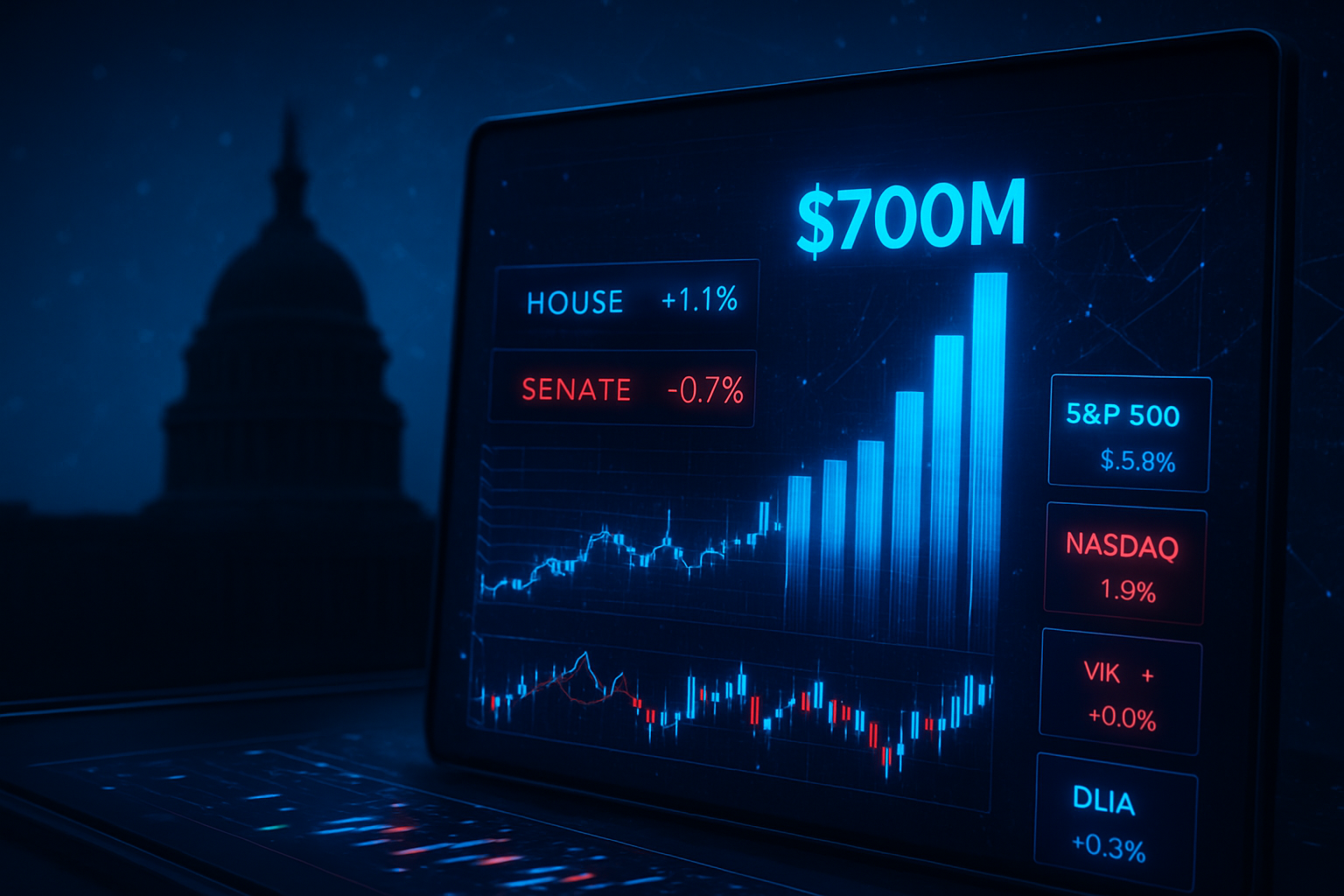
    As the calendar turns to early 2026, the political landscape is already being reshaped not by campaign rallies, but by the rapid-fire clicks of high-stakes traders. Prediction markets have officially entered their "super-cycle," with the 2026 U.S. Midterm elections driving unprecedented liquidity. For the first time in history, daily trading volume across the sector eclipsed the $700 million mark on January 12, signaling that forecasting platforms have moved from the periphery of political discourse to its very epicenter.

    At the heart of this surge is a stark divergence between traditional polling and market sentiment. While early polls suggest a competitive generic ballot, traders on platforms like Kalshi and Polymarket are aggressively pricing in a Democratic takeover of the House of Representatives, with odds hovering near 80%. Simultaneously, Vice President JD Vance has emerged as a paradox: a polarizing figure in public approval ratings, yet the undisputed betting favorite to lead the Republican ticket in 2028.

    The Market: What's Being Predicted

    The primary focus of the early 2026 cycle is the "Balance of Power" contracts, which allow traders to bet on the specific partisan split of the 110th Congress. On Kalshi, the leading regulated exchange in the U.S., the most liquid market currently concerns House control. Democrats are priced at 74–75 cents, implying a roughly 75% chance of retaking the lower chamber. Polymarket, the decentralized heavyweight, shows an even more bullish outlook for the left, with shares trading at 78–79 cents.

    In the Senate, however, the map tells a different story. Despite a national environment that favors Democrats, the 2026 Senate map is structurally difficult for the opposition. Republicans currently hold a 53–47 majority, and prediction markets give them a 66–68% probability of retaining control. The "Split Congress" outcome—a Democratic House and Republican Senate—is currently the "favorite" scenario among institutional traders, priced at 48% on Kalshi.

    Liquidity has reached a tipping point. On January 12, 2026, total daily volume across major platforms hit $701.7 million. Kalshi dominated this record-breaking day, accounting for 66.4% of the volume, largely driven by its "Combos" features which allow users to bet on complex political and economic outcomes simultaneously. This level of liquidity ensures that even "whale" positions of $1 million or more can be absorbed without radical price slippage, attracting a new class of sophisticated market participants.

    Why Traders Are Betting

    The aggressive positioning in favor of a "blue wave" in the House is being driven by what traders call the "Referendum Effect." Historically, the first midterm of a second presidential term is brutal for the incumbent party. However, traders are looking beyond history and focusing on specific policy catalysts. The second Trump administration's aggressive stances on tariffs and immigration, along with a recent tie-breaking vote by Vice President JD Vance to block a war powers resolution regarding Venezuela, have created a volatile political environment that traders believe will provoke a significant voter backlash.

    Furthermore, JD Vance’s standing as the 2028 heir apparent has turned 2026 into a proxy war for his future. On Kalshi, Vance holds a 27–28% chance of being the 2028 Republican nominee—a massive lead over rivals like Marco Rubio (11%). Traders are betting that the 2026 midterms will serve as the ultimate "stress test" for the Vance-led wing of the GOP. If the party loses the House by a wider margin than expected, his 2028 odds are predicted to crater, making these midterm contracts a hedge for 2028 presidential bets.

    The discrepancy between polls and markets is also a major factor in current trading strategies. While Morning Consult shows a modest Democratic lead of +2, markets are pricing in a much more decisive shift. Professional bettors are essentially betting that traditional polling is undercounting "suburban flight" and the impact of recent macroeconomic shifts. This "Knightian risk"—the uncertainty of how a second-term administration's disruptions will manifest at the ballot box—is currently being priced more heavily by markets than by pollsters.

    Broader Context and Implications

    The $700 million daily volume milestone is not just a win for the platforms; it represents a fundamental shift in how the public consumes political intelligence. Institutional players, including hedge funds and data analytics firms, are increasingly using these markets as a real-time sentiment gauge that reacts faster than any 1,000-person phone survey. The rise of these markets has also caught the attention of major financial institutions like Interactive Brokers (NASDAQ: IBKR), which has expanded its forecast market offerings to meet the demand for regulated election trading.

    The real-world implications of these odds are already being felt in Washington. Legislative strategies for the remainder of 2026 are being adjusted based on the high probability of a divided government. If the markets continue to hold at 75% for a Democratic House, we can expect a rush of Republican "legacy" legislation in the first half of the year before the window closes.

    From a regulatory standpoint, the 2026 cycle is the first to operate under a fully clarified legal framework following years of litigation between the CFTC and exchange platforms. This clarity has allowed for the entry of "market makers" who provide the deep liquidity necessary for the $700 million days we are now seeing. The historical accuracy of these markets—which outperformed polls in the 2024 general election—gives these early 2026 numbers a level of perceived authority that is influencing donor behavior and candidate recruitment.

    What to Watch Next

    As we head into the spring of 2026, several "volatility triggers" could shift the current odds. The primary season will be the first major test; if "Vance-aligned" candidates struggle in deep-red districts, expect his 2028 presidential odds to slide and the Democratic House probability to climb even higher. Traders will also be watching the quarterly GDP prints and Federal Reserve decisions closely, as any signs of an economic cooling could cement the "blue wave" narrative.

    Key dates to monitor include the filing deadlines in March and April, which will reveal the quality of the challengers Democrats have recruited for key swing districts. If high-profile "star" candidates jump into races that were previously considered safe Republican seats, the markets will likely react before the first television ad even airs. Additionally, the "Senate Floor" is a critical metric; if Republicans' odds of holding the Senate dip below 60%, it would signal a total collapse of the GOP's defensive map, a scenario not currently priced into the market.

    Bottom Line

    The 2026 midterm cycle is proving that prediction markets are no longer a "niche" interest but a primary pillar of the American political and financial ecosystem. The $700 million daily volume record is a testament to the growing trust in these platforms as accurate aggregators of disparate information. Currently, the "wisdom of the crowd" is betting heavily on a divided government, viewing a Democratic House takeover as a near-certainty while keeping the Senate in Republican hands.

    JD Vance remains the central figure of this drama. As the market's favorite for 2028, his political capital is effectively being "traded" through the 2026 midterm contracts. For observers and participants alike, the message from the markets is clear: the 2026 midterms will not just be a fight for the gavel, but a high-stakes referendum on the future of the Republican party's leadership. As liquidity continues to pour in, these markets will offer the most ruthless and accurate map of the American electorate’s intentions.


    This article is for informational purposes only and does not constitute financial or betting advice. Prediction market participation may be subject to legal restrictions in your jurisdiction.

    PredictStreet focuses on covering the latest developments in prediction markets.
    Visit the PredictStreet website at https://www.predictstreet.ai/.
  • The “Permanent Crisis”: Trump Impeachment Odds Surge to 57% as 2026 Midterm Fever Hits Prediction Markets

    The “Permanent Crisis”: Trump Impeachment Odds Surge to 57% as 2026 Midterm Fever Hits Prediction Markets

    As the United States enters the second year of Donald Trump’s second term, the political landscape has reached a boiling point that prediction markets are now pricing as a coin-flip for a constitutional crisis. On Kalshi, the regulated exchange for event contracts, the probability of President Trump being impeached by the House of Representatives has surged to a record high of 57%. This spike represents a dramatic shift in market sentiment, up from just 22% in early November 2025, signaling that traders believe the current friction between the executive branch and legislative oversight is nearing an inevitable fracture.

    The surge in "Yes" contracts is generating massive interest across the financial sector, as political volatility increasingly dictates market movements. For investors and political analysts alike, the 57% threshold is a psychological and statistical watershed. It suggests that the "permanent crisis" state of the administration—fueled by controversial executive actions and a looming midterm election—is no longer being treated as noise, but as a definitive fundamental driver of the 2026 economic and political outlook.

    The Market: What's Being Predicted

    The specific contract driving this conversation is Kalshi’s "Will Donald Trump be impeached in 2026?" market. Unlike traditional polling, which often lags behind the news cycle, this market provides a real-time gauge of how much capital is willing to back the likelihood of a formal House vote. While the odds of impeachment (the House vote) have climbed to 57%, the "Removal from Office" market remains significantly lower, hovering around 18%. This discrepancy highlights a nuanced view from traders: they expect a partisan House to pull the trigger, but do not yet see the two-thirds Senate majority required for a conviction.

    Trading volume on Kalshi and its decentralized counterpart, Polymarket, has exploded in the first two weeks of January 2026. Combined, these platforms have seen over $12 million in volume specifically related to the president’s tenure and potential exit. On Kalshi, the liquidity is being bolstered by institutional participation as hedge funds use these contracts to hedge against the broader market volatility often triggered by executive instability.

    The resolution criteria for these contracts are strictly legalistic. For a "Yes" payout on the impeachment contract, the U.S. House of Representatives must pass at least one Article of Impeachment before midnight on December 31, 2026. With the 2026 midterms scheduled for November, the timeline is compressed; traders are betting on whether a lame-duck Republican-led House would act under extreme pressure, or if a newly elected Democratic majority would make it their first order of business in a potential "January Surprise."

    Why Traders Are Betting

    The sudden leap to 57% is not the result of a single event, but a rapid-fire succession of "Black Swan" incidents in early January. On January 3, 2026, the administration announced the capture of Venezuelan President Nicolás Maduro by U.S. special forces in Caracas—an action taken without Congressional approval that has sparked an immediate War Powers resolution in the Senate. This was followed closely by the January 7 shooting of an American citizen during an ICE operation in Minneapolis, which triggered nationwide protests and a unified call from House Democrats to introduce "Articles of Tyranny."

    Furthermore, traders are closely watching the "Midterm Calculus." Current prediction markets on Interactive Brokers (Nasdaq: IBKR) and Robinhood (Nasdaq: HOOD) show a 74% probability of Democrats retaking control of the House in November 2026. "The smart money is moving toward a scenario where the House flips and impeachment follows almost instantly," says one high-volume trader on Polymarket. "If the GOP loses the House in November, the lame-duck period becomes a high-risk zone for retaliatory or defensive impeachment filings."

    Another major factor is the residual impact of the "Epstein Files Transparency Act" signed in late 2025. Recent allegations that the Department of Justice, led by Attorney General Pam Bondi, heavily redacted or "disappeared" certain documents have alienated some moderate Republicans. When a few key GOP members of the House Oversight Committee began expressing "openness" to an inquiry last week, the Kalshi odds jumped nearly 15 points in a single 24-hour trading session.

    Broader Context and Implications

    This surge in impeachment odds fits into a larger trend of prediction markets replacing traditional punditry as the primary source of political forecasting. In the 2024 election cycle, platforms like Kalshi and Polymarket were noted for their accuracy relative to polls, and in 2026, they have become even more integrated into the financial ecosystem. The fact that impeachment is trading at 57% tells us that the market views the U.S. government as being in a state of functional paralysis, where executive maneuvers are constantly met with the threat of legislative "nuclear" options.

    The real-world implications are significant. A high probability of impeachment typically leads to a "risk-off" sentiment in the broader equities market. Historically, periods of impeachment inquiry lead to increased volatility in the S&P 500 as investors fret over the delay of fiscal policy and the potential for civil unrest. The 57% figure acts as a "Volatility Index" for the 2026 midterms, suggesting that regardless of the legal outcome, the political process will be fraught with disruption.

    Regulatory oversight of these markets has also matured. The Commodity Futures Trading Commission (CFTC) has kept a close watch on these specific event contracts, ensuring that the surge in odds isn't the result of market manipulation but rather a genuine reflection of public and institutional sentiment. The accuracy of these markets in 2026 will likely determine the future of regulated political betting in the U.S. for decades to come.

    What to Watch Next

    The next major milestone for this market is the expected Supreme Court ruling on the "Reciprocal Tariff Act," slated for the end of January. If the Court strikes down the President's use of national emergency powers to bypass Congress on trade, many analysts expect the impeachment odds to climb toward 65% as the "abuse of power" narrative gains legal teeth. Conversely, a victory for the administration could see the odds retreat toward the 40% range.

    Additionally, the release of the final, unredacted portions of the 2025 Special Counsel reports—demanded by a bipartisan Senate subpoena—could serve as a massive catalyst. Any evidence that corroborates "political weaponization" of the DOJ would likely provide the necessary political cover for moderate House Republicans to join an impeachment inquiry.

    Traders should also monitor the 2026 Midterm "Control of the House" contracts. There is a direct mathematical correlation between the odds of a Democratic House and the odds of Trump’s impeachment. As the primary season kicks off in the spring, any sign of a "Blue Wave" building in the suburbs will almost certainly be front-run by the impeachment markets on Kalshi.

    Bottom Line

    The rise of Donald Trump’s impeachment odds to 57% on Kalshi is a stark indicator of the high-friction environment defining early 2026. It reflects a marketplace that has moved past the shock of the President’s unconventional tactics and is now coldly calculating the legislative consequences. The convergence of international military incidents, domestic civil unrest, and the looming midterm elections has created a volatile cocktail that traders are betting will end in a formal House rebuke.

    Ultimately, these prediction markets serve as more than just a betting platform; they are a sophisticated tool for measuring the stability of the American executive branch. Whether the 57% probability translates into a "Yes" resolution or retreats, the current activity proves that the market's appetite for political risk is at an all-time high. As we move deeper into the 2026 election cycle, the Kalshi ticker may be the most honest barometer we have for the health of the U.S. political system.


    This article is for informational purposes only and does not constitute financial or betting advice. Prediction market participation may be subject to legal restrictions in your jurisdiction.

    PredictStreet focuses on covering the latest developments in prediction markets.
    Visit the PredictStreet website at https://www.predictstreet.ai/.