
Tag: 2026

  • The Great Prediction War: Polymarket and Kalshi Battle for the Soul of Information Finance

    The Great Prediction War: Polymarket and Kalshi Battle for the Soul of Information Finance

    The prediction market landscape has officially entered its most volatile and high-stakes era yet. Following a staggering 2025 that saw over $40 billion in total trading volume, the industry is now locked in what analysts are calling the "Great Prediction War." This isn't just a race for market share; it is a fundamental clash between two visions of the future: the decentralized, crypto-native "truth engine" of Polymarket and the regulated, Wall Street-compliant exchange model of Kalshi.

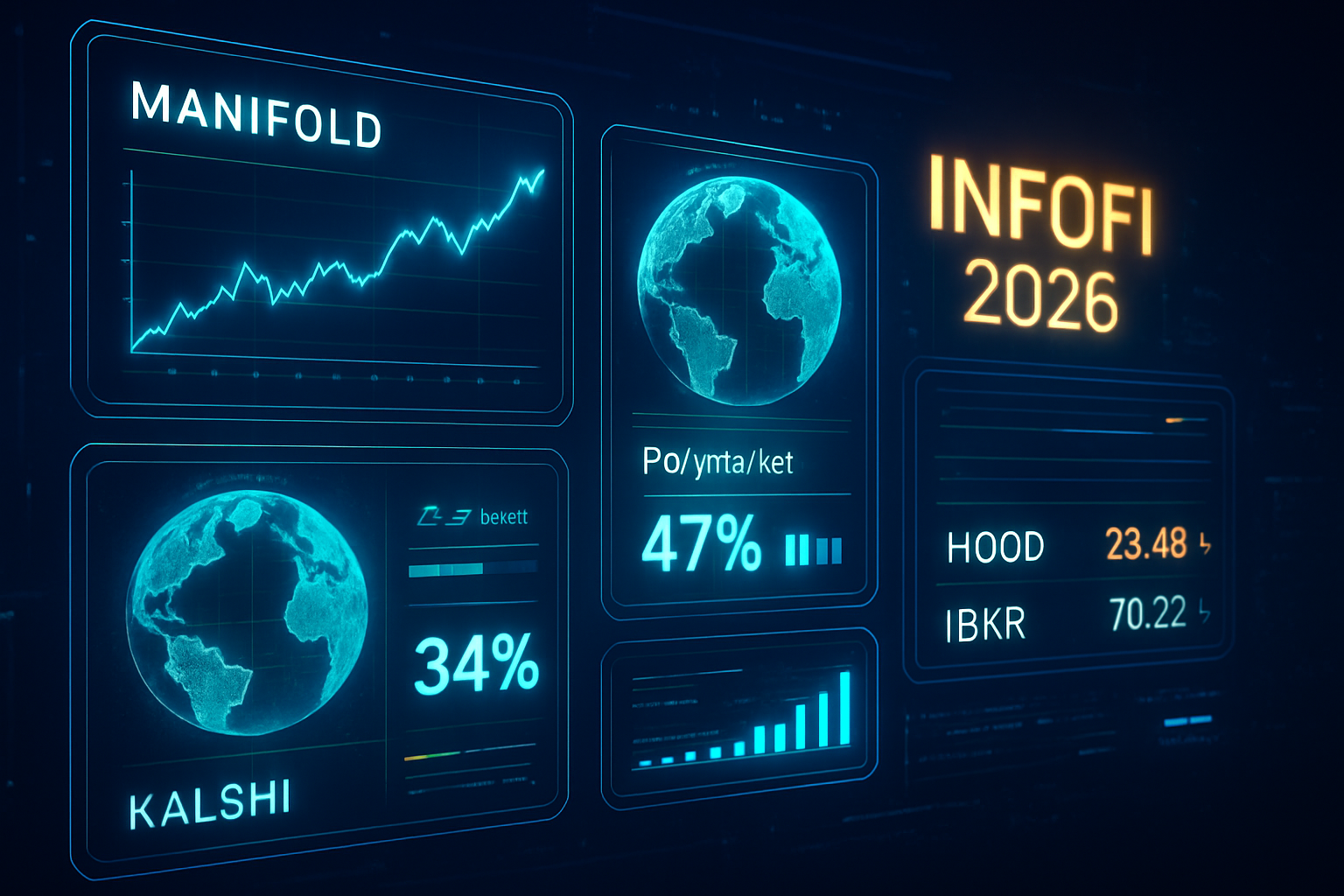
    As of February 1, 2026, the "meta-market" on Manifold Markets—where traders bet on the success of other platforms—paints a picture of a tightening race. Polymarket currently leads the odds at 47% to be the top platform by volume in 2026, while Kalshi holds a strong 34% share. The stakes have never been higher, as these platforms compete to fulfill the promise of "Information Finance," a concept where markets aren't just for gambling, but serve as the definitive source of truth for a world drowning in misinformation.

    The Market: What's Being Predicted

    The primary metric of success in the Great Prediction War is notional trading volume, and the numbers are staggering. In 2025, the industry hit a record-breaking $40 billion in volume, a nearly 400% increase from the previous year. This growth was fueled by a perfect storm of global events, ranging from hyper-local sports betting to high-stakes geopolitical conflicts. On Manifold Markets, the "Top Prediction Market by Volume in 2026" contract has become one of the most liquid markets on the site, serving as a real-time scoreboard for the industry's civil war.

    Polymarket’s 47% favorite status is largely driven by its dominance in "high-signal" events. During 2025, the platform processed over $33 billion in trades, much of it concentrated in areas where traditional media often lags: Federal Reserve policy shifts, the nuances of the Russia-Ukraine conflict, and major cultural milestones. Traders favor its decentralized infrastructure, which allows for rapid market creation and a global user base that brings diverse, often "insider" perspectives to the pricing.

    Kalshi, meanwhile, is the heavy-hitting incumbent of the regulated space. While it trails Polymarket in the Manifold odds at 34%, its 2025 performance was technically superior in raw notional volume, clocking in at $43.1 billion. However, much of this volume was derived from high-frequency sports contracts—a sector currently under fire from state regulators. The market is currently pricing in the risk that Kalshi’s legal battles over sports betting might stunt its growth, allowing Polymarket’s broader, global event catalog to take the lead in 2026.

    Why Traders Are Betting

    The divergence in odds between Polymarket and Kalshi reflects a deeper debate over the utility of "insider" information. A recent flashpoint occurred during the so-called "Maduro Trade," where a Polymarket user reportedly netted $400,000 by betting on the capture of Nicolás Maduro just hours before the news was officially broken by international wires. This incident has reinforced the belief among "Information Finance" advocates that decentralized markets are superior "truth engines" precisely because they incentivize those with privileged information to reveal it through their trades.

    Conversely, the "regulated" camp argues that long-term institutional adoption requires the safeguards that only a platform like Kalshi can provide. Goldman Sachs (NYSE: GS) CEO David Solomon recently noted that institutional clients are looking for "event-contract derivatives" that are cleared through regulated exchanges to hedge against macro risks. For these players, the transparency and compliance of Kalshi are more valuable than the raw speed of a crypto-native platform.

    Furthermore, the integration of prediction markets into mainstream retail apps has changed the game. Robinhood (Nasdaq: HOOD) and Interactive Brokers (Nasdaq: IBKR) have both moved to offer event contracts directly to their millions of users. This influx of retail "dumb money" has created massive liquidity, allowing professional traders to execute sophisticated arbitrage strategies between the decentralized prices on Polymarket and the regulated prices on Kalshi or ForecastEx.

    Broader Context and Implications

    The "Great Prediction War" is occurring against a backdrop of intense regulatory scrutiny. In January 2026, a Massachusetts judge issued a preliminary injunction against Kalshi, halting its sports-related contracts on the grounds that they constitute unlicensed gambling. This ruling has sent ripples through the industry, raising questions about whether the "regulated" path is actually more perilous than the decentralized one. Meanwhile, in Washington, U.S. Representative Ritchie Torres has introduced the "Public Integrity in Financial Prediction Markets Act of 2026," aimed at preventing government officials from trading on policy-related markets.

    These developments highlight the central tension of Information Finance: how to maintain the accuracy of the market without allowing it to become a "cesspool of insider trading," as some critics claim. The industry's massive 2025 volume proved that there is an insatiable appetite for these markets, but the legal framework is still struggling to catch up. The outcome of the Polymarket vs. Kalshi rivalry will likely dictate the regulatory template for the next decade.

    The validation of these markets is also coming from the highest levels of traditional finance. Intercontinental Exchange (NYSE: ICE), the parent company of the New York Stock Exchange, recently took a strategic stake in the sector, signaling that prediction markets are no longer a niche curiosity but a legitimate asset class. As these markets become more integrated with the global financial system, their ability to "predict" the future will increasingly be used by corporations to guide multi-billion dollar investment decisions.

    What to Watch Next

    The next six months will be a decisive period in the Great Prediction War. The most significant upcoming milestone is the full U.S. rollout of "Polymarket US." Following its 2025 acquisition of the CFTC-licensed exchange QCEX, Polymarket is preparing to launch a hybrid model that combines its popular interface with a fully compliant U.S. clearinghouse. If successful, this could neutralize Kalshi’s primary advantage and send Polymarket’s Manifold odds soaring past 60%.

    Simultaneously, the market is watching the moves of Robinhood (Nasdaq: HOOD). The platform recently announced a joint venture with Susquehanna International Group (SIG) to build its own in-house exchange for event contracts. If Robinhood decides to bypass both Kalshi and Polymarket to keep its users within its own ecosystem, it could disrupt the current duopoly and create a third front in the prediction war.

    Finally, keep a close eye on the "Torres Bill" in Congress. If the legislation passes with strict anti-insider trading provisions, it could paradoxically hurt the "accuracy" of the markets by removing the very people—government insiders—who have the most signal to provide. The debate over whether a market should be "fair" or "accurate" will be the defining philosophical struggle of 2026.

    Bottom Line

    The Great Prediction War of 2026 is more than a competition for trading fees; it is a battle to define how humanity aggregates truth in the digital age. Polymarket’s current lead in the Manifold meta-market suggests that traders value the platform's global reach and "pure" information signal, despite the regulatory clouds hanging over the crypto space. However, Kalshi’s 34% probability remains a formidable threat, backed by the weight of Wall Street and a "compliance-first" philosophy that may ultimately win over the world’s largest institutional hedgers.

    As we move deeper into 2026, the $40 billion volume of the previous year will likely be eclipsed as Information Finance becomes a standard feature of every retail brokerage account and corporate treasury. Whether the winner is a decentralized protocol or a regulated exchange, the real victor is the concept of the prediction market itself. We are moving toward a world where the "market price" of an event is seen as more reliable than a news headline or a political poll.

    For participants, the message is clear: the volatility in these platforms' odds reflects the volatility of our times. The Great Prediction War is just beginning, and the prize is nothing less than the authority to tell the world what will happen next.


    This article is for informational purposes only and does not constitute financial or betting advice. Prediction market participation may be subject to legal restrictions in your jurisdiction.

    PredictStreet focuses on covering the latest developments in prediction markets. Visit the PredictStreet website at https://www.predictstreet.ai/.

  • The New Financial Oracle: How Algorithmic Bots Turned Prediction Markets into the World’s Fastest Data Feed

    The New Financial Oracle: How Algorithmic Bots Turned Prediction Markets into the World’s Fastest Data Feed

    As we enter the first quarter of 2026, a fundamental shift is occurring in the architecture of global finance. For decades, institutional trading desks relied on the "terminal" model—terminal data from legacy providers, consensus surveys, and government reports—to price risk. Today, that hierarchy has been inverted. Algorithmic trading bots are no longer just participants in prediction markets; they are using platforms like Kalshi and Polymarket as their primary, high-fidelity data feeds to trade trillions of dollars in the legacy stock and bond markets.

    The current landscape is defined by a "prediction-first" reality. With the March 2026 Federal Open Market Committee (FOMC) meeting fast approaching, the probability shifts on decentralized and regulated prediction exchanges are moving markets minutes—sometimes hours—before traditional headlines hit the tape. As of January 30, 2026, the discrepancy between "skin-in-the-game" prediction data and traditional forecasting has become the most profitable spread for high-frequency trading (HFT) firms globally.

    The Market: What's Being Predicted

    At the center of this technological revolution is the March 2026 FOMC meeting, scheduled for March 17–18. Traders are currently wrestling with a volatile economic outlook that has split the consensus. On Kalshi, the regulated exchange that recently saw its volume surge following a successful regulatory expansion, the "March Fed Rate" contracts are seeing record liquidity. Simultaneously, Polymarket has become the de facto venue for international and crypto-native liquidity, offering a decentralized counter-narrative to domestic expectations.

    As of today, January 30, Kalshi's markets reflect a 62% probability of a 25-basis-point cut, while Polymarket—driven by a broader global user base—is pricing that same outcome at a more aggressive 71%. This 9% spread is a playground for algorithmic bots. Total trading volume across these interest-rate markets has surpassed $120 billion this cycle, a staggering figure that rivals the liquidity of some mid-cap equity sectors.

    The resolution criteria are razor-sharp: the markets settle based on the official target range announced by the Federal Reserve at the conclusion of their March meeting. However, the secondary market for these "Yes/No" contracts has become so liquid that the Intercontinental Exchange (NYSE: ICE) and CME Group (NASDAQ: CME) are now reportedly exploring direct API hooks to these prediction venues to stabilize their own interest-rate futures volatility.

    Why Traders Are Betting

    The primary driver of this activity is "Information Arbitrage." In 2026, bots are programmed to treat a price move on a prediction market as a "truth event." When a major "whale" on Polymarket moves the needle on the March FOMC cut probability, bots instantly execute corresponding trades on the 10-year Treasury note or the S&P 500. This has created a feedback loop where prediction markets act as the leading indicator, and the broader market follows.

    Recent volatility has been fueled by a series of "hot" labor reports that contradicted earlier dovish sentiment. While traditional analysts at firms like Goldman Sachs (NYSE: GS) or JPMorgan Chase & Co. (NYSE: JPM) may take hours to release a revised research note, a prediction market reacts in milliseconds. Bots can detect the immediate capital flow from insiders or sophisticated macro traders who are "betting their conviction" rather than just providing an opinion to a journalist.

    Notable large positions, or "whales," have also been spotted using "synthetic straddles." A trader might buy "No" on a rate cut on Kalshi while simultaneously going long on interest-rate futures at CME Group. This allows them to hedge their regulatory and platform risk while betting on the underlying economic reality. This convergence of sophisticated hedging strategies has propelled prediction markets from the fringes of "DeFi" into the core of the institutional "Information Finance" stack.

    Broader Context and Implications

    This trend signals a broader shift in how society prices the future. We are moving away from the "Expert Era," where we trusted a panel of economists, toward the "Incentive Era," where we trust the aggregate wisdom of people with money on the line. The historical accuracy of these markets over the past two years has been remarkable; in the 2024 elections and the 2025 energy crisis, prediction markets outperformed traditional polling and expert models by an average of 14% in terms of lead time and accuracy.

    The regulatory environment has also matured significantly. The legal victories won by Kalshi against the CFTC in previous years have paved the way for institutional giants like Interactive Brokers Group, Inc. (NASDAQ: IBKR) to offer prediction market access directly to their retail and professional clients. This has brought "normie" capital into the mix, providing the exit liquidity that algorithmic bots require to operate at scale.

    Furthermore, the rise of "Oracle Integration" means that smart contracts on various blockchains are now using these market results to auto-execute insurance payouts, supply chain orders, and even corporate governance decisions. If a prediction market says a strike is 90% likely, a bot-controlled logistics firm might automatically reroute shipments before the strike even begins.

    What to Watch Next

    The next 45 days will be a stress test for this new financial architecture. Between now and the March 18 FOMC decision, several key data releases—including the February Non-Farm Payrolls and CPI reports—will act as "volatility triggers." Watch for how quickly the prediction market price moves relative to the data release time. In late 2025, we saw "pre-emptive spikes" where prediction markets began moving 30 seconds before the official Bureau of Labor Statistics website updated, suggesting that bots are now successfully scraping or predicting government data releases with terrifying efficiency.

    Another key milestone is the expected launch of "Event-Based ETFs." Rumors are circulating that several major asset managers are filing with the SEC to create funds that track the "aggregate probability" of various macro events. If approved, this would provide a massive influx of passive capital into these markets, further narrowing the spreads and increasing the gravity prediction markets hold over the traditional NYSE and NASDAQ exchanges.

    Bottom Line

    The integration of algorithmic trading bots with prediction market data feeds represents the "Final Frontier" of market efficiency. By turning future events into tradable assets with real-time price discovery, we have created a global "sensing layer" for the economy. The March 2026 FOMC meeting is no longer just a date on a calendar; it is a live, fluctuating number that dictates the movement of billions of dollars in real-time.

    For the average investor, this means the "consensus" is now visible in a way it never was before. However, it also means that the window to act on new information is shrinking. As bots continue to dominate these feeds, the "human" element of trading is being pushed further out the risk curve. Ultimately, prediction markets are proving that the most accurate way to forecast the future is not to ask what people think will happen, but to see what they are willing to bet on.


    This article is for informational purposes only and does not constitute financial or betting advice. Prediction market participation may be subject to legal restrictions in your jurisdiction.

    PredictStreet focuses on covering the latest developments in prediction markets.
    Visit the PredictStreet website at https://www.predictstreet.ai/.
  • The Death of Guessing: How Prediction Markets Became Wall Street’s New Favorite Asset Class in 2026

    The Death of Guessing: How Prediction Markets Became Wall Street’s New Favorite Asset Class in 2026

    As of January 30, 2026, the financial landscape has undergone a tectonic shift. What were once dismissed as "speculative casinos" for crypto enthusiasts and political junkies have matured into the world’s most efficient "truth machines." Prediction markets, led by platforms like Polymarket and Kalshi, are no longer just places to bet on who will win an Oscar or a football game; they have become a foundational layer of the global financial infrastructure, institutionalized as a legitimate "Information Asset Class."

    Currently, the collective "Event Contract" market is pricing the probability of a U.S. government shutdown by the January 31 deadline at a staggering 68%, while the odds of a March interest rate cut by the Federal Reserve have plummeted from 45% to 12% in just the last week. This rapid movement isn't driven by retail hysteria, but by sophisticated institutional hedging. In 2026, when the market moves, it isn’t just noise—it’s the sound of the world’s most informed participants putting their capital behind what they know to be true.

    The Market: What's Being Predicted

    The scale of prediction markets in 2026 is unprecedented. Kalshi, a platform regulated by the Commodity Futures Trading Commission (CFTC), reported a staggering $23.8 billion in total volume for 2025, an 1,100% increase over the previous year. Just two weeks ago, on January 14, 2026, the platform hit a record single-day volume of $465.9 million. Meanwhile, Polymarket has successfully re-entered the U.S. market after its strategic acquisition of the licensed exchange QCX, pushing its combined cumulative volume with Kalshi toward the $50 billion mark.

    These platforms are no longer dominated by small-time bettors. The average trade size has ballooned to $4,800, a clear indicator that high-net-worth individuals and algorithmic funds have taken the wheel. The most liquid markets currently focus on macro-economic indicators and geopolitical stability. For instance, the "March 2026 Fed Rate Decision" market on Kalshi has already seen over $120 million in volume, providing a 24/7 real-time probability signal that is often more reactive and accurate than the traditional FedWatch Tool provided by CME Group (NASDAQ:CME).

    Resolution criteria have also become more robust. Markets now utilize a combination of official government data, decentralized oracles, and "trusted witness" protocols to ensure that payouts are indisputable. This maturity has allowed for more complex contracts, such as those predicting the specific percentage of the Consumer Price Index (CPI) or the outcome of specific legislative votes in the 2026 midterms.

    Why Traders Are Betting

    The transition from "gambling" to "Information Finance" has been accelerated by the entry of traditional financial heavyweights. In a landmark move last year, Intercontinental Exchange (NYSE:ICE), the parent company of the New York Stock Exchange, led a $2 billion strategic investment in Polymarket. This wasn't a speculative play; it was a move to own the pipeline of "event-driven data" that is now integrated into every professional trading desk.

    Institutional traders are using these markets for "pure-play hedging." For example, federal contractors and municipal bond holders are currently using Kalshi’s "Government Shutdown" contracts to hedge against the January 31 funding deadline. If the government shuts down, their traditional portfolios may take a hit, but their "Yes" contracts pay out, offsetting the loss. This is a far more precise instrument than buying gold or defensive stocks, which are often subject to unrelated market volatility.

    Perhaps the most dramatic example of this "predictive edge" occurred earlier this month during the "Maduro Trade." On Polymarket, odds for a sudden shift in Venezuelan political stability spiked to 98% hours before the U.S. military announced "Operation Absolute Resolve." This suggests that participants with on-the-ground intelligence are using these markets to monetize their information, effectively turning "insider knowledge" into a public, tradable price signal.

    Broader Context and Implications

    The "Information as an Asset Class" movement marks the definitive end of the polling era. After prediction markets correctly identified the 2024 U.S. Presidential victory in key swing states weeks before traditional pollsters, the public lost faith in the "margin of error." In 2025, this was solidified during the Canadian Federal Election, where markets priced a Liberal minority at 65% while poll-based models were still stuck at an 85% probability of a majority. The markets were right.

    Regulatory clarity has been the final piece of the puzzle. Following Kalshi's landmark legal victory in late 2024, which ruled that political event contracts are not "gambling" under federal law, the CFTC has pivoted. In early January 2026, CFTC Chairman Michael Selig announced a new formal rulebook to support "lawful innovation" in event contracts, effectively ending the era of regulatory uncertainty that previously hampered the industry.

    Furthermore, these markets are now integrated into the standard financial stack. Alphabet Inc. (NASDAQ:GOOGL) now features real-time probability charts from Kalshi and Polymarket directly in Google Finance and Search results. If you search for "recession probability," you are no longer met with op-eds, but with a live, tradable percentage. This has democratized access to institutional-grade sentiment analysis, making it available to any retail investor with a smartphone.

    What to Watch Next

    As we move toward the 2026 U.S. midterm elections, the volume in political event contracts is expected to shatter all previous records. Market analysts are watching for "lead-lag" relationships, where movements in the prediction markets precede shifts in the S&P 500 or the bond market.

    Key dates to monitor include:

    • January 31, 2026: The deadline for the U.S. government funding bill. The market is currently signaling high tension.
    • March 18, 2026: The next Federal Open Market Committee (FOMC) meeting. Prediction markets are currently pricing a "hawkish hold," contrary to some traditional bank analysts.
    • May 2026: The launch of "Climate Event Contracts" on Kalshi, which will allow insurance companies to hedge against specific hurricane and wildfire milestones using binary outcomes.

    Bottom Line

    The narrative has changed. In 2024, people asked if prediction markets were "legal" or "moral." In 2026, the only question being asked is, "What is the market saying?" The shift to "Information Finance" has turned every global event into a tradable asset, creating a world where information is not just power—it is liquidity.

    For the first time in history, we have a real-time, global dashboard of human expectations. Whether it is a corporate merger, a geopolitical conflict, or a central bank decision, prediction markets are providing a level of clarity that traditional media and polling have failed to deliver. As institutional capital continues to pour into these "truth machines," the line between "betting" and "investing" will continue to blur until it disappears entirely.


    This article is for informational purposes only and does not constitute financial or betting advice. Prediction market participation may be subject to legal restrictions in your jurisdiction.

    PredictStreet focuses on covering the latest developments in prediction markets.
    Visit the PredictStreet website at https://www.predictstreet.ai/.

  • The Meta-Forecast: Betting on the Future of Information Finance in 2026

    The Meta-Forecast: Betting on the Future of Information Finance in 2026

    As of January 27, 2026, the prediction market industry is no longer a fringe hobby for statistics nerds or a seasonal interest for election cycles; it has evolved into a multi-billion dollar pillar of the global financial system known as "InfoFi" (Information Finance). On Manifold Markets, the industry's self-appointed "meta-layer," traders are currently obsessed with a high-stakes question: who will win the "Great Prediction War" of 2026?

    With total industry volume reaching a staggering $13 billion per month in late 2025, meta-markets on Manifold are currently pricing a 47% probability that Polymarket will maintain its crown as the volume leader through the end of the year. However, the regulated giants are closing in. Interest in these meta-markets has skyrocketed as institutional liquidity from firms like Susquehanna International Group and Jane Street begins to treat event contracts not as "bets," but as sophisticated hedging tools for geopolitical and macroeconomic risk.

    The Market: What's Being Predicted

    The primary battleground for industry observers is the Manifold market titled "Top 1 Prediction Market by Volume in 2026." This contract tracks the total notional volume across the major players: Polymarket, Kalshi, and the rapidly ascending ForecastEx, owned by Interactive Brokers (NASDAQ: IBKR).

    As of today, the odds stand at:

    • Polymarket (47%): The crypto-native giant continues to lead, fueled by its role as the global "truth engine" for international events.
    • Kalshi (34%): Despite facilitating over $43 billion in trades in 2025, Kalshi’s odds have softened following a recent regulatory speed bump in Massachusetts regarding sports contracts.
    • ForecastEx (12%): A dark horse that recently surpassed $1 billion in cumulative notional volume, drawing in traditional finance (TradFi) users through the existing IBKR ecosystem.
    • Robinhood (7%): Following its high-profile joint venture with Susquehanna, Robinhood (NASDAQ: HOOD) has become the fastest-growing retail entrant, though its 2026 volume is still playing catch-up.

    Trading on these markets is characterized by high liquidity and a unique "insider" feel, as many participants are employees of these very platforms or professional market makers who provide the liquidity for the industry.

    Why Traders Are Betting

    The volatility in these meta-markets is being driven by three primary factors: regulatory arbitrage, the "InfoFi" narrative, and institutional product integration. Traders are currently reacting to a January 2026 preliminary injunction in Massachusetts that temporary banned "event contracts related to sports" on regulated exchanges. Since nearly 90% of Kalshi's record-breaking 2025 volume was derived from sports-adjacent markets, the "No" side of their dominance contract saw a massive 15% spike in volume this week.

    Meanwhile, the concept of Information Finance (InfoFi)—the idea that prediction markets are the most efficient way to price the probability of truth—is moving from theory to reality. Projects like Intuition, which launched its mainnet in late 2025, have convinced Manifold traders that the industry's growth is "non-linear." There is currently a 53% probability on Manifold that a major bank CEO, such as Jamie Dimon of JPMorgan Chase & Co. (NYSE: JPM), will publicly endorse prediction markets as a legitimate asset class before the end of Q3 2026.

    Finally, the entry of Coinbase (NASDAQ: COIN) into the space via its acquisition of The Clearing Company has signaled to traders that the infrastructure for a $10 trillion annual volume rate—the "bull case" for 2026—is finally being built.

    Broader Context and Implications

    This meta-forecasting trend reveals a fundamental shift in how the public views information. In 2024, prediction markets were used to "fact-check" polls; in 2026, they are being used to price the very future of the platforms themselves. This represents the ultimate "skin in the game" for an industry built on the premise that financial incentives lead to better forecasting.

    The regulatory implications are particularly significant. A dominant market on Manifold currently gives an 81% chance that federal preemption will eventually protect Designated Contract Markets (DCMs) from varying state-level bans. If this "Yes" outcome triggers, it would effectively create a unified national market for event contracts in the U.S., similar to the equity markets.

    Historically, Manifold's meta-markets have been eerily accurate. In late 2024, Manifold traders correctly predicted the exact quarter that Kalshi would achieve its first $1 billion month, months before it happened. The current betting activity suggests that 2026 will be the year where regulated (Kalshi, IBKR) and decentralized (Polymarket) volumes finally begin to converge as the legal "grey areas" evaporate.

    What to Watch Next

    The most immediate catalyst for these markets is the resolution of the "Public Integrity in Financial Prediction Markets Act" (H.R. 7004), currently making its way through Congress. If passed, it would formalize the rules around insider trading on event contracts—a move that sounds restrictive but is actually viewed as "bullish" by traders because it provides the legal framework necessary for pension funds and insurance companies to enter the market.

    Key dates to monitor include:

    • February 15, 2026: The deadline for the CFTC to respond to the Massachusetts injunction, which will likely decide Kalshi’s volume trajectory for the first half of the year.
    • Q2 2026 Earnings: Watch for Robinhood (NASDAQ: HOOD) to report its first full quarter of "Event Derivatives" revenue, which many expect will surprise to the upside.

    Traders should also keep an eye on the "Social-to-Market" pipeline. There is an active market on whether a major social media platform like X (formerly Twitter) or Reddit will integrate native prediction market widgets, a move that would likely push the "InfoFi" adoption probability toward 90%.

    Bottom Line

    The meta-markets on Manifold suggest that the prediction market industry is entering its "scaling phase." While Polymarket remains the volume king due to its global reach and crypto integration, the institutional weight behind ForecastEx and the retail power of Robinhood make the 2026 volume lead a closer race than most realize.

    The rise of InfoFi represents a paradigm shift where information is no longer just consumed—it is priced, traded, and verified through financial incentives. Whether the industry hits the predicted $10 trillion annual volume target by the end of 2026 remains to be seen, but the "smart money" on Manifold is betting that the search for truth has finally found its business model.

    In 2026, we aren't just predicting the news; we are betting on the machines that predict the news.


    This article is for informational purposes only and does not constitute financial or betting advice. Prediction market participation may be subject to legal restrictions in your jurisdiction.

    PredictStreet focuses on covering the latest developments in prediction markets.
    Visit the PredictStreet website at https://www.predictstreet.ai/.
  • The Great Prediction War of 2026: Polymarket and Kalshi Battle for Dominance

    The Great Prediction War of 2026: Polymarket and Kalshi Battle for Dominance

    As of January 26, 2026, the landscape of global finance is being reshaped not by interest rate swaps or traditional equities, but by the "Great Prediction War." On the popular meta-forecasting platform Manifold Markets, a high-stakes contract titled "Top 1 Prediction Market by Volume in 2026" has become the industry's most-watched barometer. Currently, Polymarket holds a 47% chance of leading the year in trading volume, while its chief rival, Kalshi, sits at 34%.

    This market is generating unprecedented interest because it represents more than a corporate rivalry; it is a battle for the soul of "Information Finance." In the last few weeks, the odds have fluctuated wildly following a series of regulatory rulings and massive institutional investments. While Kalshi dominated 2025 in raw notional volume, a recent crackdown on sports-related contracts has shifted momentum toward Polymarket, which is currently preparing for a landmark return to the United States market.

    The Market: What's Being Predicted

    The Manifold Markets meta-contract focuses on which platform will facilitate the highest total trading volume (measured in USD equivalent) for the 2026 calendar year. For resolution purposes, the contract strictly excludes "pure sports betting" to distinguish prediction markets from traditional gambling operations. This distinction is critical: in 2025, Kalshi cleared a staggering $43.1 billion in notional volume, but nearly 90% of that was derived from sports event contracts. Polymarket, meanwhile, recorded $33.4 billion, almost entirely through geopolitical, macroeconomic, and cultural markets.

    Currently, the odds reflect a "mindshare" premium for Polymarket at 47%. Traders are betting that as the 2026 U.S. midterm elections approach, the demand for non-sports "truth pricing" will outpace the retail sports volume that Kalshi has historically relied upon. Liquidity in this meta-market has surged, with over $5 million in play on Manifold alone, as whales from both the crypto and traditional finance sectors hedge their bets on the future of the industry.

    Why Traders Are Betting

    The 13-point lead held by Polymarket is largely driven by its recent institutional pivot. In October 2025, the platform secured a $2 billion strategic investment from the Intercontinental Exchange (NYSE: ICE), the parent company of the New York Stock Exchange. This partnership signaled that prediction markets are no longer "fringe" crypto projects but are being integrated into the plumbing of global markets.

    Conversely, Kalshi—which is heavily integrated with Robinhood Markets, Inc. (NASDAQ: HOOD)—has hit a regulatory speed bump. On January 20, 2026, a Massachusetts judge issued a preliminary injunction requiring Kalshi to cease offering sports-related contracts in the state. This legal friction has caused a 10% drop in Kalshi's 2026 volume odds, as traders fear more states may follow suit, strangling the platform’s primary volume driver.

    Furthermore, the "Maduro Trade" in early January—where a whistleblower allegedly profited $400,000 on a contract regarding the capture of Nicolás Maduro just hours before the news broke—has reinforced Polymarket's reputation as a "truth engine" that can price in information faster than any traditional news wire or intelligence agency.

    Broader Context and Implications

    The "Great Prediction War" coincides with the rise of "Information as an Asset Class." In 2026, information is no longer just something you consume; it is something you trade. Major market makers like Susquehanna International Group and DRW have officially entered the space, treating event contracts as legitimate financial derivatives used to hedge against "black swan" events.

    This shift has moved prediction markets away from the "speculative casino" label that plagued them in 2024. Today, corporations use these markets to hedge against specific geopolitical risks, such as semiconductor trade deals or the "Greenland Acquisition" negotiations. The historical accuracy of these markets during the 2024 election cycle has given them a "gold standard" status, often leading mainstream media polls by 48 to 72 hours in identifying shifts in public sentiment.

    What to Watch Next

    The next major catalyst for this market is Polymarket's anticipated re-entry into the U.S. market. Currently, there is a 90% priced-in probability that the CFTC will grant Polymarket full operational status in the U.S. by Q2 2026. If this occurs, a massive influx of domestic liquidity could solidify Polymarket’s lead over Kalshi.

    Investors should also keep a close eye on the 2026 midterm election cycles. If the volume for political "control of the house" markets exceeds the volume for the 2026 World Cup, Polymarket is almost certain to win the volume war. However, if Kalshi can successfully pivot its Robinhood user base toward macroeconomic contracts—such as CPI or Fed rate hike predictions—the 34% underdog could see a rapid resurgence.

    Bottom Line

    The battle between Polymarket and Kalshi is the defining economic conflict of 2026. While Kalshi has the advantage of existing U.S. infrastructure and a massive retail partnership with Robinhood, Polymarket’s backing by the NYSE’s parent company and its dominance in "truth-based" geopolitical markets give it the current edge.

    Ultimately, the "Great Prediction War" tells us that the world has entered the era of Information Finance. Whether the winner is the platform that masters sports and retail or the one that dominates geopolitical intelligence, the real victor is the market itself. Prediction markets are no longer just tools for bettors; they are the most accurate sensors we have for a volatile, fast-moving world.


    This article is for informational purposes only and does not constitute financial or betting advice. Prediction market participation may be subject to legal restrictions in your jurisdiction.

    PredictStreet focuses on covering the latest developments in prediction markets.
    Visit the PredictStreet website at https://www.predictstreet.ai/.

  • Betting Against the Brink: Why Prediction Markets See Only an 11% Chance of a January Shutdown

    Betting Against the Brink: Why Prediction Markets See Only an 11% Chance of a January Shutdown

    As the January 31 deadline for federal funding rapidly approaches, the high-stakes political drama usually associated with Capitol Hill budget battles appears to be fizzling out—at least according to the collective intelligence of the world’s most active traders. On the leading decentralized prediction platform Polymarket, the probability of a U.S. government shutdown has plummeted to just 11%, a stark contrast to the coin-flip odds seen just months ago.

    This low-probability signal comes despite the looming expiration of several funding measures, suggesting that the "shutdown fatigue" following 2025’s record-breaking 43-day funding lapse has fundamentally altered the legislative landscape. With over $3 million in trading volume on this specific outcome, the market isn't just guessing; it is pricing in a high degree of confidence that a deal is already effectively done.

    The Market: What's Being Predicted

    The primary theater for this financial forecasting is Polymarket, where the contract "Will there be another US government shutdown by January 31?" has become a focal point for political speculators. Currently, the "Yes" shares are trading at approximately 11 cents, implying an 11% chance of a funding lapse. This represents a significant collapse in odds from late December, when the same contract touched 45% amid fears of a renewed partisan deadlock.

    Parallel activity is occurring on the U.S.-regulated exchange Kalshi, which has seen even higher engagement levels. Kalshi’s shutdown market has recorded over 1.66 million transactions, with a massive liquidity pool of more than 28 million contracts. While Kalshi’s implied probability sat slightly higher at 24% earlier in the month, live order book activity has rapidly converged with Polymarket’s sub-15% levels as news of legislative progress reached the floor.

    The resolution criteria for these markets are strict: a shutdown is typically defined as a lapse in appropriations that results in the issuance of "furlough notices" to federal employees. With the clock ticking toward midnight on January 30, the narrow window for failure is what's driving the current 11% floor, as any minor procedural hiccup in the Senate could still theoretically trigger a weekend lapse.

    Why Traders Are Betting

    The overwhelming sentiment for a "No" resolution is rooted in the unique political composition of early 2026. Following the 2024 elections, Republicans maintain control of the White House, the House of Representatives, and the Senate. This unified government has streamlined the appropriations process, moving away from the chaotic "continuing resolution" (CR) cycles of the previous year.

    Traders are specifically reacting to the passage of two massive funding bills. On January 22, the House passed H.R. 7148, the Consolidated Appropriations Act of 2026, with a bipartisan 341–88 vote. This followed the enactment of the "One Big Beautiful Bill" (OBBB) Act late last year, which pre-funded nearly 90% of federal operations. Markets are also closely monitoring the influence of the Department of Government Efficiency (DOGE), whose cost-cutting recommendations have provided fiscal hawks with enough "wins" to support the broader spending packages without resorting to shutdown tactics.

    Furthermore, the memory of the 43-day shutdown in late 2025—the longest in American history—acts as a powerful deterrent. That event caused significant volatility for major defense contractors like Lockheed Martin (NYSE: LMT) and Northrop Grumman (NYSE: NOC), and traders believe leadership is desperate to avoid a repeat that could spook the broader markets or the SPDR S&P 500 ETF Trust (NYSE Arca: SPY).

    Broader Context and Implications

    The divergence between traditional media narratives and prediction markets has never been clearer. While some cable news outlets continue to highlight the "looming deadline" and "partisan friction," prediction markets have been steadily pricing in a resolution for over two weeks. This suggests that these platforms are increasingly serving as a "truth machine," filtering out political posturing to focus on the mechanical realities of bill drafting and vote counts.

    Real-world implications of these odds are significant. A low shutdown probability allows federal agencies and private sector partners to maintain normal operations without the costly preparation for a work stoppage. Historically, prediction markets have been remarkably accurate in forecasting budget resolutions, often moving ahead of official announcements from leadership.

    From a regulatory perspective, the high volume on these markets—now totaling millions across platforms—underscores the growing appetite for "event hedging." For institutional investors, these markets are no longer just a curiosity; they are a vital tool for managing the political risk associated with government contracts and Treasury yields.

    What to Watch Next

    The final hurdle remains the U.S. Senate. While the House has cleared the necessary legislation, the market will be watching for any "poison pill" amendments or filibuster threats that could delay the final vote past the January 30 deadline. Traders should monitor the Senate floor schedule on January 28 and 29; if a "cloture" vote is successfully called, the 11% probability will likely crash toward zero.

    Another factor to watch is the specific language regarding the Department of Homeland Security funding (H.R. 7147). This remains the most contentious piece of the puzzle. If the Senate decides to split this bill from the broader "minibus" package, we could see a "partial shutdown" scenario, which might still trigger a "Yes" resolution depending on the specific wording of the Polymarket and Kalshi contracts.

    Bottom Line

    The 11% probability of a government shutdown on January 31 is a testament to the current era of unified government and a collective desire to avoid the economic scars of 2025. With $3 million in volume backing this sentiment on Polymarket, the "smart money" is clearly betting that the era of the frequent "shutdown cliff" is, at least for now, in the rearview mirror.

    As a tool for public insight, these markets suggest that despite the loud rhetoric often found in Washington, the underlying legislative machinery is functioning with surprising efficiency. For those holding "No" positions, the next few days will be about watching the Senate clock. For everyone else, it’s a sign that the federal government is likely to stay open for business through the remainder of the fiscal year.


    This article is for informational purposes only and does not constitute financial or betting advice. Prediction market participation may be subject to legal restrictions in your jurisdiction.

    PredictStreet focuses on covering the latest developments in prediction markets. Visit the PredictStreet website at https://www.predictstreet.ai/.
  • The Great Prediction War of 2026: Polymarket and Kalshi Battle for Dominance as “Information Finance” Goes Mainstream

    The Great Prediction War of 2026: Polymarket and Kalshi Battle for Dominance as “Information Finance” Goes Mainstream

    As the first month of 2026 draws to a close, the prediction market industry is no longer a niche corner of the internet; it has evolved into a foundational pillar of global finance. On Manifold Markets, a high-stakes meta-contract titled "Top 1 Prediction Market by Volume in 2026" has become the definitive barometer for the sector’s future. Currently, traders are pricing in a two-horse race that reflects a massive shift in how the world consumes information and hedges against uncertainty.

    As of January 23, 2026, Polymarket holds a slight lead with approximately 47% odds of finishing the year as the volume leader, while Kalshi follows closely at 34%. The "Other" category—comprising newcomers like Robinhood Markets Inc. (NASDAQ:HOOD) and established institutional players—is capturing a significant 20% of the market share. This intense competition follows a record-breaking 2025 that saw the industry transition from "speculative casinos" to what experts now call "Information as an Asset Class."

    The Market: What’s Being Predicted

    The Manifold Markets contract is a multi-choice prediction asking which platform will record the highest total trading volume (USD equivalent) during the calendar year 2026. The resolution criteria are strict: the total must include all event contracts but specifically excludes "pure sports betting" platforms to distinguish prediction markets from traditional gambling. This distinction has become a major point of contention among traders, as Kalshi currently leads in raw notional volume—clearing over $43 billion—but derives roughly 90% of that from sports-related event contracts.

    Polymarket, by contrast, remains the "mindshare leader" for global events. Following a landmark $2 billion investment from Intercontinental Exchange (NYSE:ICE), the parent company of the New York Stock Exchange, Polymarket has seen its cumulative volume soar to $33.4 billion. While Kalshi has the raw numbers, Manifold traders are betting that Polymarket's dominance in geopolitical and macroeconomic markets will carry the day when "pure sports" are stripped from the final tally. Other notable contenders included in the contract are Interactive Brokers Group (NASDAQ:IBKR) via its ForecastX platform and PredictIt, though they currently trail the two giants.

    Why Traders Are Betting

    The current market sentiment is being driven by a "Supercycle" of events and massive institutional backing. The late 2025 investment by Intercontinental Exchange (NYSE:ICE) acted as a "institutional seal of approval," providing Polymarket with a liquidity backstop that has finally won the trust of traditional finance (TradFi) firms. Traders on Manifold, such as high-profile "whales" like pixel and Ziddletwix, have been aggressively moving the market based on these infrastructure developments.

    Recent volatility in the contract was sparked by the "January 2nd Shockwave," where a series of massive institutional-sized trades caused the odds of smaller platforms like Manifold itself to crash, while bolstering the "Big Two." Traders are also looking at the upcoming 2026 U.S. Midterm Elections as the primary volume driver. Historical data shows that political cycles are the lifeblood of prediction market growth; with the Midterms approaching, the community expects Polymarket’s global reach and decentralized nature to capture the lion's share of high-intent political volume.

    Furthermore, the recent acquisition of a 90% stake in MIAXdx by Robinhood (NASDAQ:HOOD) has introduced a "wildcard" element. Traders are watching to see if Robinhood’s massive retail user base can pivot from stock trading to event contracts quickly enough to challenge the incumbents before the year’s end.

    Broader Context and Implications

    The "Top Prediction Market of 2026" contract is more than a simple leaderboard; it represents the maturation of the entire sector. In early January 2026, Alphabet Inc. (NASDAQ:GOOGL) officially updated its advertising policies to allow prediction market promotions, and rumors are swirling that Meta Platforms Inc. (NASDAQ:META) is testing prediction widgets for its news feeds. This mainstreaming has shifted the regulatory conversation.

    While the Commodity Futures Trading Commission (CFTC) has adopted a more "forward-looking" approach under recent leadership, a new "regulatory design problem" has emerged. State gaming authorities in Nevada and Connecticut have begun issuing cease-and-desist orders against platforms like Kalshi, arguing that sports-event contracts overlap too heavily with unlicensed gambling. This legal friction is a key reason why many Manifold traders are cautious about Kalshi's chances; a significant legal setback in a major state could throttle their volume overnight.

    What to Watch Next

    The next few months will be critical for determining the winner of the 2026 volume crown. Market participants should keep a close eye on the Democratic and Republican primary season for the Midterms. If Polymarket maintains its lead in political "liquidity depth" during these early contests, its odds on Manifold are likely to climb above the 50% mark.

    Key dates to monitor include the March 2026 FOMC meeting, where prediction markets are now used as the primary data feed for algorithmic trading bots, and any potential announcements from X regarding the integration of live prediction data. Additionally, the resolution of the state-level legal challenges against Kalshi will be a massive "binary event" for the platform's 2026 volume outlook.

    Bottom Line

    The battle for the top spot in 2026 is a testament to the resilience and utility of prediction markets. No longer a hobby for "degens," these platforms are now essential tools for institutional hedging and real-time sentiment analysis. The Manifold contract suggests that while Kalshi has the technological throughput, Polymarket possesses the global brand and "event purity" that traders value most.

    As we move deeper into 2026, the real winner may not just be one platform, but the concept of Information Finance itself. Whether it is a crypto-native giant backed by the NYSE (ICE) or a retail powerhouse like Robinhood (NASDAQ:HOOD), the fact that billions of dollars are now being wagered on the accuracy of world events suggests that the era of "guesswork" in news and finance is rapidly coming to an end.


    This article is for informational purposes only and does not constitute financial or betting advice. Prediction market participation may be subject to legal restrictions in your jurisdiction.

    PredictStreet focuses on covering the latest developments in prediction markets.
    Visit the PredictStreet website at https://www.predictstreet.ai/.
  • From Courtroom to Living Room: How Kalshi’s 2024 Victory Built the $40 Billion Prediction Economy of 2026

    From Courtroom to Living Room: How Kalshi’s 2024 Victory Built the $40 Billion Prediction Economy of 2026

    As we cross the midpoint of January 2026, the landscape of American finance and political discourse has been fundamentally rewritten. What was once a niche corner of the internet for statistics nerds and high-stakes contrarians has become the primary lens through which the public views reality. Today, "market-implied probability" is no longer just a metric; it is the headline.

    The 2026 Midterm elections are already seeing unprecedented volume, with over $8 billion positioned across various House and Senate control markets. This "marquee year" for prediction markets didn't happen by accident. It is the direct result of a legal domino effect that began in October 2024, when a federal court order shattered the regulatory shackles holding back Kalshi and the broader industry. Looking back, that court victory was the "Big Bang" for what we now call Information Finance.

    The Market: What’s Being Predicted

    Currently, the primary focus for traders is the "2026 Midterm Power Balance" markets on Kalshi. Traders are currently pricing in a 68% probability that the GOP retains control of the House, while the Senate remains a toss-up at 51% for Democratic retention. Unlike the 2024 cycle, where liquidity was often fragmented, these markets now boast deep order books and institutional-grade stability.

    Kalshi, the only U.S.-regulated exchange of its kind, has seen its daily active user base grow by 400% since January 2025. Alongside it, Polymarket continues to dominate global volume, though Kalshi’s integration into mainstream retail platforms has given it a distinct edge in "Main Street" participation. The current total value locked (TVL) across political markets has crossed the $12 billion mark this month, with resolution criteria for the Midterms set for the first Tuesday of November 2026.

    The timeline for these markets has also shifted. In previous years, trading only heated up weeks before an election. In 2026, the markets are live and liquid two years out, providing a real-time "fear and greed" index for political sentiment that traditional polling—now largely relegated to a secondary data point—simply cannot match.

    Why Traders Are Betting

    The explosion in betting volume is driven by the formalization of "Information Finance." Investors no longer view these bets as mere gambling; they are increasingly used as a hedge against policy shifts. For instance, institutional traders are using House control markets to hedge against potential changes in corporate tax law, while retail investors are betting on Federal Reserve rate cuts to offset their mortgage concerns.

    This shift was accelerated by the integration of prediction markets into major brokerage apps. After Kalshi’s legal win, Robinhood Markets, Inc. (NASDAQ: HOOD) and Interactive Brokers Group, Inc. (NASDAQ: IBKR) moved quickly to offer event contracts to their millions of users. This provided a "firehose" of liquidity that permanently moved the needle on market accuracy.

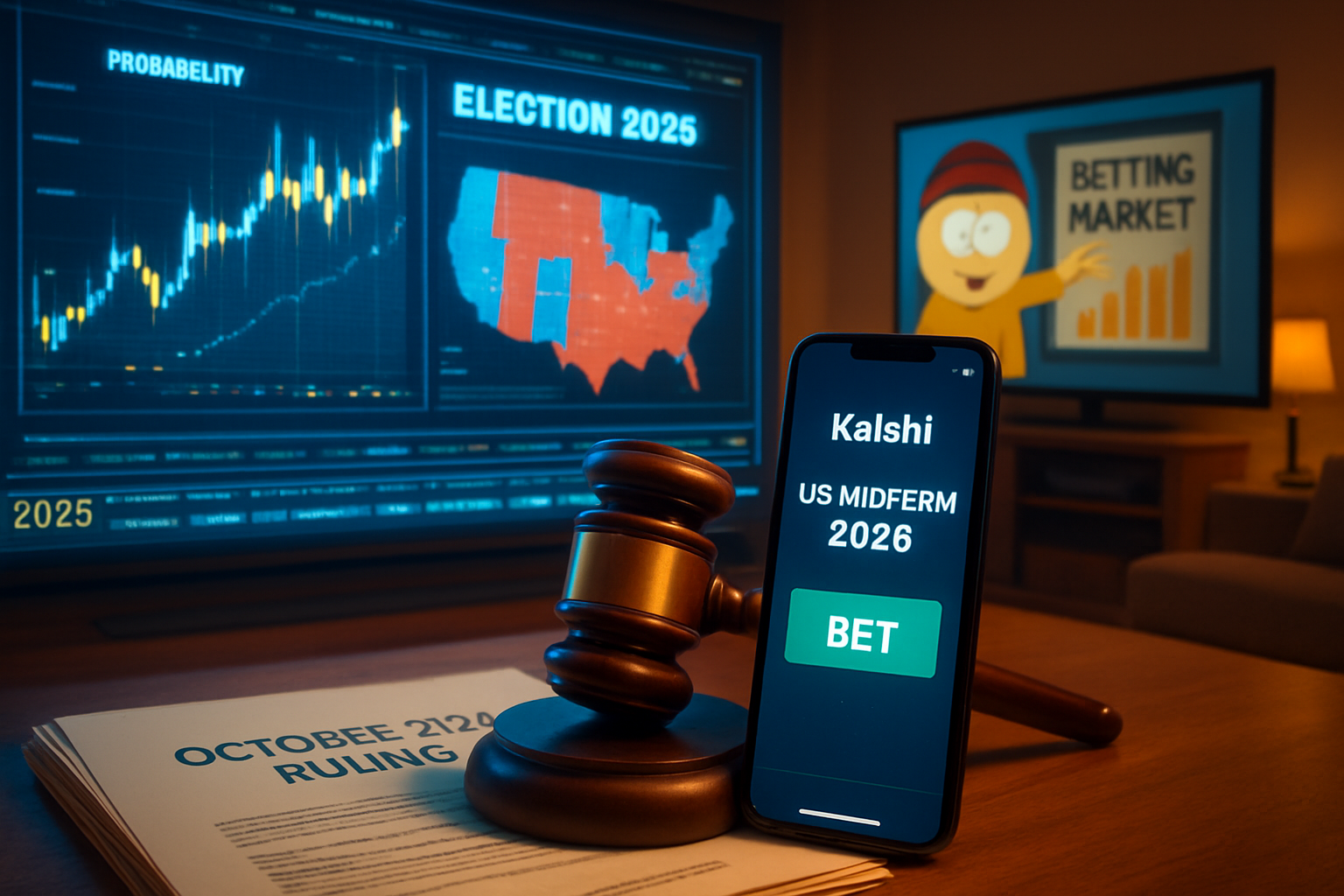
    The cultural mainstreaming of the industry was perhaps best captured in late 2025, when the long-running animated series South Park aired the episode "Conflict of Interest" (Season 27, Episode 5). The plot, which featured the townspeople betting on everything from school board meetings to the lunch menu, satirized the "betting on everything" culture that Kalshi helped create. In a meta-twist that only 2026 could produce, Kalshi actually hosted a market on how many times the word "prediction" would be uttered in the episode, with over $500,000 traded on the outcome.

    Broader Context and Implications

    To understand why 2026 is a "marquee year," one must look back to October 2, 2024. On that day, the D.C. Circuit Court of Appeals denied the Commodity Futures Trading Commission (CFTC) an emergency stay, effectively legalizing election trading in the United States. Judge Jia Cobb’s earlier ruling—which argued that the CFTC had exceeded its authority by labeling elections as "gaming"—became the "Magna Carta" of prediction markets.

    By mid-2025, the CFTC officially dropped its remaining appeals, signaling a "white flag" moment that allowed for permanent regulatory clarity. This legal peace led to a massive influx of venture capital and the entry of traditional sports betting giants like DraftKings Inc. (NASDAQ: DKNG) and Flutter Entertainment PLC (NYSE: FLUT), the parent company of FanDuel, into the event-contract space.

    The implications for public sentiment are profound. We have moved from an era of "manufactured consensus" via polls to "skin-in-the-game" reality. When a market moves today, people pay attention because money is changing hands. This has created a more resilient information ecosystem, where rumors are quickly "priced out" by those with better information, making the 2026 markets the most efficient we have ever seen.

    What to Watch Next

    As we head deeper into 2026, the next major catalysts for the market will be the primary season debates. Traditionally, these were television events; now, they are high-frequency trading sessions. Watch for "candidate survival" markets to fluctuate wildly as the first debates of the 2026 cycle begin this summer.

    Furthermore, keep an eye on the "Regulatory Harmonization Act" currently being debated in Congress. This proposed legislation aims to create a unified federal framework for all event contracts, potentially merging the oversight duties of the CFTC and the SEC for this asset class. If passed, it would likely trigger another massive wave of institutional adoption.

    Finally, the evolution of "Social Betting"—where users can create their own private markets for friends and communities—is expected to be the next big feature release from Kalshi. This could turn the 2026 Midterms into a localized experience, with neighbors betting on local city council races and school board seats with the same ease they trade the S&P 500.

    Bottom Line

    The retrospective on Kalshi’s 2024 victory reveals a simple truth: the genie is out of the bottle. What was once dismissed as a legal longshot has transformed into a $40 billion industry that has fundamentally changed how we process news and risk. 2026 is the year prediction markets became the "source of truth" for a world weary of partisan polling and media spin.

    The "marquee year" is characterized by a fusion of entertainment, finance, and democracy. Whether it’s through a South Park parody or a Robinhood notification, prediction markets are now part of the American fabric. As we look toward the 2026 Midterms, the odds don't just tell us what might happen—they tell us what the world knows will happen.


    This article is for informational purposes only and does not constitute financial or betting advice. Prediction market participation may be subject to legal restrictions in your jurisdiction.

    PredictStreet focuses on covering the latest developments in prediction markets.
    Visit the PredictStreet website at https://www.predictstreet.ai/.
  • The $52K Floor: Why Prediction Markets are Hedging Against a Bitcoin ‘Black Swan’ in Early 2026

    The $52K Floor: Why Prediction Markets are Hedging Against a Bitcoin ‘Black Swan’ in Early 2026

    As Bitcoin (BTC) hovers near the $95,600 mark this January 16, 2026, a curious divergence is emerging between the exuberant headlines of traditional finance and the cold, calculated skepticism of prediction markets. While retail investors celebrate a recovery from the volatile "Year of the Snake" in 2025, a growing segment of traders on platforms like Polymarket and Kalshi are placing heavy bets on a catastrophic reversal. Specifically, a niche but high-stakes market tracking whether Bitcoin will fall below $52,000 before March 31, 2026, has become a focal point for those hedging against a global macro "black swan."

    Currently, prediction markets are pricing the probability of a sub-$52,000 move by the end of Q1 at approximately 8%, a figure that has tripled since the start of the year. While the spot price remains strong, the "tail risk" demand suggests that professional speculators are increasingly worried about a "liquidity vacuum" similar to the 30% crash witnessed in late 2025. This market is generating intense interest because it represents the ultimate "line in the sand"—the level where institutional conviction meets the reality of a looming U.S. recession.

    The Market: What's Being Predicted

    The specific contract in question—"Bitcoin Below $52,000 by March 31, 2026"—is primarily trading on Polymarket, the decentralized platform that dominated the 2024 election cycle and has since become the de facto source for crypto sentiment. Unlike traditional futures on the CME Group (NASDAQ: CME), which often reflect institutional "long-only" momentum, these prediction contracts act as a binary insurance policy. If Bitcoin touches or closes below the $52,000 mark before the expiration date, the "Yes" shares pay out a full dollar, providing a massive windfall for those who bought in at current "penny" levels.

    Trading volume for this specific downside target has surged to over $12 million across various platforms. On Kalshi, the regulated U.S. exchange, a broader "How low will Bitcoin go?" market shows that while the consensus "floor" is expected to be around $75,000 (with a 63% probability), the $50k–$55k bucket has seen the highest percentage increase in open interest over the last 14 days. This indicates that while few expect a crash to happen, many are willing to pay for the protection if it does.

    The resolution criteria are strict: the market typically uses a 24-hour Volume Weighted Average Price (VWAP) across major exchanges like Coinbase (NASDAQ: COIN) to prevent "flash crash" manipulation from triggering a payout. The timeline is tight, with only ten weeks remaining until the March 31 deadline, making every macro headline a potential market mover.

    Why Traders Are Betting

    The primary driver behind these bearish bets is the "Sahm Rule," a recession indicator that was officially triggered in early January 2026 as U.S. unemployment climbed to 4.6%. For the first time in years, Bitcoin is facing a true "recession trade," where high-beta assets are the first to be sold during a dash for cash. Traders betting on the $52,000 level are essentially betting that the U.S. economy is entering a hard landing, which would force even the most diamond-handed institutions to liquidate.

    Furthermore, the "Saylor Risk" has re-entered the conversation. MicroStrategy (NASDAQ: MSTR), which continued its aggressive acquisition strategy throughout 2025, now holds an average purchase price of roughly $74,972. Analysts warn that if Bitcoin drops below $80,000, the "Saylor Premium"—the amount the stock trades above its net asset value—could evaporate, potentially leading to forced selling or debt-servicing issues. Traders in the prediction markets are watching the MSTR discount to NAV closely; it recently hit 0.95x, suggesting the market is already pricing in a period of underperformance.

    Technical analysts also point to the $52,000 level as the "61.8% Fibonacci golden ratio" and the primary consolidation floor from 2024. Proponents of the "Bear Flag" theory argue that the drop from the October 2025 high of $126,272 has yet to find its true bottom. For these traders, $52,000 isn't just a random number; it is the ultimate "value zone" where the 2026 bull market will either be reborn or buried.

    Broader Context and Implications

    This market reveals a fascinating psychological split in the 2026 financial landscape. Traditional analysts at firms like Standard Chartered (LSE: STAN) and Fundstrat continue to issue price targets of $150,000 to $200,000 for the end of the year. However, prediction markets are far more skeptical, with Polymarket bettors giving only a 21% chance of Bitcoin hitting $150,000 at any point in 2026. This "Crowd Wisdom" often serves as a more accurate gauge of actual risk appetite than the aspirational targets of sell-side research.

    The real-world implications of a drop to $52,000 would be catastrophic for the burgeoning "Crypto-Policy" ecosystem in Washington. With the GENIUS Act (regulating stablecoins) and the CLARITY Act (defining market structure) currently moving through the Senate, a price collapse could stall legislative progress. Lawmakers often use price action as a proxy for industry legitimacy; a 50% drawdown from the 2025 highs would likely embolden critics who argue the asset class is too volatile for sovereign-level adoption.

    Historically, prediction markets have been remarkably accurate at sniffing out "black swan" events before they appear in spot prices. During the 2022 FTX collapse and the 2024 regional banking crisis, prediction market odds moved hours—and sometimes days—before the broader market realized the extent of the damage. The current buildup of "Yes" positions on the $52k contract suggests that while the surface looks calm, the underlying plumbing of the crypto market is bracing for a surge in pressure.

    What to Watch Next

    The most immediate hurdle for the market is the January 31 U.S. government funding deadline. A potential shutdown is viewed as a volatility catalyst that could disrupt the regulatory "guardrails" the market has come to rely on. If a shutdown occurs and the dollar strengthens in a flight to safety, the odds of the $52,000 target being hit will likely jump instantly.

    Investors should also monitor the Supreme Court’s upcoming ruling on President Trump’s "Liberation Day" tariffs. A ruling that upholds broad executive power to levy tariffs could trigger a "higher-for-longer" inflation scenario, potentially forcing the Federal Reserve to pause its planned rate cuts. Since prediction markets currently price a 91.7% chance of a dovish Fed replacement in early 2026, any hawkish surprise would be a "reset" event for Bitcoin's valuation.

    Finally, keep an eye on the BlackRock (NYSE: BLK) IBIT ETF flows. Despite the bearish sentiment in prediction markets, IBIT saw over $750 million in net inflows in the first two weeks of January. If these institutional inflows begin to taper off or turn negative, the "black swan" bets on the $52,000 floor will shift from a low-probability hedge to a high-probability reality.

    Bottom Line

    The Bitcoin market of early 2026 is a tale of two realities. In one, institutional giants like BlackRock (NYSE: BLK) and MSCI (NYSE: MSCI) are finalizing the infrastructure to make Bitcoin a permanent fixture in global portfolios. In the other, prediction market traders are looking at the Sahm Rule, MSTR’s leverage, and a cooling macro environment and seeing a recipe for a 45% correction.

    The "Bitcoin below $52,000" market is the ultimate expression of this tension. While it remains a "tail risk" event with low single-digit odds for a Q1 resolution, the rising volume and shifting probabilities suggest that the market’s "bullish bias" is being tested by a cold front of economic data.

    Whether $52,000 acts as a doomsday scenario or the buying opportunity of a lifetime depends on the Fed's next move and the resilience of the U.S. consumer. For now, prediction markets are sending a clear signal: the path to $100,000 is not as clear as the headlines suggest, and the "floor" may be much further down than most are prepared for.


    This article is for informational purposes only and does not constitute financial or betting advice. Prediction market participation may be subject to legal restrictions in your jurisdiction.

    PredictStreet focuses on covering the latest developments in prediction markets. Visit the PredictStreet website at https://www.predictstreet.ai/.

  • Shutdown Showdown: Markets Signal 30% Chance of a January 31 Federal Furlough

    Shutdown Showdown: Markets Signal 30% Chance of a January 31 Federal Furlough

    As the calendar turns toward late January 2026, a familiar sense of dread has returned to the halls of Congress and the screens of global investors. After the record-breaking 43-day shutdown that paralyzed the federal government in late 2025, a new "funding cliff" is fast approaching on January 31. This time, however, the uncertainty is being quantified in real-time by a surging prediction market on Kalshi, where traders are currently pricing the odds of a government shutdown at a precarious 30%.

    The market is not just a niche interest for political junkies; it has become a high-stakes arena for institutional hedging and retail speculation. With over $1.6M in total volume traded and more than 880,000 open positions, the Kalshi contract "Will the government shut down on January 31?" has become a primary barometer for the success—or failure—of high-stakes budget negotiations between the White House and a divided Congress.

    The Market: What’s Being Predicted

    The specific market in question focuses on the midnight deadline of January 30, 2026. If a new funding agreement is not reached, the federal government will enter a partial shutdown on January 31. On Kalshi, the leading regulated prediction market in the U.S., the "Yes" contracts are currently trading at approximately 30 cents, implying a 30% probability of a shutdown. This represents a significant bounce from early January, when odds dipped to 20% following the passage of a bipartisan "minibus" spending package.

    Unlike traditional polling, the Kalshi market provides a 24/7 liquidity pool that reacts instantly to legislative maneuvers. The resolution of the contract is tied specifically to the official website of the U.S. Office of Personnel Management (OPM). If the OPM site displays a notice of a lapse in appropriations at 10:00 AM ET on January 31, the market resolves to "Yes." Interestingly, Jan 31, 2026, falls on a Saturday—a detail that has led to a fascinating "technicality" gap between regulated platforms and decentralized ones like Polymarket, where traders are debating whether a weekend lapse without a formal Monday furlough notice counts as a "shutdown."

    Why Traders Are Betting

    The volatility in the odds is driven by three primary legislative "poison pills." First is the expiration of the Enhanced Premium Tax Credits for the Affordable Care Act (ACA), which officially lapsed on December 31, 2025. Democrats have signaled they will block any further funding bills unless these subsidies are restored, while Senate Republicans are demanding strict eligibility reforms. This "subsidy cliff" has already caused healthcare premiums to spike, and traders are watching the healthcare sector, particularly UnitedHealth Group (NYSE: UNH), for signals on how much pressure the industry is putting on lawmakers.

    Second, the market is reacting to the shadow of the "One Big Beautiful Bill Act" (OBBBA), the massive tax and spending law passed in mid-2025. While that bill funded some agencies through late 2026, nine major appropriations bills—including those for Defense, Homeland Security, and Justice—remain on the chopping block for January 31.

    Finally, the market has been influenced by "whale" activity. On decentralized platforms, a trader known by the pseudonym "Burdensome-Mix" has reportedly taken a massive "Yes" position, leading to rumors of insider information regarding the breakdown of Senate negotiations. This activity has been so pronounced that it spurred the introduction of the "Public Integrity in Financial Prediction Markets Act of 2026," a proposed bill by Rep. Ritchie Torres aimed at preventing federal officials from trading on non-public legislative timelines.

    Broader Context and Implications

    The 30% odds reflect a market that is skeptical but not yet panicked. For defense titans like Lockheed Martin (NYSE: LMT) and RTX Corporation (NYSE: RTX), the market serves as a "payment risk" index. Recent executive orders from the Trump administration have already restricted stock buybacks and dividends for defense contractors until production targets are met. A shutdown on January 31 would halt progress payments on major weapon systems, creating a liquidity crunch that these firms are desperate to avoid.

    Historically, prediction markets have been remarkably accurate at front-running Congressional "deals." In the 2025 shutdown, the Kalshi market predicted the resolution four days before the final bill was signed. Today, the 30% probability suggests that while the rhetoric on Capitol Hill is heated, "smart money" still believes there is a 70% chance that a last-minute Continuing Resolution (CR) or a second "minibus" will be hammered out.

    Furthermore, the divergence between Kalshi and Polymarket—where a "funding lapse" is priced at 56% but a "shutdown" at 29%—highlights the nuance of these markets. Traders expect the funding to technically expire, but many believe a deal will be reached over the weekend of January 31 before the "furlough" reality hits federal workers on Monday morning.

    What to Watch Next

    The most immediate catalyst for the market is scheduled for January 22, 2026, when the CEO of UnitedHealth Group is set to testify before a Senate committee regarding the expiration of ACA subsidies. If the testimony results in a breakthrough or a "hardening" of partisan lines, expect the 30% odds to move violently in either direction.

    Another key milestone is the progress of the "Homeland Security and Border Security" funding bill. This has remained the most contentious piece of the appropriations puzzle. If a "clean" funding bill for this department fails to advance by January 25, the "Yes" odds on Kalshi will likely surge toward 50%. Traders are also keeping a close eye on the Senate's "minibus" package; its failure to clear a 60-vote threshold this week would be a clear signal that a lapse is imminent.

    Bottom Line

    The Kalshi market for the January 31 shutdown is more than just a betting pool; it is a sophisticated data point in an era of extreme political polarization. The current 30% probability suggests a "cautious optimism" among traders, but the $1.6M in volume indicates that the stakes could not be higher. For the first time, prediction markets are acting as a real-time check on Congressional grandstanding, forcing lawmakers to contend with a public and transparent probability of their own failure.

    As we approach the January 30 deadline, the intersection of healthcare subsidies, defense spending restrictions, and prediction market transparency will define the start of 2026. Whether the government remains open or shutters its doors, the message from the markets is clear: the era of "wait and see" politics is being replaced by the era of "price it in."


    This article is for informational purposes only and does not constitute financial or betting advice. Prediction market participation may be subject to legal restrictions in your jurisdiction.

    PredictStreet focuses on covering the latest developments in prediction markets.
    Visit the PredictStreet website at https://www.predictstreet.ai/.