
Tag: 2024 election

  • The New Oracle: Prediction Markets Emerge as Global ‘Early Warning Systems’

    The New Oracle: Prediction Markets Emerge as Global ‘Early Warning Systems’

    As we move into early 2026, the global information landscape has undergone a radical transformation. No longer are political analysts and corporate strategists solely reliant on slow-moving surveys or expert panels to gauge the future. Instead, they are turning to the real-time, high-stakes data of prediction markets. These platforms, once viewed as niche betting hubs, have matured into what many are now calling the world’s most accurate "Early Warning Systems" (EWS).

    In January 2026, the evidence of this shift is undeniable. While traditional polling data often lags behind reality by days or even weeks, prediction markets are responding to geopolitical tremors and economic shifts in mere seconds. From the capture of international fugitives to the timing of Federal Reserve interest rate cuts, these markets are providing a level of foresight that traditional media is struggling to match.

    The Market: What's Being Predicted

    The scope of what can be traded on prediction markets has expanded dramatically since the landmark 2024 election cycle. Platforms like Polymarket and Kalshi have moved far beyond simple "Who will win the presidency?" contracts. Today, traders are betting on everything from the success of SpaceX's Starship Flight 12 to the number of confirmed measles cases in specific Texas counties.

    The scale of these markets is equally impressive. In late 2025, total weekly notional volume across major platforms frequently exceeded $5 billion. Kalshi alone recorded its highest-ever weekly volume of $1.98 billion in the first week of January 2026, largely driven by NFL-related event contracts. Meanwhile, Polymarket, following its successful U.S. relaunch via the acquisition of a CFTC-licensed exchange, reported over $21.5 billion in total nominal volume through December 2025.

    These platforms rely on binary outcome contracts—where a share pays out $1 if the event occurs and $0 if it doesn't—providing a clear, percentage-based probability for any given event. This "price discovery" for future events has become an essential tool for institutional investors and news organizations alike.

    Why Traders Are Betting

    The 2024 U.S. Presidential Election was the ultimate proof of concept for the "Early Warning" theory. Throughout October 2024, traditional pollsters like The New York Times (NYSE: NYT) and 538 described the race as a "dead heat." However, prediction markets told a different story. By late October, the price of a Donald Trump "win" share on Polymarket and Kalshi had moved decisively toward 67%, signaling a shift in momentum that polls didn't capture until it was too late.

    Traders are driven by the "financial incentive for accuracy." Unlike a survey respondent who may give a socially desirable answer, or a television pundit who faces no financial penalty for a wrong prediction, prediction market participants must put capital at risk. This filters out noise and prioritizes "hidden" information.

    A prime example occurred in early January 2026. Hours before the Trump administration announced the capture of Venezuelan leader Nicolás Maduro, a single trader on Polymarket placed a $32,000 bet on his downfall, eventually netting a $400,000 profit. This instance of "information finance" sparked debates about insider information, but it also proved that markets can act as a sensor for events long before they hit the headlines.

    Broader Context and Implications

    The evolution of these markets has been bolstered by significant regulatory victories. Following the CFTC vs. Kalshi legal battle, which concluded in May 2025 when the government dropped its appeal, political event contracts are now legally traded on federally regulated exchanges in the U.S. This has cleared the path for mainstream integration, with Warner Bros. Discovery (NASDAQ: WBD) and its subsidiary CNN, as well as Comcast’s (NASDAQ: CMCSA) CNBC, now featuring live prediction market odds as a standard part of their election and economic coverage.

    Furthermore, traditional finance players like Robinhood Markets, Inc. (NASDAQ: HOOD) and Interactive Brokers Group, Inc. (NASDAQ: IBKR) have integrated these markets into their platforms, bringing prediction contracts to millions of retail investors. This influx of liquidity has reduced the influence of "whales" and increased the "wisdom of crowds," making the signals more stable and reliable.

    Historically, prediction markets have shown a remarkable ability to process complex news faster than experts. In 2025, economic contracts on the CME Group (NASDAQ: CME) FedWatch tool and Kalshi correctly priced in a June rate cut months in advance, even as many bank analysts remained skeptical of a cooling labor market.

    What to Watch Next

    As we look toward the remainder of 2026, the 2026 Midterm Elections (November 3, 2026) are already the highest-liquidity markets in the world. Currently, markets are pricing a 79% probability of a Democratic House takeover and a 67% chance of the GOP maintaining control of the Senate. These odds are expected to shift rapidly as the primary season begins in March.

    Outside of politics, the 2026 Winter Olympics in Milan-Cortina (February 6–22) and the 2026 FIFA World Cup in June will provide massive volume for sports-related event contracts. In the tech sector, all eyes are on the anticipated IPO of SpaceX. Rumors of a mid-2026 public offering have already created a highly active market, with traders currently betting on a debut valuation exceeding $1 trillion.

    Bottom Line

    The rise of prediction markets as "Early Warning Systems" represents a fundamental shift in how we perceive and process the future. By attaching a financial value to truth, these platforms have successfully bypassed the biases of traditional polling and the lag of institutional reporting. They are no longer just betting platforms; they are the new infrastructure of information.

    As we head into the 2026 midterms and beyond, the most important signal won't be found in a pundit's monologue or a "margin of error" poll—it will be found in the fluctuating price of a contract on an exchange. For the first time in history, the collective wisdom of the crowd isn't just a theory; it’s a tradable asset.


    This article is for informational purposes only and does not constitute financial or betting advice. Prediction market participation may be subject to legal restrictions in your jurisdiction.

    PredictStreet focuses on covering the latest developments in prediction markets.
    Visit the PredictStreet website at https://www.predictstreet.ai/.
  • The Accuracy War: PredictIt vs. Kalshi vs. Polymarket

    The Accuracy War: PredictIt vs. Kalshi vs. Polymarket

    The 2024 U.S. Presidential election served as a high-stakes laboratory for the burgeoning world of prediction markets, pitting established academic platforms against crypto-native giants and regulated newcomers. As of January 19, 2026, the dust has finally settled on the post-election post-mortems, revealing a surprising "Accuracy War" where the most liquid markets weren’t necessarily the most correct. While all major platforms eventually signaled a Republican victory, the path they took—and the volatility they experienced—highlighted deep structural divides in how we forecast the future.

    Currently, the market is shifting its focus to the 2026 Midterms, with "control of the House" contracts already seeing significant early action. On Kalshi, the probability of a Democratic "Blue Wave" in 2026 is currently hovering at 42%, while PredictIt traders are more cautious at 38%. This 400-basis-point spread is a direct result of the different participant bases and fee structures that define these platforms. The divergence is generating intense interest among arbitrageurs who are looking to exploit the lingering "accuracy gap" that defined the 2024 cycle.

    The Market: What's Being Predicted

    The core of the "Accuracy War" centers on how PredictIt, Kalshi, and Polymarket processed the 2024 election data compared to their current handling of the 2026 legislative outlook. During the 2024 cycle, Polymarket dominated the headlines with over $3.3 billion in total volume, while the regulated U.S. exchange Kalshi struggled initially after a late legal entry in October 2024. PredictIt, the long-standing academic project, operated under a cloud of regulatory uncertainty that was only resolved in mid-2025.

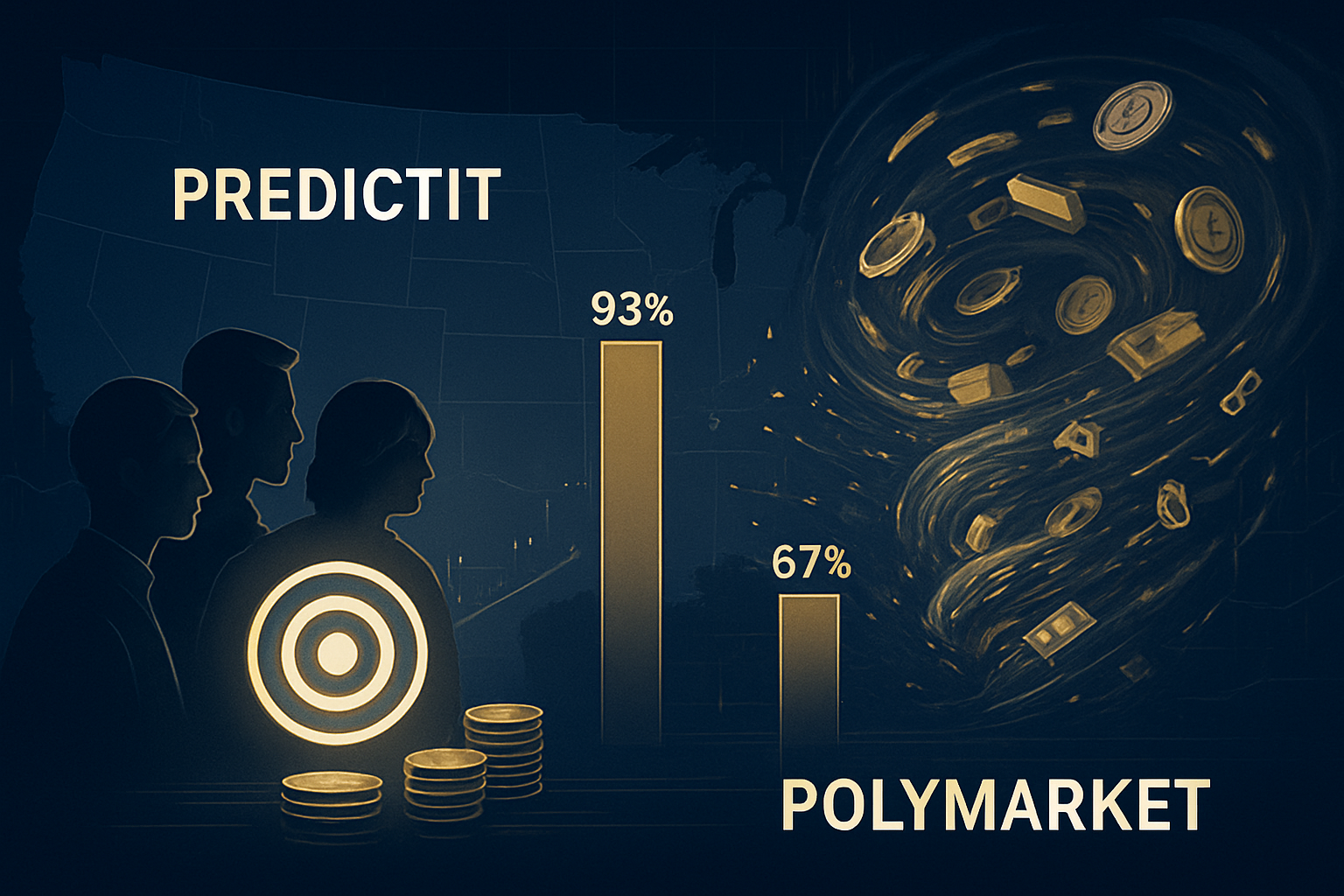
    A landmark study from Vanderbilt University released in late 2025 found that PredictIt achieved a staggering 93% accuracy rate across 2,500 individual contracts, compared to 78% for Kalshi and just 67% for Polymarket. This disparity has fundamentally changed how traders view these platforms. While Polymarket offers the highest liquidity and the "wisdom of the global crowd," its signals were often distorted by massive "whale" positions, such as the famous $30 million bet by a French trader that skewed Republican odds for weeks.

    Today, the resolution criteria for 2026 markets have become more standardized thanks to the 2025 CLARITY Act, which provided a federal framework for event contracts. Kalshi has surged to a dominant position, claiming a 66.4% share of daily volume as of mid-January 2026. Polymarket, meanwhile, has successfully pivoted into the U.S. market, launching a regulated domestic arm in December 2025 to compete directly with Kalshi and PredictIt on American soil.

    Why Traders Are Betting

    The primary driver of the odds today is the varying "friction" created by fee structures. PredictIt remains the most expensive venue, charging a 10% fee on all gross profits and a 5% fee on withdrawals. This creates a "PredictIt Premium," where a contract might trade at 55 cents when the "true" probability is closer to 50%, simply because traders need a higher margin to cover the fees. In contrast, the newly launched Polymarket US (DCM) has introduced a hyper-competitive 0.10% fee to lure traders away from Kalshi’s probability-weighted fee model, which averages around 1.2% per trade.

    Participant demographics also play a crucial role. PredictIt’s $3,500 trading limit (raised from $850 in July 2025) ensures that the market represents a "crowd of peers" rather than a "market of whales." This "enforced diversity" is credited with its high accuracy in 2024; it was essentially a massive survey of informed U.S. voters with skin in the game. On the other hand, the international nature of Polymarket Global often leads to "sentiment-driven" spikes, where global crypto-traders bet on "narratives" rather than granular U.S. state-level polling or legislative nuances.

    Recent news has also influenced the 2026 odds. Following the partnership between Kalshi and Warner Bros. Discovery (NASDAQ: WBD)'s CNN to integrate live odds into political broadcasts, a surge of "retail" money has entered the market. This influx of less-experienced traders often creates "noise" that savvy pros—many of whom utilize institutional tools from Comcast (NASDAQ: CMCSA)'s CNBC—are quick to capitalize on through mean-reversion strategies.

    Broader Context and Implications

    The "Accuracy War" has broader implications for how prediction markets are integrated into the global financial system. The 2025 CLARITY Act was a watershed moment, finally clarifying that event contracts are legitimate financial tools for hedging real-world risks. This has allowed major news organizations, including News Corp (NASDAQ: NWS)'s Dow Jones and The Wall Street Journal, to treat prediction market prices with the same reverence as the S&P 500 or Treasury yields.

    Furthermore, the 2024 results debunked the "Liquidity Equals Accuracy" myth. The fact that the highest-volume market (Polymarket) was the least accurate in its price discovery suggested that "whales" can, in fact, move the needle and create misleading signals. This has led to a renewed interest in the "PredictIt model" of capping individual stakes to ensure a broader, more representative sample of opinions. It suggests that for political events, the "wisdom of the crowd" works best when the crowd isn't dominated by a few deep-pocketed individuals.

    The regulatory environment has also matured. The CFTC’s shift from an adversarial to a collaborative stance with platforms like PredictIt has encouraged more academic research into how these markets can serve as "early warning systems" for geopolitical instability or economic shifts. Prediction markets are no longer seen as "gambling" but as a vital layer of the information economy.

    What to Watch Next

    As we approach the 2026 Midterms, all eyes are on the performance of Polymarket’s new U.S.-regulated exchange. If it can maintain its low fee structure while attracting the high-quality, domestic participant base that PredictIt enjoys, it could theoretically combine the best of both worlds: high liquidity and high accuracy. Traders should watch for any shifts in the "spread" between PredictIt and Kalshi prices; a narrowing gap would indicate that the markets are becoming more efficient at cross-platform arbitrage.

    Key dates to monitor include the upcoming "State of the Union" in February 2026, which historically triggers massive volume and price swings in legislative control contracts. Additionally, the first major "test" of the CLARITY Act’s enforcement provisions is expected this spring, as several platforms attempt to launch "economic indicator" contracts tied to sensitive data like the Consumer Price Index (CPI) before they are officially released.

    Bottom Line

    The competition between PredictIt, Kalshi, and Polymarket has evolved into a sophisticated ecosystem where "accuracy" is the ultimate currency. While Polymarket won the battle for volume in 2024, PredictIt won the battle for precision. In 2026, the playing field is leveling as Kalshi dominates the regulated U.S. space and Polymarket enters the domestic arena with a competitive edge.

    The key takeaway for any market observer is that prediction markets are not a monolith. The "odds" on one platform are a reflection of its specific rules, its fees, and its people. As we head into a new election cycle, the "Accuracy War" continues, and the winners will be the platforms that can best balance the need for deep liquidity with the necessity of a diverse, informed participant base.

    Ultimately, prediction markets have proved their worth as a superior alternative to traditional polling. In an era of fragmented media and partisan bubbles, the cold, hard numbers of a trading screen offer the most honest look at where the world is actually heading.


    This article is for informational purposes only and does not constitute financial or betting advice. Prediction market participation may be subject to legal restrictions in your jurisdiction.

    PredictStreet focuses on covering the latest developments in prediction markets.
    Visit the PredictStreet website at https://www.predictstreet.ai/.
  • The Nate Silver Effect: How Prediction Markets Unseated the Pollsters in 2024

    The Nate Silver Effect: How Prediction Markets Unseated the Pollsters in 2024

    As we look back from the vantage point of January 2026, the 2024 U.S. Presidential Election is increasingly viewed not just as a political realignment, but as a total disruption of the forecasting industry. For decades, traditional polling was the undisputed king of election intelligence. However, the 2024 cycle saw the emergence of the "Nate Silver Effect," a phenomenon where decentralized prediction markets—led by Polymarket and Kalshi—effectively replaced legacy polling aggregates as the most accurate "real-time" gauge of political reality.

    The numbers tell a stark story: while major polling models described the race between Donald Trump and Kamala Harris as a 50/50 "toss-up" until the final hours of Election Night, prediction markets consistently priced a Trump victory at roughly 60/40 throughout October. This divergence was not a fluke, but a signal. By the time the Associated Press officially called the race, prediction markets had been trading at 95% certainty for hours, cementing their status as the new "liquid truth" in an era of demographic shifts and polling volatility.

    The Market: What's Being Predicted

    The 2024 cycle was the first time prediction markets operated at a scale that rivaled institutional finance. On Polymarket alone, the "Presidential Election Winner" contract saw nearly $3.7 billion in total volume, with cumulative election-related betting across all platforms estimated to have reached nearly $19 billion by the time the dust settled.

    The markets didn't just predict the final outcome; they successfully navigated the chaotic internal dynamics of the Democratic Party. Long before legacy media confirmed that President Joe Biden would step aside, Polymarket traders were ahead of the curve. Following the first presidential debate in late June 2024, the probability of Biden withdrawing jumped from 20% to nearly 40%. By July 4—over two weeks before his actual announcement on July 21—traders had already assigned a staggering 70% probability to his exit, while most traditional news outlets were still reporting his candidacy as "firm."

    However, the markets were not infallible. The selection of Tim Walz as the Vice Presidential nominee served as a rare "miss" for the wisdom of crowds. In the final 48 hours before the pick, Polymarket traders heavily favored Pennsylvania Governor Josh Shapiro, with his odds peaking at 65%. Walz was considered a distant dark horse, fluctuating between 8% and 25% until the news leaked. This served as a critical reminder that while markets aggregate information, they can still fall victim to "echo chambers" when insiders maintain a tight seal on information.

    Why Traders Are Betting

    The shift toward prediction markets in 2024 was accelerated by a collapse in polling reliability, most notably epitomized by the "Selzer Miss." Just days before the election, legendary pollster Ann Selzer released a poll showing Kamala Harris leading by 3 points in Iowa—a state Trump had won handily in 2016 and 2020. While this poll sent shockwaves through traditional media and caused a brief panic in polling models, the prediction markets largely shrugged it off, maintaining Trump’s massive lead in the state. Trump ultimately won Iowa by 14 points, marking one of the most significant misses in modern polling history and vindicating the market’s skepticism.

    The "Nate Silver Effect" became the catalyst for this market maturity. When Nate Silver, the founder of FiveThirtyEight and the world's most famous election forecaster, joined Polymarket as an advisor in July 2024, it provided an immediate "halo effect" for the platform. Silver’s involvement signaled that these markets weren't merely "gambling" platforms for crypto enthusiasts; they were sophisticated data aggregation tools.

    Following Silver’s appointment, Polymarket’s monthly volume exploded, jumping from $111 million in June to $213 million in July. His presence bridge the gap between "quants" and political pundits, encouraging institutional traders to enter the fray and provide the liquidity necessary for the markets to become truly efficient.

    Broader Context and Implications

    The success of prediction markets in 2024 has fundamentally changed how the financial world consumes political news. In the year since the election, major retail brokerages like Robinhood Markets, Inc. (NASDAQ: HOOD) and Interactive Brokers Group, Inc. (NASDAQ: IBKR) have fully integrated "event contracts" into their platforms. This has moved prediction markets from the fringes of the internet into the 401(k)s of average Americans.

    Regulatorily, the landscape in early 2026 is a complex patchwork. While Kalshi won a landmark legal victory against the Commodity Futures Trading Commission (CFTC) in late 2024—paving the way for legal election betting in the U.S.—the fight has now moved to the state level. Several states, including Tennessee and Connecticut, have attempted to issue cease-and-desist orders against these platforms, arguing they violate state-level anti-gambling statutes.

    Despite these hurdles, the accuracy of these markets has become their greatest defense. By providing a real-time, money-backed probability of events, they offer a hedge against "expert" bias. In 2024, the Brier scores (the gold standard for measuring forecast accuracy) for prediction markets were significantly better than those of the most prominent polling aggregates, proving that when people put their money where their mouths are, the data tends to be cleaner.

    What to Watch Next

    As we move deeper into 2026, the focus of prediction markets has shifted from domestic politics to global geopolitical and economic events. Traders are currently heavily focused on the 2026 FIFA World Cup and the potential for a "soft landing" versus a recession as the Federal Reserve navigates the post-election economic landscape.

    The next major test for the "Nate Silver Effect" will be the 2026 Midterm Elections. After the polling failures of 2024, many traditional polling firms have struggled to find funding, while prediction markets are seeing record-breaking participation. Watch for whether these platforms can maintain their accuracy in lower-liquidity "down-ballot" races, or if they will remain most effective only for high-profile national contests.

    Bottom Line

    The 2024 election was a paradigm shift. It proved that in a fractured information environment, the most reliable signal is often the one backed by financial risk. The "Nate Silver Effect" successfully legitimized a new form of collective intelligence, turning "betting" into "forecasting" and "gambling" into "data science."

    As we look toward the future of prediction markets in 2026, the question is no longer whether these markets are accurate, but how they will be regulated and integrated into our daily financial lives. For the first time in history, the "wisdom of crowds" has a ticker symbol, and the traditional pollsters may never recover their crown.


    This article is for informational purposes only and does not constitute financial or betting advice. Prediction market participation may be subject to legal restrictions in your jurisdiction.

    PredictStreet focuses on covering the latest developments in prediction markets.
    Visit the PredictStreet website at https://www.predictstreet.ai/.
  • The Liquidity Paradox: Why PredictIt’s $850 Limit Beat Polymarket’s $2.4 Billion in 2024

    The Liquidity Paradox: Why PredictIt’s $850 Limit Beat Polymarket’s $2.4 Billion in 2024

    In the wake of the most heavily traded political event in history, a landmark study from Vanderbilt University has sent shockwaves through the burgeoning prediction market industry. The report, titled "Prediction Markets? The Accuracy and Efficiency of $2.4 Billion in the 2024 Presidential Election," reveals a startling inverse relationship between raw capital and predictive precision. While the 2024 cycle saw billions of dollars flow into contracts on a potential Trump-Harris matchup, the massive liquidity often cited as the primary strength of these markets appears to have been their greatest vulnerability.

    The study, led by Joshua D. Clinton and TzuFeng Huang, analyzed over 2,500 political contracts across the final five weeks of the campaign. It found that PredictIt, the academic-aligned platform known for its stringent $850 individual betting limit, achieved a staggering 93% accuracy rate on Election Eve. This outperformed the federally regulated Kalshi (78%) and the decentralized volume-leader Polymarket (67%), the latter of which became a global phenomenon for its nine-figure "whale" positions but struggled to separate signal from noise.

    The Market: What's Being Predicted

    The focus of the Vanderbilt research was the 2024 U.S. Presidential Election, a cycle that transformed prediction markets from niche hobbies into mainstream financial instruments. The primary contracts involved the winner of the Presidency, individual state outcomes, and control of the House and Senate. By November 2024, Polymarket had recorded over $2.4 billion in total volume on its primary presidential winner contract, while Kalshi, which recently gained legal clearance to offer election betting, saw its volume surge in the final weeks following a partnership with Robinhood (Nasdaq: HOOD).

    Prices on these exchanges function as implied probabilities: a contract trading at $0.52 indicates a 52% consensus chance of an event occurring. Throughout the cycle, these odds fluctuated wildly. In October 2024, Polymarket prices famously diverged from traditional polling, at one point giving Donald Trump a 67% chance of victory while national polls remained within the margin of error. This divergence created massive arbitrage opportunities—situations where traders could bet on opposite outcomes across different platforms to lock in a guaranteed profit—which Vanderbilt researchers found peaked just days before the vote.

    Why Traders Are Betting

    The 2024 election was characterized by a fundamental clash between "data-driven" traders and "sentiment-driven" whales. On Polymarket, a single anonymous French trader, dubbed the "Théo" whale, reportedly wagered over $30 million on a Republican sweep. This outsized position single-handedly shifted the platform's odds, a move that researchers now believe contributed to Polymarket's lower 67% accuracy rating by creating a "feedback loop" of artificial confidence.

    Conversely, PredictIt’s success is being attributed to its "enforced diversity." Because no single user can risk more than $850 on a single contract, the price is determined by the collective wisdom of thousands of unique participants rather than a handful of deep-pocked speculators. This structure effectively neutralized the impact of institutional influence from players like Interactive Brokers (Nasdaq: IBKR), which launched its own ForecastEx exchange to cater to high-net-worth hedgers. While traditional forecasting methods like polling struggled with non-response bias, the Vanderbilt study suggests that markets with lower entry barriers and tighter limits may actually provide a "purer" signal.

    Broader Context and Implications

    The Vanderbilt findings arrive at a critical juncture for the industry. The perceived accuracy of prediction markets has led to major media integration, with real-time odds now a staple of coverage on CNBC, owned by Comcast (Nasdaq: CMCSA), and CNN, owned by Warner Bros. Discovery (Nasdaq: WBD). However, the 26-point accuracy gap between PredictIt and Polymarket suggests that these media outlets may be anchoring their coverage to the wrong data sets.

    Furthermore, the study highlights a failure in market efficiency. Theoretically, if the same event is being predicted on two different platforms, the prices should be identical. Vanderbilt found this was rarely the case. The lack of correlation between platforms suggests that traders were often reacting to internal "social media vibes" rather than external political developments. This has already triggered a regulatory response in Washington. Following reports of potential insider trading on international events, Representative Ritchie Torres introduced the "Public Integrity in Financial Prediction Markets Act of 2026," which seeks to restrict government officials from participating in these markets to prevent information asymmetry.

    What to Watch Next

    As we move toward the 2026 midterm elections, the industry is undergoing a massive consolidation. DraftKings Inc. (Nasdaq: DKNG) and Flutter Entertainment (NYSE: FLUT), the parent of FanDuel, are reportedly exploring the integration of event contracts directly into their sports betting apps, which would introduce tens of millions of new users to the ecosystem. The key question for 2026 is whether these platforms will adopt the "whale-friendly" model of Polymarket or the "capped-signal" model of PredictIt.

    The next major milestone for the industry will be the first quarterly report from the Commodity Futures Trading Commission (CFTC) under its new oversight framework. This report is expected to address the "Vanderbilt Gap" and could potentially lead to new rules regarding maximum position sizes for political contracts. Investors should also monitor the stock performance of Intercontinental Exchange (NYSE: ICE), which has a strategic stake in the infrastructure powering these markets, as a bellwether for institutional confidence in the sector.

    Bottom Line

    The Vanderbilt University study serves as a sobering reality check for the "liquidity is king" mantra. The 93% accuracy of PredictIt proves that a well-designed market with restricted participation can significantly outperform a multi-billion-dollar global pool dominated by speculative capital. It suggests that for prediction markets to fulfill their promise as a superior forecasting tool, they must prioritize the breadth of their participant base over the depth of their order books.

    As we look toward the 2026 and 2028 cycles, the "Vanderbilt Gap" will likely define the debate over market regulation and design. For now, the takeaway is clear: if you want to know who will win an election, look to the market where the many bet a little, rather than the market where the few bet a lot. The $2.4 billion experiment of 2024 has shown that in the world of high-stakes forecasting, volume is no substitute for variety.


    This article is for informational purposes only and does not constitute financial or betting advice. Prediction market participation may be subject to legal restrictions in your jurisdiction.

    PredictStreet focuses on covering the latest developments in prediction markets. Visit the PredictStreet website at https://www.predictstreet.ai/.
  • The Death of the Toss-Up: How Polymarket’s $19B Election Bet Vindicated Prediction Markets

    The Death of the Toss-Up: How Polymarket’s $19B Election Bet Vindicated Prediction Markets

    When the dust finally settled on the 2024 U.S. Presidential Election, the biggest winner wasn't just on the ballot; it was the platform that saw the outcome coming long before the first cable news network called a single swing state. Polymarket, the decentralized prediction platform, didn't just participate in the election cycle—it dominated the narrative, processing nearly $19 billion in cumulative volume across its various election-related contracts and correctly calling the outcome in all 50 states.

    While traditional polling aggregators and mainstream media outlets spent the final weeks of the campaign describing the race as a "dead heat" or a "coin flip," Polymarket’s traders were already pricing in a decisive shift. The platform reached a staggering 95% probability for a Donald Trump victory at 11:43 p.m. ET on Election Night—nearly six hours before the Associated Press made its official call at 5:34 a.m. ET. This massive divergence has fundamentally altered how political outcomes are forecasted, moving the needle from subjective opinion polling toward the "liquid truth" of incentivized markets.

    The Market: What's Being Predicted

    At the heart of the 2024 frenzy was a suite of over 50 individual state-level markets and a flagship "Presidential Election Winner 2024" contract. This primary market alone saw a cumulative volume of approximately $3.7 billion, but when including markets for House and Senate control, popular vote margins, and candidate-specific milestones, the total ecosystem volume surged toward the $19 billion mark. This liquidity provided a level of stability and signal clarity that smaller, regulated U.S. competitors were only beginning to match at the time.

    The resolution criteria were binary: which candidate would secure the majority of electoral votes as certified by the states. Throughout October 2024, as polls showed the candidates within the margin of error, Polymarket consistently priced Trump as a 60/40 favorite. This "spread" represented a significant departure from traditional forecasting models, which stayed locked in a 50/50 toss-up narrative until the early hours of Wednesday morning.

    The success of these markets caught the attention of major financial players. Robinhood Markets, Inc. (NASDAQ: HOOD) and Interactive Brokers Group, Inc. (NASDAQ: IBKR) both launched their own "event contracts" in late October 2024, following a landmark court ruling involving the exchange Kalshi. However, Polymarket’s early lead in liquidity and its crypto-native user base allowed it to remain the primary reference point for "real-time" probability during the most critical hours of the election.

    Why Traders Were Right

    The accuracy of Polymarket in 2024 is largely attributed to the "Wisdom of Crowds" and the concept of "skin in the game." Unlike poll respondents, who may experience "social desirability bias"—telling pollsters what they think is the "correct" or "polite" answer—prediction market traders face immediate financial consequences for being wrong. This financial incentive filters out noise and forces participants to find the most accurate information available, including obscure county-level data and early voting trends that traditional models often lag behind.

    A significant factor in the market’s movements was the presence of high-conviction "whales." One notable trader, a French national identified as "Théo," reportedly bet upwards of $30 million on a Trump victory. While critics initially feared this was a "market manipulation" attempt to skew perception, post-election analysis revealed it was a sophisticated data-driven play based on "neighbor polls"—a method that asks respondents who they think their neighbors will vote for, which historically captures hidden support more accurately.

    Furthermore, the markets were faster to react to major campaign catalysts. For instance, when President Joe Biden withdrew from the race in July 2024, Polymarket odds had already priced the probability of his exit at over 70% weeks in advance, while many political pundits were still dismissing the possibility. This speed allowed institutions like Bloomberg to integrate Polymarket data directly into their terminals, providing professional traders with a faster volatility gauge than any poll could offer.

    Broader Context and Implications

    The 2024 cycle has marked a permanent shift in the relationship between prediction markets and the financial sector. Since the election, the "event contract" asset class has exploded. By early 2026, Intercontinental Exchange, Inc. (NYSE: ICE), the parent company of the New York Stock Exchange, made a landmark investment in the sector, signaling that prediction data is now viewed as an essential alternative data set for hedging political and economic risk.

    The regulatory landscape has also shifted dramatically. Following the success of the 2024 markets, the CFTC has faced increased pressure to provide a clearer framework for event contracts. This has paved the way for more mainstream adoption, with Coinbase Global, Inc. (NASDAQ: COIN) acquiring prediction-infrastructure firms to scale these offerings to their millions of retail users. Even the sports betting giants DraftKings Inc. (NASDAQ: DKNG) and Flutter Entertainment plc (NYSE: FLUT) have launched dedicated "prediction" verticals to capture the growing demand for non-sports wagering.

    Historically, prediction markets were seen as a niche interest for crypto enthusiasts. However, the 2024 results—specifically the Brier score of 0.0296, which significantly outperformed Nate Silver’s "Silver Bulletin" model—have validated them as a superior forecasting tool. This success has sparked a broader debate about the "death of polling," as organizations like the New York Times face questions about why their sophisticated polling models failed to capture the "clean sweep" that the markets were already pricing in.

    What to Watch Next

    As we look toward the 2026 midterm elections, prediction markets are no longer a "side-show" but the main event. Analysts expect cumulative volumes for the 2026 cycle to exceed $25 billion, as institutional participation grows and more brokerages offer direct access to political contracts. The focus is now shifting toward "Micro-Prediction Markets," where traders can bet on specific policy outcomes, such as the likelihood of corporate tax rate changes or the passage of specific healthcare legislation.

    Key milestones to monitor include the upcoming SEC and CFTC rulings on the cross-listing of event contracts on traditional equity exchanges. If approved, we could see a future where political "odds" are traded as easily as shares of Alphabet Inc. (NASDAQ: GOOGL) or Meta Platforms, Inc. (NASDAQ: META). Furthermore, the integration of AI-driven trading bots into these markets is expected to increase liquidity even further, though it may also introduce new challenges regarding market manipulation and flash volatility.

    Bottom Line

    Polymarket’s performance in the 2024 election was a watershed moment for decentralized finance and political science. By correctly calling every state and providing a high-certainty victory signal hours before official media calls, the platform proved that markets can process complex, disparate information more efficiently than traditional institutions. The $19 billion in volume wasn't just a figure of speculation; it was a figure of participation in a new era of "liquid democracy."

    As we move into 2026, the era of the "unpredictable" election may be coming to an end. While polling remains a useful tool for understanding voter sentiment, prediction markets have established themselves as the definitive tool for understanding voter outcomes. For investors and political observers alike, the lesson of 2024 is clear: follow the money, not the polls.


    This article is for informational purposes only and does not constitute financial or betting advice. Prediction market participation may be subject to legal restrictions in your jurisdiction.

    PredictStreet focuses on covering the latest developments in prediction markets.
    Visit the PredictStreet website at https://www.predictstreet.ai/.
  • The Death of the Pollster: How Prediction Markets Seized Narrative Authority from Pollsters

    The Death of the Pollster: How Prediction Markets Seized Narrative Authority from Pollsters

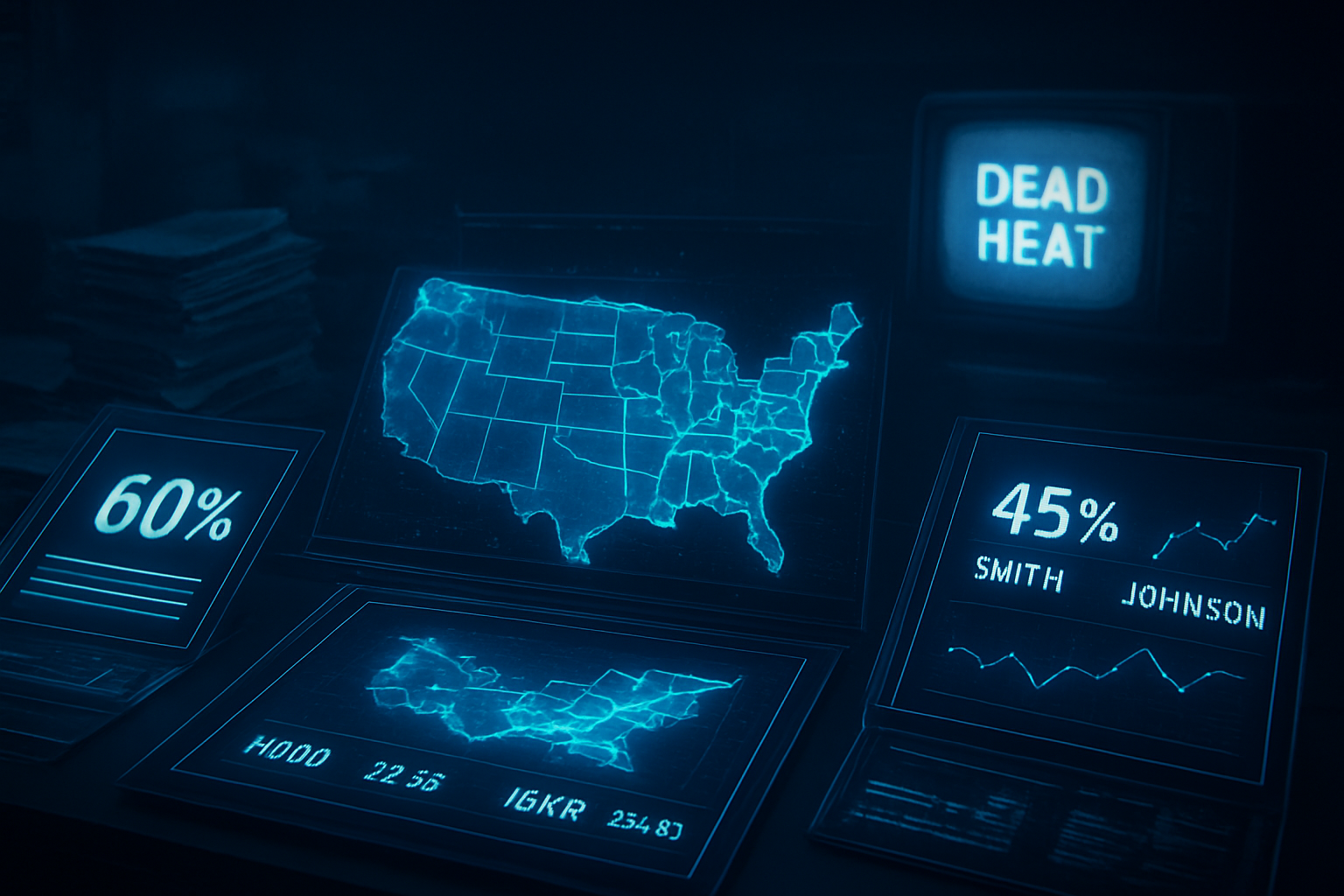
    The 2024 U.S. Presidential Election will be remembered not just for its political outcome, but as the moment the "narrative authority" in American discourse shifted from traditional polling to prediction markets. For decades, the public relied on poll aggregators and pundits to define the "toss-up" nature of elections. However, as the dust settled on the 2024 cycle, a clear winner emerged in the business of information: the markets. While traditional polls remained frozen in a "dead heat" narrative until Election Day, platforms like Polymarket and Kalshi had already moved to a 60% probability for a Trump victory weeks earlier—a signal that proved far more accurate than the "margin of error" hedging of the legacy media.

    As of January 15, 2026, this shift is no longer a fringe theory. It is a structural reality. Prediction markets have moved from the periphery of the crypto world into the core of the global financial system. Today, the probabilities generated by thousands of traders are treated with the same weight as the S&P 500 or Treasury yields. The 2024 election served as the ultimate proof-of-concept, demonstrating that when "skin in the game" meets real-time data, the resulting "wisdom of the crowd" updates faster and more accurately than any 1,000-person phone survey ever could.

    The Market: What's Being Predicted

    The 2024 Presidential Election market was the largest event contract in history, with Polymarket alone processing over $3.6$ billion in volume. During the final stretch in October 2024, the divergence between markets and polls reached a fever pitch. While the New York Times and other legacy outlets described a race within the margin of error, Trump’s odds on Polymarket and Kalshi climbed steadily, peaking between 57% and 67%. This gap led to accusations of market manipulation, but the resolution of the market—a decisive Trump victory—validated the traders' conviction.

    Today, the prediction market landscape has expanded significantly beyond that single election. Major financial institutions have stepped in to provide liquidity and access. Robinhood Markets, Inc. (NASDAQ: HOOD) launched its "Prediction Markets Hub" in early 2025, which has since become the company's fastest-growing business line. Similarly, Interactive Brokers Group, Inc. (NASDAQ: IBKR) integrated event contracts via its ForecastEx exchange, allowing institutional investors to hedge against geopolitical and economic risks. The market is no longer just predicting "who wins," but is now used for forecasting Fed rate decisions, Supreme Court rulings, and even corporate earnings.

    The shift in liquidity has been transformative. In the 2024 cycle, a "whale" making a $10 million bet could move the needle; in 2026, the participation of retail giants like Robinhood means that millions of smaller participants are providing a much "thicker" and more resilient price signal. These markets resolve instantly upon a verifiable event, such as an Associated Press call or a government data release, providing a definitive settlement that eliminates the weeks of post-game punditry that used to follow major events.

    Why Traders Are Betting

    The primary reason prediction markets outperformed polling in the 2024 cycle was the speed of information processing. Traditional polls often suffer from a "reality gap"—the 7 to 14 days it takes to collect, weight, and publish data. Traders, however, react in seconds. A prime example was the June 2024 debate between Joe Biden and Donald Trump. While pundits spent days debating the "optics," Polymarket odds for Biden’s withdrawal from the race surged from 20% to nearly 70% within hours. The polls didn't reflect this massive shift for nearly two weeks, by which time the political reality had already moved on.

    Traders also utilize granular, real-time data that pollsters often ignore. In the final weeks of 2024, "whales" on these platforms were reportedly monitoring early voting returns and voter registration shifts in key swing states like Pennsylvania and Nevada. By pricing in this hard data—rather than relying on "likely voter" models—the markets were able to identify Trump’s under-polled strength. This "information finance" approach allows participants to synthesize disparate signals, from satellite imagery of parking lots to obscure regulatory filings, into a single, actionable price.

    Comparison to traditional methods shows a stark contrast in incentives. A pollster faces little personal financial risk for being wrong if they stay within the "consensus" margin of error. A trader, however, faces immediate financial loss for inaccuracy. This incentive structure forces market participants to strip away personal bias and focus on the most likely outcome. This is why, despite a heavy media narrative favoring a Harris "momentum" story in late 2024, the markets remained skeptical, correctly identifying that the underlying data did not support the hype.

    Broader Context and Implications

    The success of prediction markets in 2024 has led to a total reconfiguration of media and regulation. In 2025, CNN and CNBC followed the lead of financial terminals by signing landmark data-sharing deals with Kalshi. Now, in early 2026, it is common to see live probability tickers during news broadcasts, replacing the outdated "pundit panels." This marks the official transition of prediction markets into the "truth layer" of the internet—a place where public sentiment is quantified rather than guessed.

    However, this transition hasn't been without conflict. We are currently witnessing a "preemption war" in the legal system. Following the landmark Kalshi v. CFTC ruling that legalized election betting at the federal level, several states including Michigan and Nevada attempted to classify these markets as "illegal gambling" in late 2025. A coalition of companies, including Robinhood (NASDAQ: HOOD) and Kalshi, is currently fighting these state-level bans in federal court, arguing that federal oversight by the Commodity Futures Trading Commission (CFTC) preempts state gambling laws.

    Beyond politics, the real-world implications are profound. Corporations are now using these markets to manage risk. For instance, a tech company might buy "Yes" contracts on a specific regulatory crackdown to hedge the potential drop in their stock price. This creates a more stable economic environment where "unforeseeable" events are actually priced in months in advance. The historical accuracy of these markets, particularly since the 2024 pivot, has turned them into an essential tool for both the C-suite and the kitchen table.

    What to Watch Next

    As we look toward the 2026 midterm elections, the focus has shifted to how these markets will handle even more complex local data. We are seeing the emergence of "hyper-local" markets that predict everything from mayoral races to city-level zoning changes. The key milestone to monitor will be the outcome of the current federal court cases regarding state-level bans. If the courts rule in favor of the Prediction Market Coalition by mid-2026, it will clear the way for a truly national, frictionless market.

    Another factor to watch is the integration of Artificial Intelligence into the trading ecosystem. By January 2026, an estimated 40% of prediction market volume is driven by AI agents that can scan thousands of news sources and data points simultaneously. This could lead to even faster market adjustments, potentially moving odds before a human can even read a headline. The interaction between human intuition and AI data processing will be the next frontier in refining the accuracy of these platforms.

    Finally, keep an eye on how traditional pollsters attempt to "market-ize" their own products. We are already seeing some legacy firms launching their own "expert-only" markets to compete with the retail-driven platforms. Whether these closed systems can compete with the massive liquidity of open platforms like Polymarket remains to be seen, but the competition is healthy for the overall goal: more accurate information.

    Bottom Line

    The shift from polling to prediction markets represents the most significant change in how we measure public opinion in a century. The 2024 election was the "Big Bang" for this industry, proving that financial incentives create a more accurate signal than voluntary surveys. By January 2026, the debate is no longer about whether these markets work, but about how far their influence will reach into every facet of our economic and social lives.

    For the average citizen, this means the end of the "polling rollercoaster." Instead of reacting to a single outlier poll that generates a week of anxiety-inducing headlines, we can now look at a stable, liquid market that aggregates all available information into a single number. While markets are not infallible and can still experience volatility, they have proven to be the most reliable compass in an increasingly complex and noisy information landscape.

    The legacy of the 2024 cycle is clear: in the battle for narrative authority, the crowd with skin in the game has won. As we move deeper into 2026, the question is no longer "What do the polls say?" but "Where is the money moving?" The answer to that question has become the most important signal in the world.


    This article is for informational purposes only and does not constitute financial or betting advice. Prediction market participation may be subject to legal restrictions in your jurisdiction.

    PredictStreet focuses on covering the latest developments in prediction markets.
    Visit the PredictStreet website at https://www.predictstreet.ai/.