Blog

  • The 99% Consensus: Why Prediction Markets Are Calling the Fed’s Bluff on Interest Rates

    The 99% Consensus: Why Prediction Markets Are Calling the Fed’s Bluff on Interest Rates

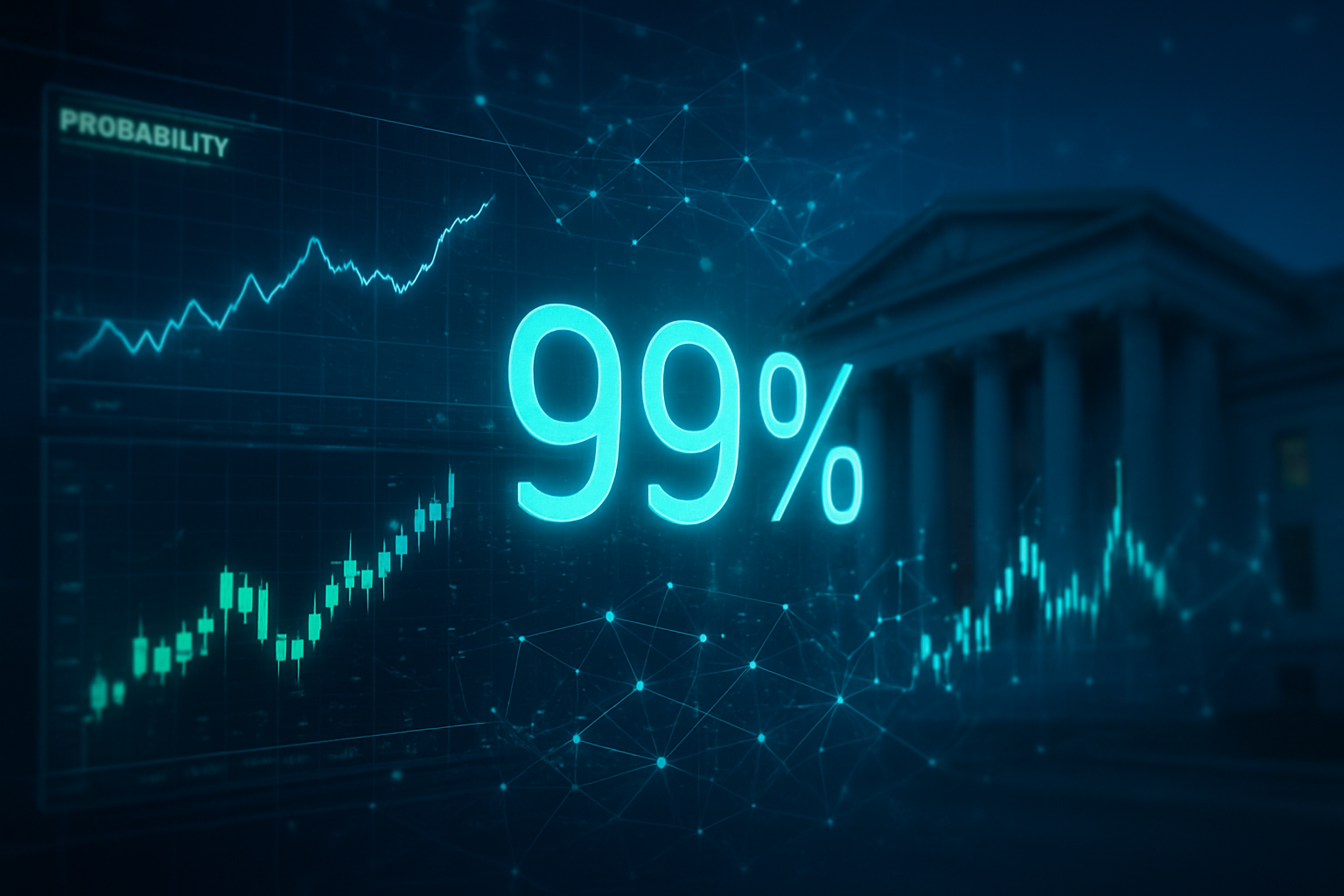
    As the Federal Open Market Committee (FOMC) convenes for its first meeting of 2026, the financial world is witnessing a rare moment of absolute conviction. On Polymarket, the world’s largest decentralized prediction market, the probability of the Federal Reserve maintaining interest rates at their current target of 3.50%–3.75% has surged to a staggering 99%. This near-certainty reflects a dramatic shift from late 2025, when traders were still debating the possibility of a fourth consecutive rate cut.

    The "No Change" consensus isn't just a hunch; it represents hundreds of millions of dollars in "skin in the game" betting that Chair Jerome Powell will opt for a "wait-and-see" approach. While traditional bank analysts at firms like Goldman Sachs (NYSE: GS) and JPMorgan (NYSE: JPM) were still debating the nuances of "sticky inflation" just weeks ago, prediction markets have been pricing in this pause with cold, mathematical precision. This 99% certainty has transformed the FOMC meeting from a high-stakes guessing game into a validation exercise for the burgeoning field of event-based forecasting.

    The Market: What's Being Predicted

    The specific market in question focuses on the outcome of the January 27–28, 2026, FOMC meeting. On Polymarket, the "Fed Interest Rate Decision: January 2026" contract has become one of the most liquid markets on the platform, with cumulative trading volume exceeding $471 million. As of this morning, the "No Change" contract is trading at $0.99, meaning a bettor must risk $99 to win a single dollar in profit—a level of confidence rarely seen in macro-economic forecasting.

    Other platforms tell a similar story. Kalshi, the federally regulated exchange, shows its "Fed maintains rate" contract trading between 98.5% and 99%. Even the CME Group’s (NASDAQ: CME) FedWatch Tool, which derives its data from 30-day Fed Funds futures, mirrors this sentiment with a 97.2% to 99% probability of a hold. The consistency across decentralized, regulated, and traditional futures markets suggests that the era of "Fed surprises" may be drawing to a close as prediction market liquidity deepens.

    The resolution criteria for these contracts are straightforward: the official press release from the Federal Reserve Board of Governors. If the target range remains at 3.50%–3.75% when the statement is released tomorrow afternoon, the "No" contracts will expire at $1.00, rewarding the massive pool of traders who have bet on stability.

    Why Traders Are Betting

    The 99% certainty is anchored in a trifecta of robust economic data that emerged in early January. First, the December 2025 jobs report showed the unemployment rate ticking down to 4.4%, easing fears of a labor market "hard landing." Second, the Atlanta Fed’s GDPNow tool estimated a blistering 5.4% annualized growth for Q4 2025. Finally, headline CPI has remained stubbornly fixed at 3.0%, well above the Fed's 2% target.

    Traders are also employing sophisticated "bonding" strategies. By betting on an outcome with a 99% probability, institutional "whales" are effectively using prediction markets as a high-yield savings account. A 1% return over the 48-hour duration of an FOMC meeting, when compounded throughout the year, represents an annualized return that dwarfs traditional fixed-income products. This "smart money" activity has been bolstered by the Intercontinental Exchange (NYSE: ICE), which recently finalized a $2 billion strategic investment in Polymarket, signaling that the institutional world now views these odds as a primary data source.

    Furthermore, a "lame duck" dynamic is influencing the market. Chair Jerome Powell’s term ends in May 2026, and reports of a Department of Justice investigation into the Fed's recent internal protocols have surfaced. Traders believe the Fed will stay the course to maintain a veneer of institutional stability and independence during this period of heightened political and legal scrutiny.

    Broader Context and Implications

    The shift toward prediction markets marks a fundamental change in how the public and institutions digest economic news. Historically, the "analyst consensus" from major banks like Morgan Stanley (NYSE: MS) or Nomura (NYSE: NMR) was the gold standard. However, data from 2024 and 2025 has begun to flip the script. During the December 2025 "pivot," prediction markets assigned a 95% probability to a rate cut while several major brokerages were still forecasting a hold. The markets were right; the analysts were late.

    This trend highlights the "wisdom of the crowd" in absorbing "statistical noise." A late-2025 government shutdown disrupted Bureau of Labor Statistics data, creating confusion for traditional models. Prediction market participants, however, successfully looked past the noisy data to the underlying economic strength, providing a cleaner signal than traditional economist surveys.

    Regulatory milestones have also fueled this growth. In November 2025, Polymarket officially returned to the U.S. market after acquiring the licensed exchange QCEX. While Kalshi continues to fight state-level battles in places like Massachusetts and Nevada, the overall trend is toward a regulated, liquid environment where event contracts are treated as legitimate hedging tools rather than mere gambling.

    What to Watch Next

    While the January "hold" is essentially priced to perfection, the real volatility lies in the "Dot Plot" and Powell’s post-meeting press conference. Traders will be looking for clues regarding the March 2026 meeting. Currently, prediction markets are split, with a 60% chance of a 25-basis-point cut in March, diverging from JPMorgan’s (NYSE: JPM) forecast that the Fed will hold rates steady through the entirety of 2026.

    Key milestones to monitor include:

    • The February Employment Situation Report: Any spike in unemployment could rapidly shift the March odds.
    • The "Shadow Chair" Race: As Powell's term winds down, markets on Kalshi for the next Fed Chair—with names like Rick Rieder and Kevin Warsh leading—will likely begin to correlate with interest rate expectations.
    • Inflation Print (Feb 12, 2026): If CPI remains at 3% or higher, the current 60% probability for a March cut may evaporate.

    Bottom Line

    The 99% certainty on Polymarket and Kalshi regarding the January FOMC decision is more than just a bet; it is a declaration of the new economic order. Prediction markets have evolved from niche experimental platforms into high-fidelity mirrors of reality, often moving faster and more accurately than the most prestigious research desks on Wall Street.

    As we move into 2026, the convergence of institutional capital from the likes of ICE (NYSE: ICE) and the regulatory "thaw" for platforms like Polymarket suggests that the "Fed Watch" of the future will happen on a blockchain or a regulated exchange, rather than in a bank's quarterly report. For now, the message from the markets is clear: Jerome Powell has found a level he likes, and he isn't moving until the data forces his hand.


    This article is for informational purposes only and does not constitute financial or betting advice. Prediction market participation may be subject to legal restrictions in your jurisdiction.

    PredictStreet focuses on covering the latest developments in prediction markets.
    Visit the PredictStreet website at https://www.predictstreet.ai/.
  • The New Wall Street: How Robinhood and Webull Turned Every American Into a Forecaster

    The New Wall Street: How Robinhood and Webull Turned Every American Into a Forecaster

    As of late January 2026, the financial landscape has undergone a tectonic shift that few saw coming just two years ago. The integration of prediction markets into the everyday brokerage accounts of millions has transformed "event contracts" from a niche obsession into a multi-billion dollar pillar of mainstream finance. Today, the ability to trade on the outcome of a Federal Reserve meeting or a geopolitical standoff is as accessible as buying a fractional share of an index fund.

    Currently, the market is bracing for the January 28 Federal Reserve announcement. While traditional futures markets suggest a modest 16% chance of a rate cut, prediction markets on Robinhood Markets, Inc. (NASDAQ: HOOD) and Kalshi are signaling a 96% "certainty" of a pause. This massive divergence is generating unprecedented interest, with over $1.2 billion in notional value changing hands in the last week alone. Traders are increasingly looking to these markets—not as a form of gambling, but as the most accurate "financial weather vane" available in the digital age.

    The Market: What's Being Predicted

    The central engine of this revolution is the "Binary Event Contract"—a simple "Yes/No" proposition that settles at $1.00 if an event occurs and $0.00 if it does not. Through strategic partnerships with Kalshi, a CFTC-regulated exchange, and the recent vertical integration of Robinhood Markets, Inc. (NASDAQ: HOOD) into the exchange space, retail traders now have 24/7 access to hundreds of these markets. These contracts are currently trading on Robinhood, Webull, and Interactive Brokers Group, Inc. (NASDAQ: IBKR) through its ForecastX subsidiary.

    The sheer volume of these markets is staggering. As of January 27, 2026, Robinhood has surpassed 11 billion event contracts traded since its initial pilot launch in late 2024. While political outcomes—such as the 2026 U.S. Midterm elections—remain the "heavyweights" of the platform, high-frequency "hourly" contracts on S&P 500 movements and Bitcoin price targets have become the bread and butter for retail speculators.

    Liquidity has improved dramatically, thanks to the entry of institutional market makers like Susquehanna International Group (SIG). In the past, a $100,000 bet could move a niche prediction market by 10 or 20 points. Today, the "Robinhood effect" ensures that even multi-million dollar positions in major economic contracts experience minimal slippage. This deep liquidity has allowed these platforms to challenge the dominance of offshore, unregulated competitors like Polymarket, which, despite its massive global mindshare, now shares the stage with the U.S.-regulated giants.

    Why Traders Are Betting

    The primary driver of the current "betting fever" is the search for "Alpha"—information that the traditional market hasn't priced in yet. Traders are using prediction markets to hedge real-world risks. For example, a homebuyer might buy "Yes" contracts on a Fed rate hike to offset the cost of their potential mortgage increase. This "financialization of information" has moved beyond speculation into a form of personal insurance.

    Recent "whale" activity has also fueled the fire. In mid-January 2026, a series of high-conviction trades on Venezuelan political stability—dubbed the "Maduro Trade"—saw massive returns for early movers, signaling a major geopolitical shift before traditional news outlets could even confirm the story. This "wisdom of the crowd" often acts as a leading indicator, moving 10 to 15 minutes ahead of the Bloomberg terminal.

    Furthermore, the psychology of the retail trader has evolved. The "gamification" of the 2021 meme-stock era has matured into a more sophisticated "skin in the game" philosophy. Notable retail "whales," some generating over $100,000 in monthly profits by specializing in niche categories like box office results or hyper-local weather patterns, have become influencers in their own right. They argue that prediction markets are the only "honest" markets because they reward accuracy over hype.

    Broader Context and Implications

    The mainstreaming of prediction markets via Robinhood and Webull represents a victory for the "democratization of finance." This shift was largely enabled by the CLARITY Act of 2025, which provided a clear federal regulatory roadmap for event derivatives. However, the road hasn't been entirely smooth. Just this month, regulators in Massachusetts and New York issued cease-and-desist orders against certain sports-related contracts, highlighting a growing tension between federal oversight and state-level gambling concerns.

    Historical data from the 2024 U.S. election proved that prediction markets were significantly more accurate than traditional polling, a fact that has emboldened the industry. This accuracy has led to the emergence of "Information Finance," a sector where firms like Intercontinental Exchange, Inc. (NYSE: ICE) are now investing billions. These companies view prediction market data as a valuable commodity, selling real-time probability feeds to hedge funds and government agencies.

    Perhaps the most significant move in this space occurred on January 21, 2026, when Robinhood completed its acquisition of a 90% stake in MIAXdx. By owning its own exchange and clearinghouse, Robinhood is signaling that it no longer wants to be just a storefront for Kalshi’s products; it wants to be the primary architect of the world's event-trading infrastructure.

    What to Watch Next

    The immediate focus for the market is the January 28 FOMC meeting. If the Fed defies the 96% probability and cuts rates, it could trigger one of the largest "liquidation events" in the history of prediction markets, testing the resilience of the clearinghouses. Beyond the Fed, the upcoming Super Bowl LXI in February is expected to be the largest sports-related prediction event in history, with Webull already offering zero-commission trading for the game.

    Investors should also monitor the legal battles in Massachusetts. A court victory for Kalshi could open the floodgates for more "exotic" contracts across all 50 states, while a loss could force platforms to geofence their most popular products. The evolution of the "Prediction Hub" on these apps is also expected to include more AI-driven sentiment analysis, helping users synthesize thousands of news points into a single "Yes/No" trade.

    Finally, keep an eye on the integration of these markets into retirement accounts. There are already whispers in Washington about a pilot program that would allow 401(k) participants to use event contracts for downside protection against inflation—a move that would truly cement prediction markets as a permanent fixture of the American financial diet.

    Bottom Line

    The integration of prediction markets into the platforms of Robinhood and Webull has fundamentally changed how the public interacts with news and data. What was once a hobby for mathematicians and political junkies is now a legitimate asset class used by millions to hedge risk and express opinions. The "wisdom of the crowd" is no longer a theoretical concept; it is a tradable, liquid, and highly accurate financial instrument.

    This shift tells us that the future of finance is not just about what companies are worth, but about what events are worth. As we look toward the 2026 Midterms and beyond, these markets will likely continue to outperform traditional forecasting methods. While regulatory hurdles remain, the momentum behind "Information Finance" appears unstoppable.

    For the retail trader, the message is clear: the era of being a passive observer of world events is over. In the world of 2026, every headline is a trade, and every prediction has a price.


    This article is for informational purposes only and does not constitute financial or betting advice. Prediction market participation may be subject to legal restrictions in your jurisdiction.

    PredictStreet focuses on covering the latest developments in prediction markets. Visit the PredictStreet website at https://www.predictstreet.ai/.
  • The Meta-Forecast: Betting on the Future of Information Finance in 2026

    The Meta-Forecast: Betting on the Future of Information Finance in 2026

    As of January 27, 2026, the prediction market industry is no longer a fringe hobby for statistics nerds or a seasonal interest for election cycles; it has evolved into a multi-billion dollar pillar of the global financial system known as "InfoFi" (Information Finance). On Manifold Markets, the industry's self-appointed "meta-layer," traders are currently obsessed with a high-stakes question: who will win the "Great Prediction War" of 2026?

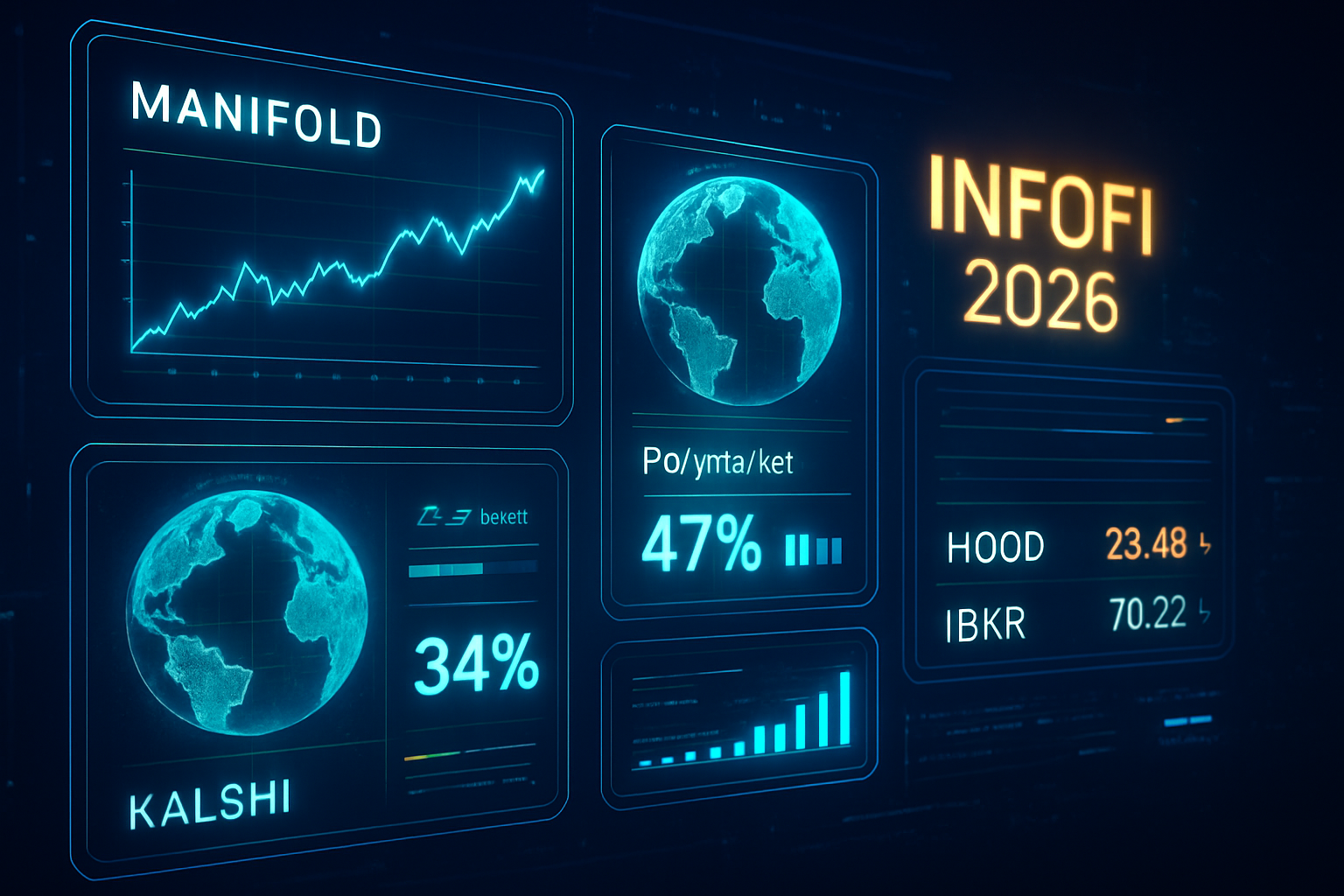
    With total industry volume reaching a staggering $13 billion per month in late 2025, meta-markets on Manifold are currently pricing a 47% probability that Polymarket will maintain its crown as the volume leader through the end of the year. However, the regulated giants are closing in. Interest in these meta-markets has skyrocketed as institutional liquidity from firms like Susquehanna International Group and Jane Street begins to treat event contracts not as "bets," but as sophisticated hedging tools for geopolitical and macroeconomic risk.

    The Market: What's Being Predicted

    The primary battleground for industry observers is the Manifold market titled "Top 1 Prediction Market by Volume in 2026." This contract tracks the total notional volume across the major players: Polymarket, Kalshi, and the rapidly ascending ForecastEx, owned by Interactive Brokers (NASDAQ: IBKR).

    As of today, the odds stand at:

    • Polymarket (47%): The crypto-native giant continues to lead, fueled by its role as the global "truth engine" for international events.
    • Kalshi (34%): Despite facilitating over $43 billion in trades in 2025, Kalshi’s odds have softened following a recent regulatory speed bump in Massachusetts regarding sports contracts.
    • ForecastEx (12%): A dark horse that recently surpassed $1 billion in cumulative notional volume, drawing in traditional finance (TradFi) users through the existing IBKR ecosystem.
    • Robinhood (7%): Following its high-profile joint venture with Susquehanna, Robinhood (NASDAQ: HOOD) has become the fastest-growing retail entrant, though its 2026 volume is still playing catch-up.

    Trading on these markets is characterized by high liquidity and a unique "insider" feel, as many participants are employees of these very platforms or professional market makers who provide the liquidity for the industry.

    Why Traders Are Betting

    The volatility in these meta-markets is being driven by three primary factors: regulatory arbitrage, the "InfoFi" narrative, and institutional product integration. Traders are currently reacting to a January 2026 preliminary injunction in Massachusetts that temporary banned "event contracts related to sports" on regulated exchanges. Since nearly 90% of Kalshi's record-breaking 2025 volume was derived from sports-adjacent markets, the "No" side of their dominance contract saw a massive 15% spike in volume this week.

    Meanwhile, the concept of Information Finance (InfoFi)—the idea that prediction markets are the most efficient way to price the probability of truth—is moving from theory to reality. Projects like Intuition, which launched its mainnet in late 2025, have convinced Manifold traders that the industry's growth is "non-linear." There is currently a 53% probability on Manifold that a major bank CEO, such as Jamie Dimon of JPMorgan Chase & Co. (NYSE: JPM), will publicly endorse prediction markets as a legitimate asset class before the end of Q3 2026.

    Finally, the entry of Coinbase (NASDAQ: COIN) into the space via its acquisition of The Clearing Company has signaled to traders that the infrastructure for a $10 trillion annual volume rate—the "bull case" for 2026—is finally being built.

    Broader Context and Implications

    This meta-forecasting trend reveals a fundamental shift in how the public views information. In 2024, prediction markets were used to "fact-check" polls; in 2026, they are being used to price the very future of the platforms themselves. This represents the ultimate "skin in the game" for an industry built on the premise that financial incentives lead to better forecasting.

    The regulatory implications are particularly significant. A dominant market on Manifold currently gives an 81% chance that federal preemption will eventually protect Designated Contract Markets (DCMs) from varying state-level bans. If this "Yes" outcome triggers, it would effectively create a unified national market for event contracts in the U.S., similar to the equity markets.

    Historically, Manifold's meta-markets have been eerily accurate. In late 2024, Manifold traders correctly predicted the exact quarter that Kalshi would achieve its first $1 billion month, months before it happened. The current betting activity suggests that 2026 will be the year where regulated (Kalshi, IBKR) and decentralized (Polymarket) volumes finally begin to converge as the legal "grey areas" evaporate.

    What to Watch Next

    The most immediate catalyst for these markets is the resolution of the "Public Integrity in Financial Prediction Markets Act" (H.R. 7004), currently making its way through Congress. If passed, it would formalize the rules around insider trading on event contracts—a move that sounds restrictive but is actually viewed as "bullish" by traders because it provides the legal framework necessary for pension funds and insurance companies to enter the market.

    Key dates to monitor include:

    • February 15, 2026: The deadline for the CFTC to respond to the Massachusetts injunction, which will likely decide Kalshi’s volume trajectory for the first half of the year.
    • Q2 2026 Earnings: Watch for Robinhood (NASDAQ: HOOD) to report its first full quarter of "Event Derivatives" revenue, which many expect will surprise to the upside.

    Traders should also keep an eye on the "Social-to-Market" pipeline. There is an active market on whether a major social media platform like X (formerly Twitter) or Reddit will integrate native prediction market widgets, a move that would likely push the "InfoFi" adoption probability toward 90%.

    Bottom Line

    The meta-markets on Manifold suggest that the prediction market industry is entering its "scaling phase." While Polymarket remains the volume king due to its global reach and crypto integration, the institutional weight behind ForecastEx and the retail power of Robinhood make the 2026 volume lead a closer race than most realize.

    The rise of InfoFi represents a paradigm shift where information is no longer just consumed—it is priced, traded, and verified through financial incentives. Whether the industry hits the predicted $10 trillion annual volume target by the end of 2026 remains to be seen, but the "smart money" on Manifold is betting that the search for truth has finally found its business model.

    In 2026, we aren't just predicting the news; we are betting on the machines that predict the news.


    This article is for informational purposes only and does not constitute financial or betting advice. Prediction market participation may be subject to legal restrictions in your jurisdiction.

    PredictStreet focuses on covering the latest developments in prediction markets.
    Visit the PredictStreet website at https://www.predictstreet.ai/.
  • Predictive Power: Iran Conflict Markets Surge to $107M as Traders Price in 83% Chance of US Action

    Predictive Power: Iran Conflict Markets Surge to $107M as Traders Price in 83% Chance of US Action

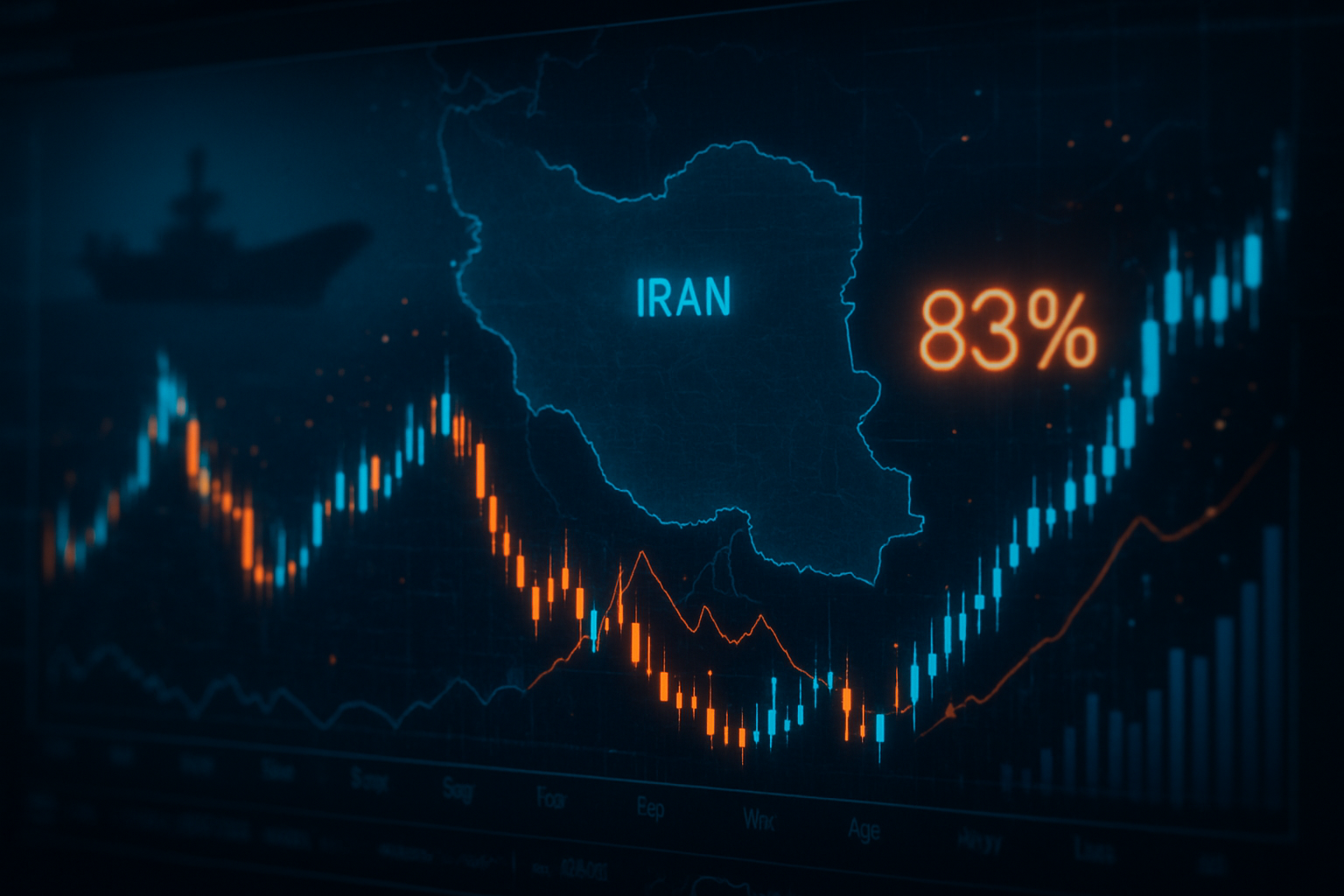
    As of January 27, 2026, the geopolitical landscape in the Middle East has reached a fever pitch, and nowhere is this tension more visible than on global prediction markets. Polymarket, the world’s largest decentralized prediction platform, has seen the volume in its Iran-related military action markets explode to over $107 million. Traders are currently pricing in a staggering 83% probability that the United States will conduct a military strike against Iranian targets before June 30, 2026—a sharp climb from just 48% at the start of the year.

    The surge in trading activity follows a volatile 2025, marked by direct military confrontations and shifting diplomatic alliances. What was once dismissed as "digital gambling" has transformed into a critical barometer for global risk. With millions of dollars at stake, these markets are no longer just reflecting public opinion; they are serving as a high-stakes "shadow intelligence" network that many institutional investors now monitor more closely than traditional news broadcasts from outlets like CNN, owned by Warner Bros. Discovery (NASDAQ: WBD).

    The Market: What's Being Predicted

    The focal point of this massive liquidity is the "US Military Action Against Iran" umbrella market on Polymarket. This contract, which has recorded over $107 million in total volume, requires a definitive "Yes" resolution if the U.S. military executes an airstrike, naval attack, or ground operation on Iranian soil, airspace, or maritime territory. While the 83% chance of U.S. action dominates the long-term outlook, short-term contracts are equally active. A market predicting an Israeli strike by January 31, 2026, is currently trading at a low 6%—a dramatic drop from 53% earlier this month—suggesting that traders believe unilateral Israeli action is being sidelined in favor of a coordinated, U.S.-led operation.

    The resolution criteria for these markets are notoriously strict to prevent ambiguity. For a "Yes" to be triggered, the action must be a physical kinetic strike; economic sanctions or cyberattacks are explicitly excluded. Verification relies on official government statements or a consensus of at least five major international news organizations, including Thomson Reuters (NYSE: TRI), the Associated Press, and The New York Times Company (NYSE: NYT). This level of rigor has attracted professional arbitrageurs and institutional desks looking for a clear, binary way to play geopolitical volatility.

    Why Traders Are Betting

    The current bullishness on military action is heavily informed by the events of June 2025, known as "Operation Rising Lion." During that period, Israel conducted surgical strikes on Iranian nuclear facilities in Natanz and Isfahan. In the 48 hours leading up to those strikes, Polymarket odds for an Israeli attack surged from 14% to nearly 99%, providing a much faster signal than traditional media. This historical accuracy has emboldened traders in the current cycle.

    However, the market is also being driven by whispers of "insider" activity. The platform is still reeling from the controversy surrounding a trader known as "Rundeep," who allegedly placed massive "Yes" bets just hours before Operation Rising Lion. This has led to increased scrutiny from intelligence agencies, including Israel's Shin Bet, though the decentralized nature of the platform makes enforcement difficult. Beyond speculation, the fundamental drivers include the continued expansion of Iran's enrichment programs and the recent deployment of U.S. carrier strike groups to the North Arabian Sea, which many see as a precursor to the 83% probability currently reflected in the odds.

    Broader Context and Implications

    The evolution of these markets represents a paradigm shift in risk management. Hedge funds are no longer just using traditional derivatives to hedge their energy exposure; they are "shorting" peace. For instance, risk managers for global logistics firms have been using the "Strait of Hormuz Closure" market—currently at 48%—to offset potential spikes in shipping insurance costs. The "wisdom of the crowd" found in prediction markets often incorporates fragmented information from ground-level sources and diplomatic leaks that haven't yet reached the mainstream.

    Furthermore, these markets have shown a significant correlation with other asset classes. Analysts have noted a high inverse correlation between the "Iran Strike" odds and the price of Bitcoin, while safe-haven assets have moved in tandem with the conflict probability. In early 2026, as the odds of a U.S. strike climbed, Gold prices surged past the $5,000 per ounce mark. Even major tech platforms like Alphabet Inc. (NASDAQ: GOOGL) via Google Finance have begun integrating real-time prediction market data into their dashboards, signaling a growing acceptance of these odds as legitimate financial signals.

    What to Watch Next

    The immediate focus for traders is the January 31, 2026, deadline for the unilateral Israeli strike market. While the 6% probability suggests the immediate threat of a solo mission has passed, any sudden movement in these odds could signal a breakdown in U.S.-Israel coordination. Market participants are also keeping a close eye on the "Regime Stability" contracts. Currently, there is a 27% probability that Supreme Leader Ali Khamenei will be removed from power by March 31, 2026, reflecting the domestic unrest that has plagued Iran since late 2025.

    As we approach the June 30th deadline for the primary U.S. strike market, expect liquidity to tighten and volatility to increase. Key dates for U.S. Congressional testimony on Middle East policy and the scheduled rotation of naval assets in the Persian Gulf will be major catalysts for market movement. Traders will be looking for any deviation from the current 83% "Yes" price as a signal of a possible diplomatic breakthrough or a delay in military plans.

    Bottom Line

    The $107 million volume in Iran military action markets underscores a new reality: prediction markets are becoming the world’s most efficient processing engine for geopolitical risk. By incentivizing the discovery of truth through financial gain, platforms like Polymarket are providing a level of clarity that traditional intelligence and media often struggle to match. The high conviction behind an impending U.S. strike suggests that the "smart money" is preparing for a significant escalation in the first half of 2026.

    Whether these markets are accurately predicting the future or simply reflecting a collective anxiety, their impact on modern finance is undeniable. As tools for hedging and "shadow intelligence," they have become essential for anyone navigating the complexities of the modern Middle East. For now, all eyes remain on the 83% probability, a number that carries the weight of billions in potential economic impact and the lives of millions in the region.


    This article is for informational purposes only and does not constitute financial or betting advice. Prediction market participation may be subject to legal restrictions in your jurisdiction.

    PredictStreet focuses on covering the latest developments in prediction markets. Visit the PredictStreet website at https://www.predictstreet.ai/.

  • Arctic Real Estate: How the ‘Greenland Framework’ is Shaking Up Prediction Markets

    Arctic Real Estate: How the ‘Greenland Framework’ is Shaking Up Prediction Markets

    The "Greenland Framework," a diplomatic and strategic pivot announced by President Donald Trump at the World Economic Forum in Davos on January 21, 2026, has sent shockwaves through geopolitical prediction markets. After weeks of escalating tensions that some dubbed the "Arctic Missile Crisis," the market is now pricing in a sophisticated compromise: the transition from an outright purchase of the world's largest island to a "sovereign lease" model.

    As of late January 2026, the probability of the United States establishing a permanent, sovereign-controlled presence in Greenland by the end of President Trump’s term has surged. Traders are no longer betting on a simple real estate transaction, but on a complex geopolitical architecture that integrates Greenland into the U.S. "Golden Dome" missile defense system. This shift has triggered record volume on platforms like Polymarket and Kalshi, as participants weigh the likelihood of a "Cyprus-style" arrangement over the next three years.

    The Market: What's Being Predicted

    The betting landscape for Greenland has matured significantly since the initial rumors surfaced in 2019. On Polymarket, the contract for "U.S. acquires Greenland by end of 2026" is currently trading at 23%, a significant bounce from the 5% lows seen in mid-2025. However, the real action is in the longer-dated markets. On Kalshi, the probability that the U.S. will achieve "sovereign control or title" over any part of Greenland by January 20, 2029, is currently sitting at 43%, with total trading volume across Greenland-related contracts nearing $20 million.

    The resolution criteria for these markets have become increasingly granular. Most platforms now specify that "acquisition" includes the creation of Sovereign Base Areas (SBAs), similar to the British territories in Cyprus. This allows for a "Yes" resolution even if the entire island does not become the 51st state, provided the U.S. gains "right, title, and ownership" over strategic zones like the Pituffik Space Base. This nuance has allowed liquidity to pool in "partial acquisition" contracts, which are currently trading at a premium compared to "total annexation" scenarios.

    Why Traders Are Betting

    The primary driver of the recent market volatility was the "Greenland Crisis" of early January 2026. After Deputy Chief of Staff Stephen Miller declined to rule out military force to secure the island’s rare earth minerals, odds for a forced takeover spiked to nearly 40%. However, the unveiling of the "Greenland Framework" in Davos provided a diplomatic off-ramp. Traders are now betting that the Trump administration will use 25% tariffs on European goods—specifically targeting Denmark and its neighbors—as a "hammer" to force a lease agreement rather than a sale.

    Strategic interests are also fueling the "Yes" side of the trade. The integration of Greenland into the "Golden Dome" (NYSE:RTX)—the space-based missile defense constellation—is seen by defense analysts as a non-negotiable for the Pentagon. Reports of a $2 billion contract for SpaceX to provide a 600-satellite "Starshield" constellation have led traders to believe the U.S. will not stop until its "ground station bridge" in Greenland is fully secured. Additionally, the U.S. Commerce Department's $1.6 billion investment in companies like USA Rare Earth (Nasdaq:USAR) signals a long-term commitment to bypassing Chinese supply chains via Greenlandic minerals.

    Broader Context and Implications

    This market represents a new era for prediction platforms, which are increasingly being used as "real-time sentiment gauges" for high-stakes diplomacy. Unlike traditional polling, which struggled to capture the rapid shift in Danish-U.S. relations, prediction markets reacted instantly to the appointment of Louisiana Governor Jeff Landry as Special Envoy to Greenland. Traders recognized Landry’s "culinary diplomacy"—involving high-profile fishing trips with Greenlandic officials—as a signal that the administration was moving toward a "hearts and minds" economic approach rather than a purely hostile one.

    The real-world implications are immense. If the "Greenland Framework" succeeds, it could redefine national sovereignty in the 21st century, creating a precedent for "sovereign economic zones" in strategic territories. For investors, the "Greenland Trade" has extended beyond the prediction platforms and into the equities of mining firms. Amaroq Minerals (TSXV:AMRQ), which holds significant gold and strategic metal assets in South Greenland, has seen its stock price correlate closely with the "Yes" odds on Kalshi, serving as a secondary vehicle for those looking to play the Greenland narrative.

    What to Watch Next

    The next major catalyst for this market will be the scheduled "Operation Arctic Endurance" in mid-2026. This NATO-led exercise will test the security of the proposed Greenland corridor and serve as a "stress test" for the Framework. If Denmark or the Greenlandic Parliament (Inatsisartut) refuses to participate or blocks U.S. access during the exercise, expect the "Yes" odds for 2026 to plummet while the "forced acquisition" contracts on decentralized platforms may see a speculative spike.

    Traders should also monitor the U.S. Treasury’s implementation of the 10% "Greenland Tariff" on European nations currently opposing the Framework. Any signs of a "thaw" in Copenhagen—perhaps prompted by economic pressure or a promise of shared mineral royalties—would likely send the odds of a 2029 acquisition toward the 60% mark. Conversely, a victory for the opposition in the upcoming Danish snap elections could freeze negotiations entirely.

    Bottom Line

    The Greenland Framework has transformed a fringe geopolitical meme into a multi-million dollar prediction market. By moving from a "purchase" to a "sovereign lease" model, the Trump administration has created a viable, albeit controversial, path forward that markets are beginning to take seriously. The current 43% probability on Kalshi suggests that while the deal is far from certain, it is no longer being treated as a fantasy.

    Prediction markets have proven to be an invaluable tool in this saga, cutting through the noise of diplomatic "no's" to reveal a underlying belief that economic and security pressures will eventually lead to a U.S. foothold on the island. As we move deeper into 2026, the intersection of missile defense, rare earth mining, and aggressive trade policy will continue to make the Greenland market one of the most volatile and closely watched sectors in the forecasting world.


    This article is for informational purposes only and does not constitute financial or betting advice. Prediction market participation may be subject to legal restrictions in your jurisdiction.

    PredictStreet focuses on covering the latest developments in prediction markets.
    Visit the PredictStreet website at https://www.predictstreet.ai/.
  • The $100 Million Play: How Kalshi’s Regulated Sports Markets are Rewriting the Playbook for Institutional Bettors

    The $100 Million Play: How Kalshi’s Regulated Sports Markets are Rewriting the Playbook for Institutional Bettors

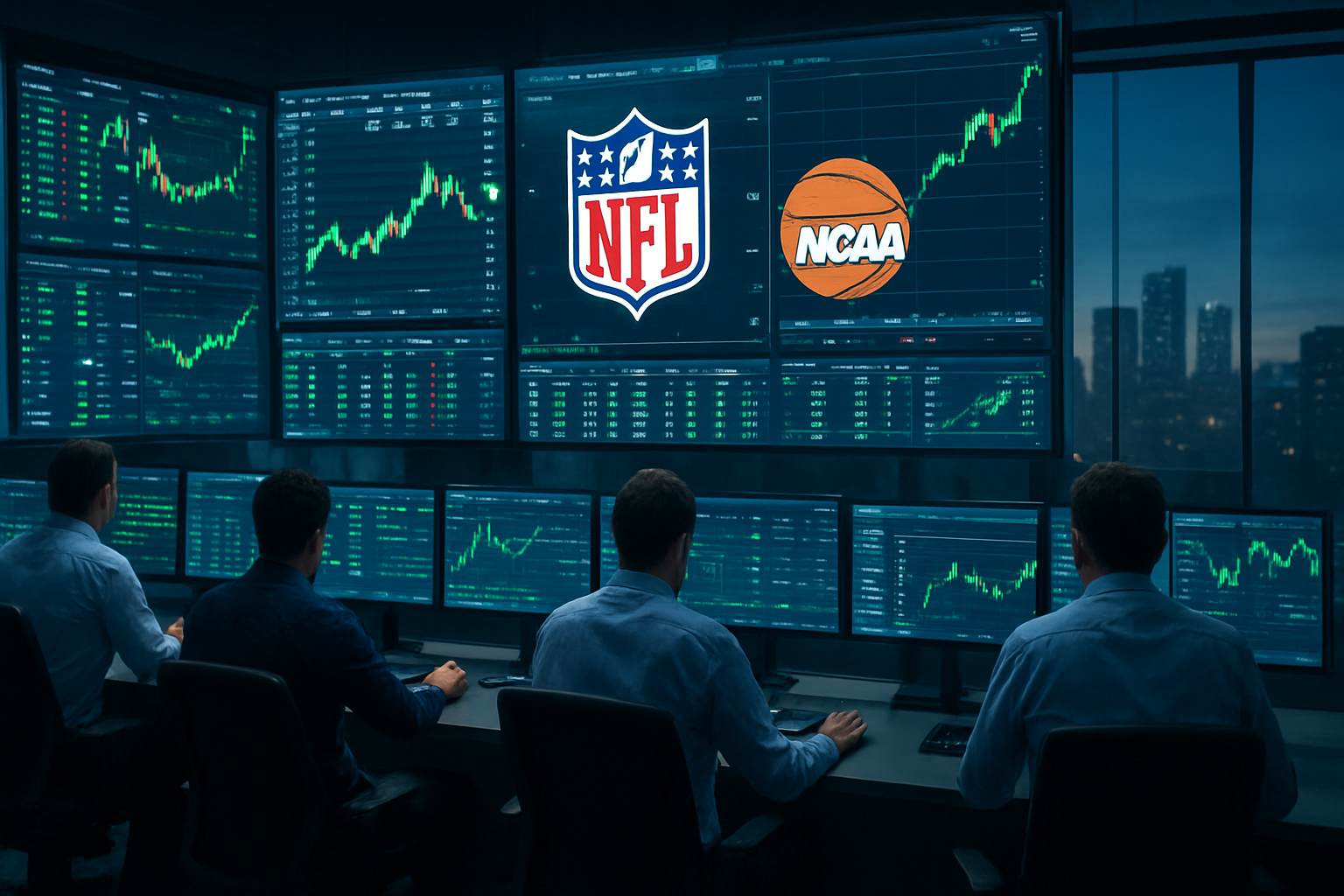
    In the week following the NCAA Football Championship, the dust is settling on more than just the gridiron. On January 20, 2026, the championship game did more than crown a college football king; it solidified Kalshi as a financial juggernaut. The platform recorded a staggering $111 million in trading volume for the single event, a figure that signals a tectonic shift in how Americans—and increasingly, Wall Street—engage with sports.

    Currently, the markets for the upcoming Super Bowl LX are already seeing nearly $150 million in open interest, with odds fluctuating as professional trading desks move multi-million dollar positions. This is no longer just "betting" in the traditional sense; it is the financialization of sports outcomes through federally regulated event contracts. Driven by a landmark regulatory victory and integration into major retail brokerages, Kalshi has transformed sports results into a legitimate asset class, attracting institutional-scale liquidity that was previously confined to offshore exchanges or private bookmakers.

    The Market: What's Being Predicted

    The core of Kalshi’s explosion lies in its "event contracts," which are binary options that pay out $1 if an event occurs and $0 if it does not. Unlike traditional sportsbooks where you "place a bet" against the house, Kalshi operates a peer-to-peer exchange where traders buy and sell contracts from one another. In the lead-up to the 2025-2026 NFL playoffs, this model allowed for unprecedented liquidity. For instance, the final day of the NFL regular season on January 4, 2026, saw a single-day volume record of $403 million.

    While Polymarket continues to dominate the decentralized, crypto-native space, Kalshi has carved out a massive lead in the regulated U.S. domestic market. By the third week of January 2026, total trading volume for the NFL playoffs reached nearly $2 billion. The resolution criteria for these markets are strictly defined by official league data, ensuring that contracts settle instantly upon the final whistle. This transparency has allowed Kalshi to list complex derivatives, including point spreads and player performance metrics, all under the watchful eye of federal regulators.

    Why Traders Are Betting

    The migration of capital toward Kalshi is driven by one primary factor: regulatory certainty. Following the 2024 court victory in KalshiEX LLC v. CFTC, and the subsequent decision by the Commodity Futures Trading Commission (CFTC) to drop its appeal in May 2025, Kalshi’s status as a Designated Contract Market (DCM) became unassailable. This regulatory "seal of approval" has opened the floodgates for institutional participants.

    Unlike traditional sportsbooks—which are notorious for limiting or banning "sharp" bettors who win too consistently—Kalshi’s exchange model welcomes winners. Large-scale proprietary trading firms and hedge funds now treat touchdowns and game wins as "Zero Days to Expiration" (0DTE) derivatives. They use these contracts to hedge macro risks or to capitalize on high-frequency data models that traditional books cannot accommodate. Furthermore, the integration of Kalshi markets into platforms like Robinhood (NASDAQ: HOOD) and Coinbase (NASDAQ: COIN) has brought institutional-level liquidity into the hands of over 24 million retail users, creating a deeper, more stable market than any sportsbook could offer.

    Broader Context and Implications

    The success of Kalshi represents a pivotal moment in the "Prediction Market vs. Gambling" debate. By framing sports outcomes as event contracts under the Commodity Exchange Act (CEA), Kalshi has managed a feat that traditional sports betting apps like DraftKings or FanDuel could not: federal preemption. Recent rulings in federal courts have suggested that the CEA preempts state-level gaming restrictions, allowing Kalshi to legally offer sports trading in all 50 U.S. states, including major markets like California and Texas where traditional online sports betting remains prohibited.

    This shift reveals a growing public appetite for transparent, low-fee alternatives to the "vig-heavy" model of traditional gambling. It also highlights a change in public sentiment; sports are increasingly viewed through the lens of data and probability rather than just loyalty and luck. However, this growth has not come without friction. The NCAA has voiced significant concerns regarding the integrity of college sports, particularly around "player prop" markets. In response, Kalshi has had to balance its aggressive expansion with "market design" concessions, such as pulling controversial transfer portal markets in late 2025 to maintain its standing with federal regulators.

    What to Watch Next

    All eyes are now turned toward Super Bowl LX on February 8, 2026. Early trading suggests the championship winner market could surpass $300 million in volume before kickoff. This will be the ultimate test of Kalshi’s infrastructure and its ability to handle "Black Swan" events or massive late-game volatility without the "suspension of play" issues that often plague traditional sportsbooks during high-volume periods.

    Beyond the Super Bowl, the next major milestone is March Madness 2026. Following the $350 million trading week in mid-January for NCAA basketball, analysts expect the tournament to break all previous records for prediction market engagement. Traders will be watching closely for any new regulatory guidance from the CFTC regarding "micro-trading" or live in-game contracts, which represent the next frontier for the platform.

    Bottom Line

    Kalshi’s rise marks the end of the era where sports betting was a sidelined, "sin-taxed" activity and the beginning of its life as a legitimate financial instrument. The $111 million NCAA Championship volume is not an outlier; it is the new baseline for a world where sports data is as tradable as oil or gold.

    For the broader prediction market ecosystem, Kalshi’s success proves that regulation, rather than being a hindrance, can be a massive catalyst for liquidity when paired with a superior exchange model. As institutional capital continues to pour into these markets, the line between "trader" and "fan" will continue to blur, forever changing the landscape of both Wall Street and the stadium.


    This article is for informational purposes only and does not constitute financial or betting advice. Prediction market participation may be subject to legal restrictions in your jurisdiction.

    PredictStreet focuses on covering the latest developments in prediction markets.
    Visit the PredictStreet website at https://www.predictstreet.ai/.
  • The ‘STOCK Act for InfoFi’: Markets Skeptical of Congressional Crackdown on Insider Trading

    The ‘STOCK Act for InfoFi’: Markets Skeptical of Congressional Crackdown on Insider Trading

    The nascent but rapidly maturing world of "Information Finance" (InfoFi) is facing its most significant regulatory test yet. Introduced in early January 2026, the Public Integrity in Financial Prediction Markets Act of 2026 (H.R. 7004) seeks to formally ban federal officials, political appointees, and government employees from trading in prediction markets using non-public information. The bill, which many have dubbed the "STOCK Act for Prediction Markets," comes in the wake of a scandalous wager involving the ouster of a foreign leader that has sent shockwaves through Washington and the financial world.

    Despite the high-profile nature of the controversy, prediction markets themselves remain unconvinced that the legislative hammer will fall anytime soon. On the non-profit platform PredictIt, contracts for the bill’s passage in 2026 are currently trading at a lowly 12 to 15 cents, implying less than a 15% probability that the legislation will clear both chambers and reach the President's desk this year. This skepticism highlights a growing disconnect between the public outrage in the halls of Congress and the cold, hard calculations of the trading pits.

    The Market: What's Being Predicted

    The primary venue for speculating on this legislative outcome is PredictIt, where the market "Will H.R. 7004 pass in 2026?" has seen a surge in volume since the bill’s introduction on January 9. Trading opened at a cautious 8 cents and peaked briefly at 22 cents following a fiery press conference by the bill’s sponsor, Rep. Ritchie Torres (D-NY), before settling back to its current range. The low price suggests that while the bill has political momentum, traders expect it to languish in the House Committee on Oversight and Accountability, a common fate for ethics-related legislation during a midterm election cycle.

    On Kalshi, the first CFTC-regulated prediction market in the U.S., the platform has opted not to list a direct contract on the bill to avoid potential conflicts of interest among its politically active user base. However, traders are using a proxy market: "Will the CFTC adopt new insider trading rules by year-end?" That contract is currently priced at 20 cents (20%), reflecting a belief that even if H.R. 7004 fails, regulatory agencies may act independently to tighten the screws on market participants.

    The liquidity in these markets has remained robust, with over $500,000 in open interest across the major platforms. The resolution criteria are strictly tied to the bill being signed into law by 11:59 PM ET on December 31, 2026.

    Why Traders Are Betting

    The sudden urgency for H.R. 7004 was sparked by the now-infamous "Maduro Trade." On January 3, 2026, an anonymous trader on the decentralized platform Polymarket wagered $32,000 that Venezuelan leader Nicolás Maduro would be removed from power by the end of the month. Hours later, the U.S. government announced "Operation Absolute Resolve," a successful raid that led to Maduro’s capture. The trader's position skyrocketed, netting a profit of over $400,000.

    "The timing was too perfect to be anything other than a leak from someone with high-level security clearance," said one veteran PredictIt trader. This event has become the "smoking gun" for proponents of H.R. 7004, who argue that prediction markets have become a "dark pool" for government insiders to monetize classified intelligence.

    However, the "No" voters (those betting against the bill) point to the gridlocked nature of the current Congress. With a slim majority and a crowded legislative calendar, passing a bill that restricts the financial activities of members of Congress and their staff is a notoriously difficult task. Furthermore, platforms like Interactive Brokers Group (NASDAQ: IBKR) and Robinhood Markets, Inc. (NASDAQ: HOOD), which have expanded their "event contract" offerings, have lobbied for "surgical" regulation rather than broad bans, fearing that over-regulation could stifle the liquidity that makes these markets useful forecasting tools.

    Broader Context and Implications

    The debate over H.R. 7004 represents a pivotal moment for the prediction market industry. For years, proponents like economist Robin Hanson have argued that "insider trading" is actually a feature of these markets, as it forces the most accurate information to the surface. However, as prediction markets move into the mainstream—competing with traditional financial instruments—they are being held to the same integrity standards as the Nasdaq (NASDAQ: NDAQ) or the New York Stock Exchange.

    Tarek Mansour, CEO of Kalshi, has taken a proactive stance, publicly supporting the spirit of H.R. 7004. He argues that regulated U.S. exchanges already have surveillance systems in place to catch suspicious activity, similar to those used by the Cboe Global Markets (BATS: CBOE). By codifying these rules into law, the industry hopes to distinguish "clean" regulated platforms from offshore, unregulated competitors that have become magnets for illicit activity.

    If the bill were to pass, it would likely lead to a "Know Your Customer" (KYC) overhaul across the industry, requiring platforms to flag accounts held by "Politically Exposed Persons" (PEPs). This could temporarily reduce liquidity but significantly increase the institutional credibility of prediction markets as a source of "truth" for policymakers and businesses.

    What to Watch Next

    The next major catalyst for the market will be a scheduled hearing in the House Financial Services Committee in late February 2026. Market analysts suggest that if the bill gains even a single prominent Republican co-sponsor during that session, the odds on PredictIt could jump from 15% to over 30% instantly.

    Additionally, the Commodity Futures Trading Commission (CFTC) is expected to release its report on the "Maduro Trade" investigation in early March. Any evidence linking the trade to a specific government official would likely create an irresistible public mandate for Congress to act, potentially forcing a floor vote on H.R. 7004 before the summer recess.

    Investors should also watch for any defensive moves from the major platforms. If Polymarket or other decentralized venues implement voluntary bans on federal official trading, the "fire" behind the legislative push might subside, as lawmakers often prefer industry self-regulation over passing new statutes.

    Bottom Line

    The "Public Integrity in Financial Prediction Markets Act" is the first major legislative attempt to define the boundaries of the "InfoFi" era. While the markets are currently pricing in a high degree of skepticism regarding the bill's passage, the underlying issues of market integrity and insider access are not going away.

    For prediction markets to fulfill their potential as "truth machines," they must navigate the transition from a niche hobby to a regulated financial ecosystem. Whether or not H.R. 7004 becomes law, the "Maduro Trade" has ensured that the days of consequence-free insider wagering in prediction markets are likely over. Traders who can correctly anticipate the timing and severity of this regulatory "moat-building" will be the ones who profit as the industry matures.


    This article is for informational purposes only and does not constitute financial or betting advice. Prediction market participation may be subject to legal restrictions in your jurisdiction.

    PredictStreet focuses on covering the latest developments in prediction markets. Visit the PredictStreet website at https://www.predictstreet.ai/.
  • The $44 Billion Prediction War: How Kalshi and Polymarket Redefined the Truth in 2026

    The $44 Billion Prediction War: How Kalshi and Polymarket Redefined the Truth in 2026

    As of January 27, 2026, the global financial landscape has been permanently altered by what analysts are calling the "Great Prediction War." This isn't a conflict of weapons, but of data, liquidity, and "truth pricing." For the first time in history, the collective intelligence of the crowd is outperforming traditional polling, expert analysis, and even some institutional intelligence services. At the center of this revolution are two titans: the regulated, sports-heavy Kalshi and the geopolitical "truth engine" Polymarket.

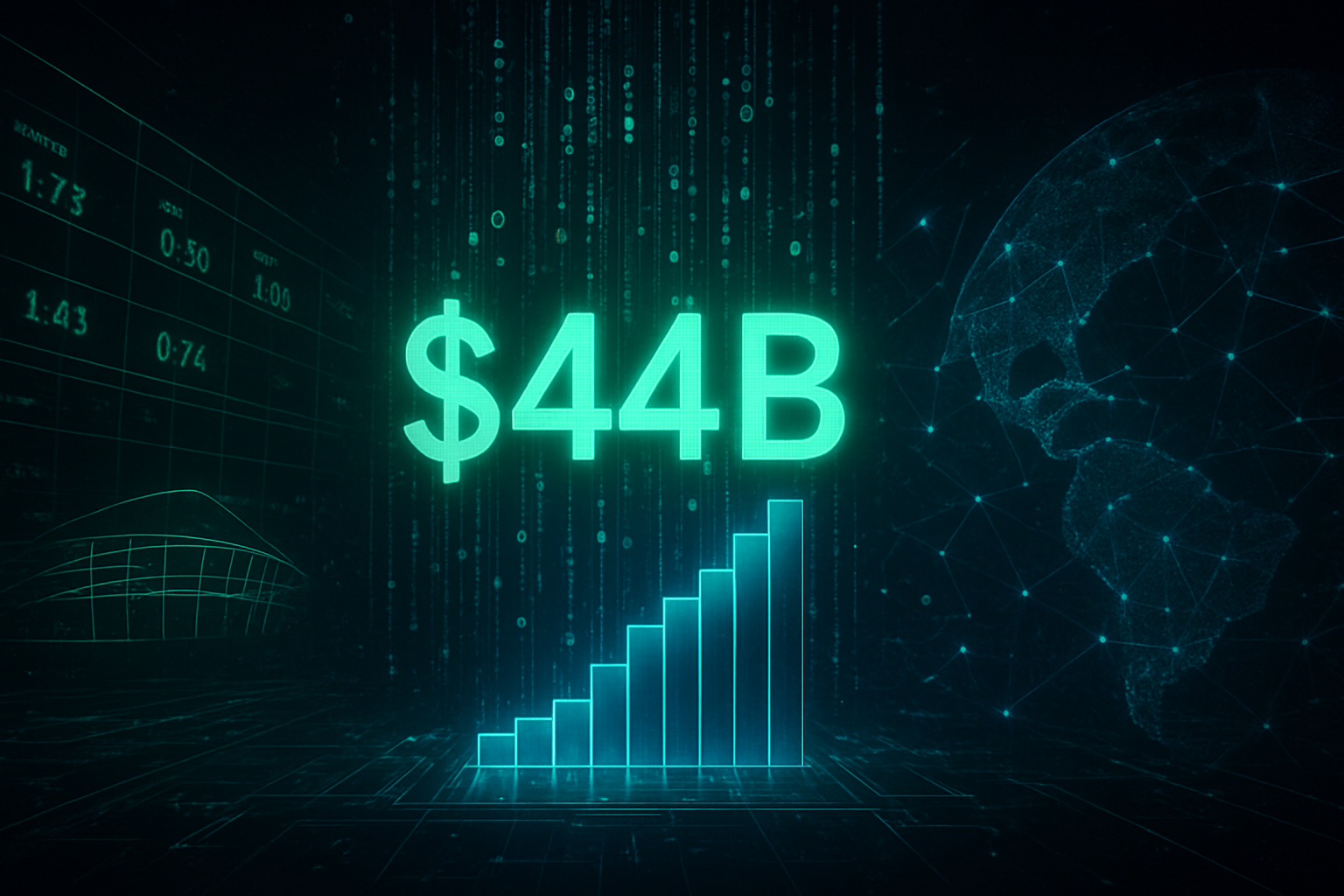
    The industry has just capped off a historic 2025, with total notional volume reaching a staggering $44 billion—a figure that has transformed prediction markets from a niche corner of the internet into a foundational pillar of modern finance. While the probabilities on major events shift by the second, the underlying message is clear: "Information Finance" has arrived, and it is here to stay.

    The Market: What's Being Predicted

    The competition between Kalshi and Polymarket has created a duopoly that mirrors the legendary rivalries of the New York Stock Exchange (NYSE) and the Nasdaq. In 2025, Kalshi reported a record-breaking $43.1 billion in notional trading volume, a meteoric 2,100% rise from the previous year. This volume is largely driven by its "sports flywheel," with 91.1% of its contracts tied to athletic outcomes. Kalshi’s dominance in the sports sector has been cemented by its integration with retail giants like Robinhood (NASDAQ: HOOD) and partnerships with major leagues such as the NHL.

    Conversely, Polymarket has captured the global "mindshare" for geopolitical and macroeconomic forecasting. While its 2025 volume of $33.4 billion trails Kalshi in raw numbers, its cultural and political impact is arguably greater. Polymarket’s odds on the Russia-Ukraine ceasefire, Iranian political stability, and Federal Reserve interest rate hikes are now cited as "the source of truth" by newsrooms and algorithmic trading desks globally. The platform’s liquidity in these high-stakes markets has become so deep that the Intercontinental Exchange (NYSE: ICE)—the parent company of the New York Stock Exchange—recently finalized a landmark $2 billion investment in the platform to bridge the gap between traditional finance and decentralized forecasting.

    Why Traders Are Betting

    The surge in trading volume isn't just about gambling; it's about the search for accurate information in an era of deepfakes and media polarization. Traders are increasingly using these platforms to hedge against real-world risks. For example, the "Maduro Trade" on January 3, 2026, became the stuff of legend when a Polymarket user turned a $32,000 position into $436,000 by betting on the capture of Venezuelan leader Nicolás Maduro by U.S. forces (Operation Absolute Resolve) just hours before it was officially announced.

    This event sparked a firestorm of debate regarding insider trading in prediction markets. It also highlighted why traders prefer these markets over traditional methods: they are reactive in real-time. While cable news was still debating rumors, the "Maduro capture" contract on Polymarket had already spiked to a 98% probability, providing a signal that was far ahead of any official press release.

    Furthermore, the entry of institutional "whales" on January 2nd, 2026, saw multi-million dollar trades on U.S. economic policy contracts, signaling that hedge funds are now using prediction markets as a legitimate alternative to Treasury futures or the VIX (CBOE Volatility Index). This shift is being supported by the regulatory legitimacy of Kalshi's CFTC-regulated model, which offers a safe harbor for institutional capital that requires strict compliance.

    Broader Context and Implications

    The "Great Prediction War" reflects a broader trend toward the "gamification of truth." As the industry approaches the projected $44 billion milestone, it is facing unprecedented regulatory scrutiny. In response to the Maduro Trade, Rep. Ritchie Torres introduced the "Public Integrity in Financial Prediction Markets Act of 2026," which aims to ban federal employees from trading on markets where they may have material non-public information. This mirrors the SEC's oversight of the stock market and suggests that prediction markets are now viewed as a legitimate financial asset class.

    Historically, prediction markets have proven more accurate than traditional polling. During the 2024 election cycle, these platforms correctly signaled shifts in battleground states days before pollsters adjusted their numbers. However, the rise of sports contracts on Kalshi has invited a different kind of regulation. Courts in Massachusetts and Connecticut have recently issued injunctions against certain sports-related contracts, arguing they overlap with unlicensed gambling. The resolution of these legal battles will determine whether prediction markets can continue to scale as a hybrid of finance and entertainment.

    What to Watch Next

    The next major milestone for the industry is the 2026 U.S. Midterm Elections. Early high-intent volume is already flowing into "Control of the House" and "Control of the Senate" markets as corporations look to hedge against potential tax code changes. These markets are currently showing a high degree of volatility, reflecting the polarized political climate.

    Additionally, the upcoming 2026 FIFA World Cup, hosted in North America, is expected to be the largest betting event in human history. Both Kalshi and Polymarket are reportedly in a bidding war to secure exclusive "prediction data partnerships" with FIFA and major broadcast networks. If Kalshi successfully integrates World Cup markets into the Robinhood app, analysts predict their 2026 volume could exceed $100 billion.

    Investors should also watch for the official U.S. relaunch of Polymarket. After acquiring the CFTC-licensed exchange QCEX, Polymarket is set to challenge Kalshi on its home turf with a fully regulated U.S. offering, potentially ending the "offshore" stigma that has historically followed decentralized platforms.

    Bottom Line

    The battle between Kalshi and Polymarket is no longer just about which platform has more users; it is a competition over who will provide the world’s "Source of Truth." Kalshi has won the battle for volume through its aggressive expansion into sports and its "Wall Street" regulatory approach. Polymarket, meanwhile, has won the battle for mindshare, becoming the essential dashboard for anyone trying to navigate the complexities of global politics and macroeconomics.

    As the industry crosses the $44 billion threshold, the ultimate winner is the public's access to better information. Whether you are a hedge fund manager hedging against a "black swan" event or a retail investor looking for a more accurate weather forecast, prediction markets have become an indispensable tool. The "Great Prediction War" of 2026 isn't just a financial story—it's the story of how humanity finally found a way to put a price on the future.


    This article is for informational purposes only and does not constitute financial or betting advice. Prediction market participation may be subject to legal restrictions in your jurisdiction.

    PredictStreet focuses on covering the latest developments in prediction markets.
    Visit the PredictStreet website at https://www.predictstreet.ai/.
  • The Six-Figure Ceiling: Why Prediction Markets Are Cooling on Bitcoin’s $100,000 Breakout

    The Six-Figure Ceiling: Why Prediction Markets Are Cooling on Bitcoin’s $100,000 Breakout

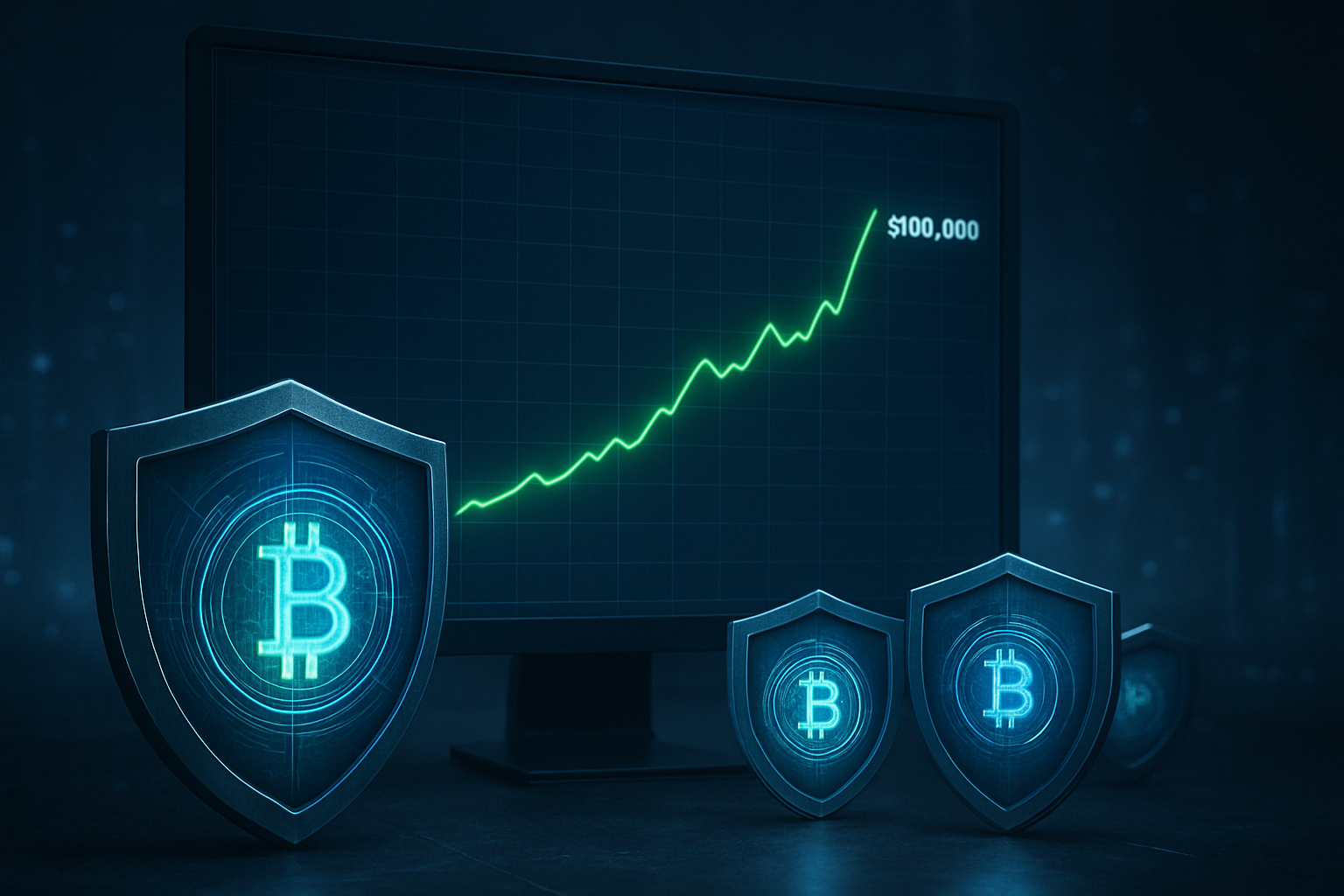
    As the final week of January 2026 unfolds, the euphoric "Bitcoin $100K" mantra that dominated New Year’s headlines is meeting a harsh reality check. Just two weeks ago, Bitcoin (BTC) stood on the precipice of history, peaking at a breathtaking $97,900 on January 14. Since then, the momentum has stalled, and the prediction markets—often the most sober indicators of financial outcomes—have undergone a dramatic repricing.

    Current odds on leading platforms now suggest a less than 10% chance that Bitcoin will cross the $100,000 threshold before February 1. This shift marks a significant transition in market psychology: the speculative "moon" missions of early January have given way to a disciplined focus on capital preservation. With the price currently oscillating between $86,000 and $89,000, traders are no longer betting on a last-minute miracle; they are positioning for a period of cautious consolidation.

    The Market: What's Being Predicted

    The "Bitcoin to $100k" trade has been one of the highest-volume events in the prediction market space this month. On Polymarket, the world’s largest decentralized prediction platform, the contract for "Bitcoin to hit $100,000 by Feb 1" is currently trading at just 6 cents (representing a 6% probability). This is a staggering collapse from mid-month, when the same contract was trading as high as 35 cents.

    On the regulated U.S. exchange Kalshi, sentiment is similarly bearish. Their price contracts for the $100,000 milestone are currently priced between 7% and 9%. The volume on these specific outcomes has surged, with nearly $6 million in 24-hour turnover recorded on January 26 alone. However, the majority of this volume is now dominated by "No" bettors and institutional hedgers who are liquidating their "Yes" positions to lock in whatever value remains before the February 1 resolution.

    The resolution criteria for these markets are strict: Bitcoin must touch or exceed $100,000 on major exchanges (usually an aggregate of Coinbase, Binance, and Kraken) at any point before the clock strikes midnight on February 1. With less than five days remaining and a $12,000 gap to close, the market's verdict is increasingly definitive.

    Why Traders Are Betting

    Several factors have contributed to this rapid cooling of sentiment. After the $97,900 peak on January 14, Bitcoin encountered a "wall of supply" that even the most bullish institutions couldn't overcome.

    • ETF Inflow Fatigue: Early January saw record-breaking inflows into spot ETFs, led by the iShares Bitcoin Trust from BlackRock (NYSE: BLK). On January 14, inflows hit a staggering $760 million in a single day. However, since the price rejection at $97.9k, those inflows have slowed to a trickle, suggesting that retail and institutional "FOMO" (fear of missing out) has been exhausted for the time being.
    • Macro Headwinds: Sentiment has been dampened by broader economic uncertainty. News of potential new tariffs and a "wait-and-see" approach from the Federal Reserve regarding interest rates have pushed investors toward a "risk-off" stance.
    • Whale Hedging: On-chain data indicates that while large holders (whales) are not necessarily dumping their spot positions, they are aggressively opening leveraged shorts to protect against a potential drop toward the $85,000 support level. This "hedged" behavior is being reflected in prediction markets as whales use these platforms to offset potential losses in their portfolio.

    Broader Context and Implications

    The shift from $100,000 optimism to capital preservation reflects a maturing crypto market. In previous cycles, a move toward $100,000 might have triggered a parabolic, irrational "blow-off top." In 2026, however, the presence of institutional giants like MicroStrategy (NASDAQ: MSTR) and major Wall Street funds has introduced a more calculated approach to price discovery.

    This market movement also highlights the rising utility of prediction markets as a sentiment gauge. While social media "influencers" may continue to call for $100k, the cold, hard cash on Polymarket and Kalshi provides a more accurate reflection of where the smart money is moving. The decline in odds suggests that traders are prioritizing the safety of USD-backed stablecoins and yield-generating assets over the slim chance of a 15% price spike in four days.

    Regulatory considerations also loom large. As prediction markets grow in liquidity, their ability to forecast major financial milestones is being watched closely by regulators. The accuracy of these markets in predicting the mid-month rejection at $97.9k has only bolstered their reputation as essential tools for modern price discovery.

    What to Watch Next

    As we approach the February 1 deadline, the primary focus for traders will be the $85,000 support level. If Bitcoin can hold this floor, the path to $100,000 in the spring remains wide open. Prediction markets are already pricing in an 80% chance of Bitcoin reaching six figures at some point in 2026—just not this week.

    Key dates to monitor include the upcoming month-end options expiry and the next round of institutional ETF reporting. Any surprise increase in inflows from Fidelity (NYSE: FNF) or other major issuers could provide a short-term bump, but a rally to $100,000 by February 1 would now require an unprecedented catalyst.

    Bottom Line

    The current state of the Bitcoin prediction markets serves as a sobering reminder that psychological barriers like $100,000 are rarely broken on the first attempt. The fall from 35% odds to under 10% in just two weeks illustrates how quickly sentiment can pivot from greed to preservation when a key technical level is rejected.

    For prediction market participants, the lesson is clear: follow the liquidity, not the hype. While the "six-figure" dream is far from dead, the "No" bets for February 1 have become the dominant trade of the season. As Bitcoin stabilizes in the high $80,000s, the market is effectively taking a breath, waiting for the next fundamental driver to push it over the finish line later this year.


    This article is for informational purposes only and does not constitute financial or betting advice. Prediction market participation may be subject to legal restrictions in your jurisdiction.

    PredictStreet focuses on covering the latest developments in prediction markets. Visit the PredictStreet website at https://www.predictstreet.ai/.
  • The $17 Million Truth Signal: Prediction Markets Brace for 80% Chance of U.S. Government Shutdown

    The $17 Million Truth Signal: Prediction Markets Brace for 80% Chance of U.S. Government Shutdown

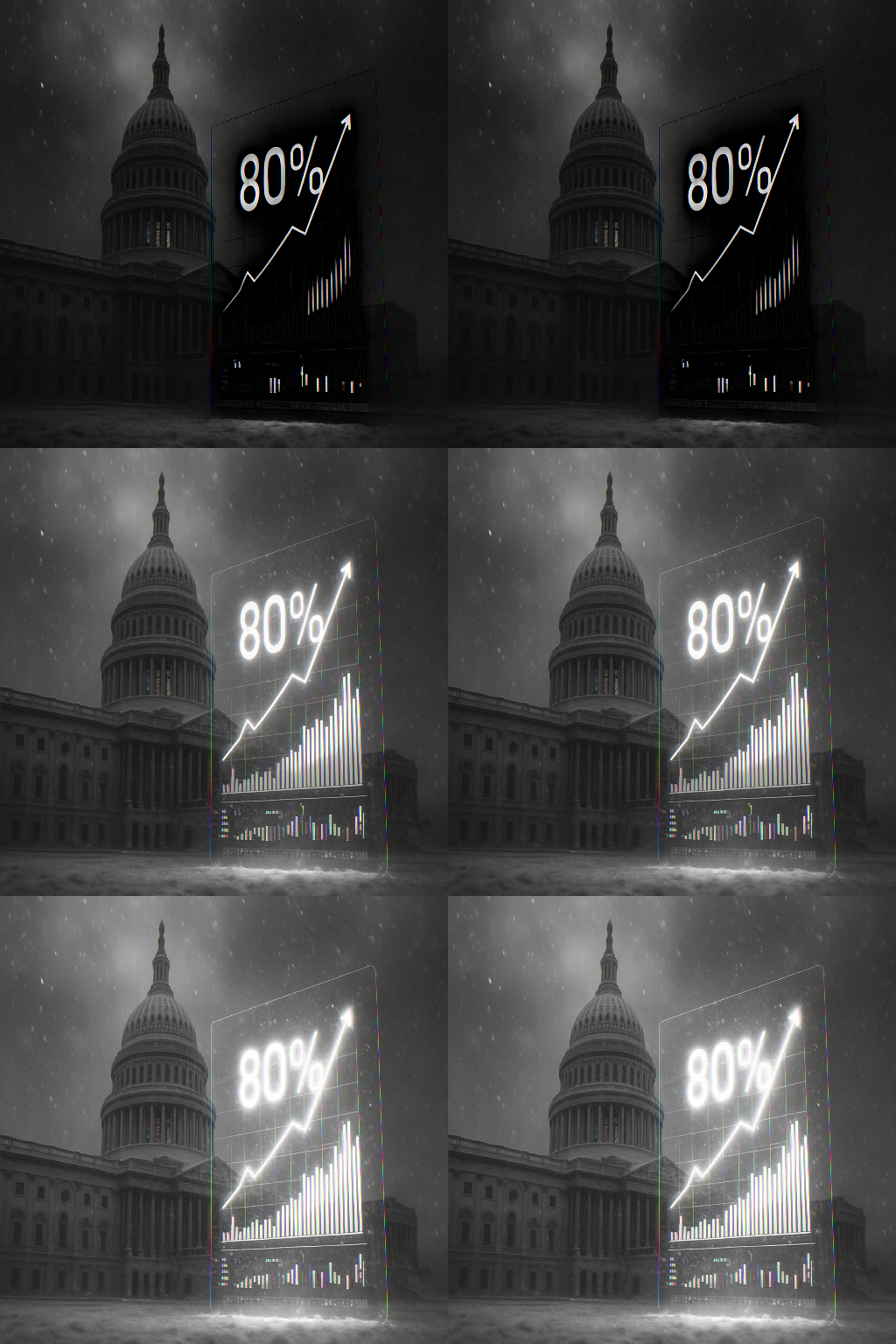
    As the clock ticks toward a midnight deadline on January 31, 2026, the traditional halls of power in Washington D.C. are being outpaced by a different kind of authority: the collective intelligence of prediction markets. For weeks, political pundits maintained a cautious optimism that a funding deal would be reached, but the "smart money" has decisively pivoted. On major forecasting platforms, the probability of a federal government shutdown has surged to a staggering 80%, reflecting a bleak reality that many news outlets are only now beginning to acknowledge.

    This sudden spike in odds—climbing from a mere 10% just days ago—comes amid a high-stakes standoff over Department of Homeland Security (DHS) funding. With over $17 million already wagered across regulated and decentralized exchanges, the market's conviction is serving as a real-time "truth signal," cutting through the partisan rhetoric to reveal the high likelihood of a significant lapse in federal operations.

    The Market: What's Being Predicted

    The current volatility is concentrated in two primary venues: Kalshi, a U.S.-regulated prediction market, and Polymarket, a decentralized platform that has seen a massive influx of global capital. On Kalshi, the contract asking "Will the government be shut down on Saturday?" has seen more than 880,000 active positions, with "Yes" shares currently trading at $0.79, implying a 79% probability. Polymarket shows an even higher conviction, with volumes on its shutdown contract crossing the $11 million mark and odds hovering around 80%.

    The resolution criteria for these markets are specific: the federal government must experience a funding gap that lasts for at least 24 hours starting at 12:01 a.m. ET on February 1, 2026. While the primary market focuses on the "if," secondary markets are already debating the "how long." On Kalshi, the favored outcome in the "duration" market is currently "7+ days," suggesting that traders expect a protracted battle rather than a brief weekend "glitch."

    This level of liquidity—exceeding $17 million in combined volume—is a testament to the maturation of the industry. Large-scale institutional hedging is now visible, as firms look to protect themselves against the "Data Fog" that occurs during a shutdown. When the government closes, agencies like the Bureau of Labor Statistics (BLS) and the Bureau of Economic Analysis (BEA) stop releasing critical economic indicators, such as CPI and employment reports, leaving investors blind.

    Why Traders Are Betting

    The catalyst for this market panic was a tragic and polarizing event: the fatal shooting of Alex Jeffrey Pretti, a U.S. citizen and nurse, by federal DHS agents during an enforcement operation in Minneapolis on January 24. This incident sparked domestic unrest and triggered an immediate legislative blockade. Senate Minority Leader Chuck Schumer and top Democratic appropriators have vowed to block any spending package that includes DHS funding without "radical" oversight reforms.

    Republicans, led by Senate Majority Leader John Thune, have refused to decouple DHS funding from the broader $1.2 trillion appropriations package. The legislative math is currently impossible:

    • The Recess Factor: The House of Representatives is currently in recess and not scheduled to return until February, making it nearly impossible to pass a last-minute compromise.
    • The "Weather" Variable: A severe winter storm in the D.C. area has already delayed Senate proceedings, further compressing an already tight timeline.
    • The Consensus Collapse: On January 23, markets saw only a 9% chance of a shutdown. The 70-point jump in four days represents a "violent repricing" of risk as the gravity of the DHS standoff became clear.

    While cable news networks like CNN or Fox Business (operated by Fox Corporation, (NASDAQ: FOXA)) were still reporting on "ongoing negotiations" early this week, prediction markets were already cratering. Traders saw the combination of a House recess and a Senate stalemate as a mathematical dead end, leading to the current high-conviction "Yes" positions.

    Broader Context and Implications

    The 2026 shutdown market marks a turning point for prediction platforms as a tool for public information. We are seeing what some analysts call the "Financialization of Truth." In an era of deep political polarization and "fake news," prediction markets provide a neutral, incentive-compatible metric. Unlike a pundit who loses nothing by being wrong, a trader on Kalshi or Polymarket loses their principal. This "skin in the game" creates a more reliable forecast than traditional polling or expert analysis.

    The real-world implications of an 80% shutdown signal are already being felt in the broader financial markets. Defense contractors such as Lockheed Martin (NYSE: LMT) and Raytheon Technologies (NYSE: RTX) often see short-term stock volatility during funding gaps due to payment delays. Similarly, financial services firms like Interactive Brokers Group, Inc. (NASDAQ: IBKR) are seeing increased activity as retail investors use these prediction markets to hedge their portfolios against a potential market-wide dip.

    Regulatory scrutiny is also evolving. The success of Kalshi in operating a regulated U.S. market for such high-stakes political events shows a shifting tide at the Commodity Futures Trading Commission (CFTC). By allowing these markets to function, regulators are implicitly acknowledging their value as an "early warning system" for the economy.

    What to Watch Next

    Over the next 72 hours, three key milestones will determine if the 80% probability holds or if a "black swan" compromise emerges. First, monitor any emergency "pro forma" sessions in the House. If leadership calls members back to D.C. despite the recess, the "No" shares on Kalshi will likely skyrocket as a deal becomes feasible.

    Second, keep an eye on the "Minneapolis Reform Rider." There are whispers of a stripped-down Continuing Resolution (CR) that would fund the government for 14 days while specifically sequestering DHS funds. If this gains traction in the Senate, expect a rapid sell-off in "Yes" shares.

    Finally, the weather in the capital remains a literal and figurative cooling factor. If the winter storm prevents a quorum in the Senate on Friday, the shutdown becomes a procedural certainty. Traders are currently monitoring NOAA weather feeds with as much intensity as they are monitoring C-SPAN.

    Bottom Line

    The 2026 DHS funding standoff has proven that prediction markets are no longer a niche hobby for "crypto bros" or math nerds; they are a vital piece of the global information infrastructure. The 80% probability currently priced into the market is a sobering "truth signal" that a federal shutdown is the most likely path forward.

    While politicians continue to trade barbs on social media, the $17 million committed to these markets tells a more honest story: the legislative process has broken down. For the average citizen and the sophisticated investor alike, the lesson is clear: when the rhetoric of Washington clashes with the cold hard cash of the markets, follow the money. As of late January 2026, the money is betting on a very quiet—and very closed—federal government.


    This article is for informational purposes only and does not constitute financial or betting advice. Prediction market participation may be subject to legal restrictions in your jurisdiction.

    PredictStreet focuses on covering the latest developments in prediction markets. Visit the PredictStreet website at https://www.predictstreet.ai/.