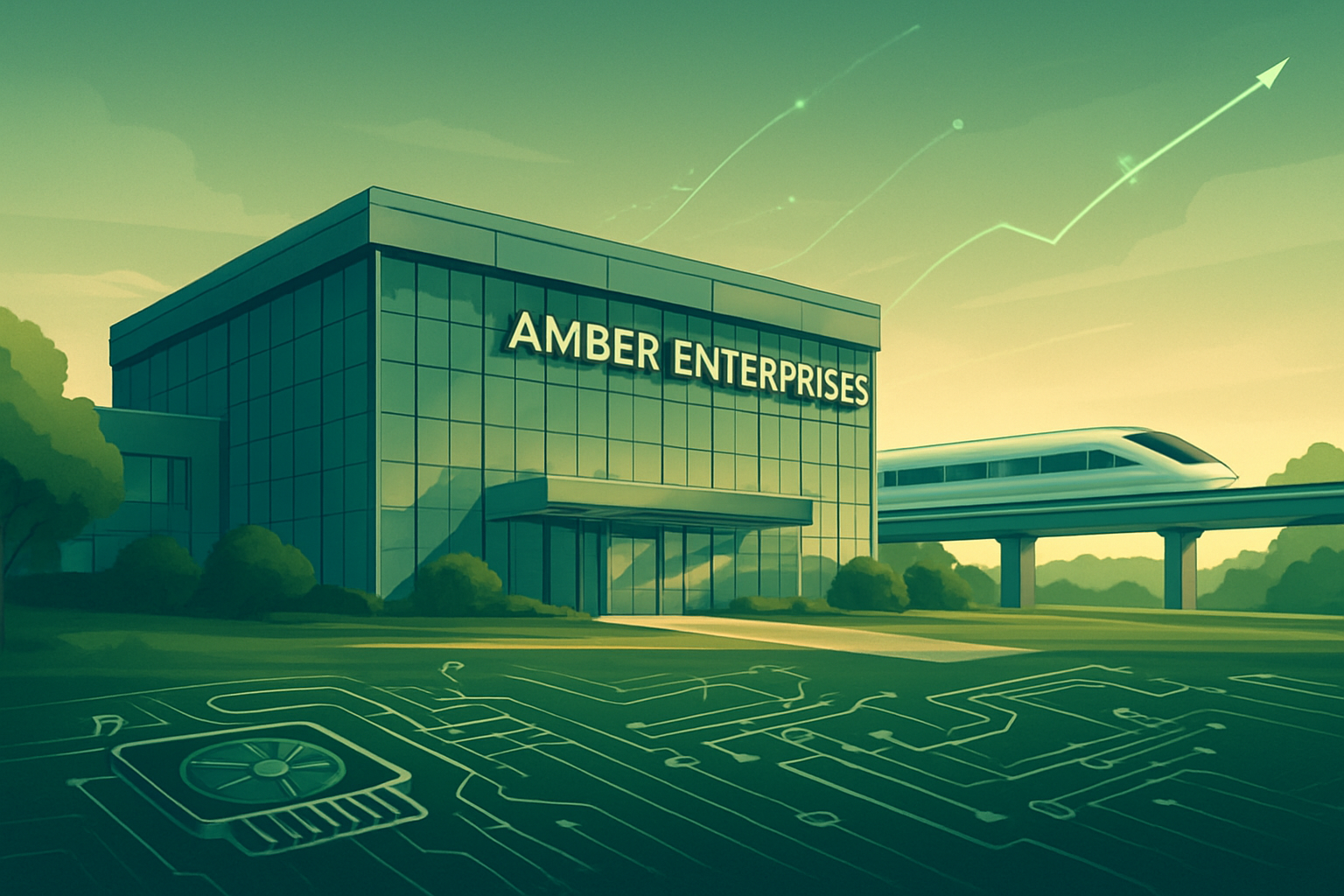
As of December 19, 2025, the Indian industrial landscape is witnessing a significant pivot from assembly-led growth to deep-tech engineering. At the heart of this transformation is Amber Enterprises India Ltd (NSE: AMBER), a company that has long functioned as the silent backbone of India’s cooling industry. Recently, Amber made headlines with a strategic commitment of Rs 500 crore to establish a cutting-edge Research & Development (R&D) centre in Rajpura, Punjab. This move is not merely an expansion of capacity but a clear signal of the company's intent to dominate the high-end HVAC (Heating, Ventilation, and Air Conditioning) design space and reduce the nation’s reliance on imported technology.
Historical Background
Founded in 1990 by Vivek K. Bansal, Amber Enterprises began its journey as a modest sheet metal component manufacturer in Rajpura, Punjab. Over the next three decades, the company underwent a radical metamorphosis. What started as a small-scale vendor for consumer durable brands evolved into a multi-plant powerhouse.
A pivotal moment occurred in the mid-2000s when Amber transitioned from being a simple Original Equipment Manufacturer (OEM) to an Original Design Manufacturer (ODM), taking charge of the intellectual property behind the products it built. The company’s 2017 Initial Public Offering (IPO) marked its entry into the big leagues, providing the capital necessary to diversify beyond air conditioners into electronics and mobility subsystems.
Business Model
Amber operates a sophisticated, backward-integrated business model that spans four key verticals:
- Room Air Conditioners (RAC): The core legacy business where Amber manufactures finished AC units for 8 of the top 10 brands in India.
- Components: A high-margin segment producing heat exchangers, motors, and sheet metal parts. This vertical has recently expanded into components for washing machines and refrigerators through a 50:50 joint venture with Resojet.
- Electronics (EMS): Through its subsidiary IL JIN Electronics and the recent 2025 acquisition of Shogini Technoarts, Amber has become a leader in Printed Circuit Board (PCB) assembly and design.
- Mobility: Operated under the Sidwal brand, this segment provides specialized HVAC solutions for the Indian Railways, Metro networks, and defense applications.
Stock Performance Overview
Amber Enterprises has been a rewarding, albeit volatile, play for long-term investors. Since its 2017 listing at an issue price of approximately Rs 859, the stock has seen multi-bagger returns.
- 1-Year Performance: The stock reached a record high of Rs 8,626 in October 2025, driven by a blistering summer and infrastructure tailwinds.
- 5-Year Performance: Amber has significantly outperformed the Nifty 50, benefiting from the "China Plus One" strategy and India's Production Linked Incentive (PLI) schemes.
- Recent Trends: Following a recent Q2 FY26 earnings miss—attributed to an extended monsoon and GST policy uncertainty—the stock has corrected to the Rs 6,600 – Rs 6,700 range, offering what many analysts consider a strategic entry point.
Financial Performance
The financial narrative of 2025 is one of two halves. In H1 FY2025-26, Amber reported a robust 25% revenue growth, reaching Rs 5,096 crore. However, the second quarter (Q2) saw a net loss of Rs 32 crore, a stark contrast to the Rs 21 crore profit in the previous year.
Despite these short-term headwinds, the company’s balance sheet remains geared for growth. With a focus on increasing its Return on Capital Employed (ROCE) to the 19-21% range, Amber is shifting its revenue mix toward higher-margin electronics and mobility segments, which currently offset the seasonal fluctuations of the RAC business.
Leadership and Management
The company is steered by Executive Chairman and CEO Jasbir Singh and Managing Director Daljit Singh. The leadership is widely respected for its "execution-first" approach and its ability to integrate acquisitions seamlessly. Under their tenure, Amber has transformed from a family-run enterprise into a professionally managed corporation with a clear focus on corporate governance and long-term value creation. Their strategy focuses on "vertical integration," ensuring that Amber controls as much of the bill of materials as possible.
Products, Services, and Innovations
The newly announced Rs 500 crore R&D centre in Punjab is the crown jewel of Amber’s innovation pipeline. This facility will house 500 engineers dedicated to:
- Variable Refrigerant Volume (VRV) Technology: Moving into high-end commercial cooling.
- Energy Efficiency: Designing 5-star and beyond energy-rated systems to meet tightening BEE norms.
- In-house PCB Design: Reducing the lag between design and mass production in the electronics segment.
Competitive Landscape
Amber operates in an increasingly crowded field, yet it maintains a distinct moat. Its primary competitors include:
- Dixon Technologies (NSE: DIXON): While Dixon leads in mobile and lighting EMS, Amber holds a monopoly-like advantage in HVAC and railway cooling.
- PG Electroplast (NSE: PGEL): A rising challenger in the RAC space that has shown aggressive growth but lacks Amber’s depth in mobility and heavy engineering.
- In-house Manufacturing: Brands like Blue Star and Voltas occasionally expand their own manufacturing, but Amber’s scale usually allows it to produce components at a lower cost than the brands can achieve themselves.
Industry and Market Trends
The cooling industry in India is no longer a luxury but a necessity, driven by rising global temperatures and urbanization. Key trends include:
- Premiumization: Consumer preference is shifting toward inverter ACs and smart, IoT-enabled cooling.
- Infrastructure Boom: The expansion of Vande Bharat trains and new Metro lines in Tier-2 cities has created a massive order book for Amber’s mobility division.
- Local Sourcing: The Indian government's push to curb imports from China has forced brands to rely more heavily on domestic ODMs like Amber.
Risks and Challenges
No investment is without risk. Amber faces three primary challenges:
- Seasonality: A short summer or an extended monsoon, as seen in late 2025, can significantly impact the RAC segment’s quarterly earnings.
- Commodity Sensitivity: Fluctuations in the prices of copper and aluminum directly impact margins if not passed on to customers immediately.
- Client Concentration: While Amber serves many brands, losing one of the top three customers could create a temporary revenue vacuum.
Opportunities and Catalysts
The Rs 500 crore Punjab R&D centre is a massive long-term catalyst. By owning the R&D process, Amber can transition from a domestic supplier to a global export hub for the Middle East and Southeast Asian markets. Additionally, the recent acquisition of Shogini Technoarts positions Amber to capture the burgeoning PCB market, which is essential for India’s broader electronics ecosystem.
Investor Sentiment and Analyst Coverage
Despite the Q2 FY26 dip, investor sentiment remains largely bullish. Institutional investors (FIIs and DIIs) maintain significant holdings, viewing Amber as a proxy for India’s manufacturing resurgence. Most major brokerage houses maintain a "BUY" rating, with price targets looking toward the Rs 8,500 – Rs 9,000 range, citing the "unmatched" scale of their mobility order book, which currently stands at over Rs 2,600 crore.
Regulatory, Policy, and Geopolitical Factors
Amber is a "poster child" for the Production Linked Incentive (PLI) scheme for White Goods. Having committed Rs 460 crore under the scheme, the company has already begun receiving substantial incentives that bolster its bottom line. Geopolitically, the shift of supply chains away from China (the "China Plus One" strategy) continues to favor Amber, as global brands seek reliable, non-Chinese manufacturing partners.
Conclusion
As we look toward 2026, Amber Enterprises India Ltd stands at a crossroads of maturity and expansion. The Rs 500 crore investment in its Punjab R&D centre signifies a shift from a manufacturer to an innovator. While short-term earnings may be susceptible to the whims of the weather and macro-economic policy shifts, the company’s strategic positioning in high-growth areas like electronics and railway mobility provides a robust cushion. For the patient investor, Amber represents a foundational play in the "Make in India" story—one that is increasingly defined not by the assembly of parts, but by the creation of technology.
This content is intended for informational purposes only and is not financial advice.